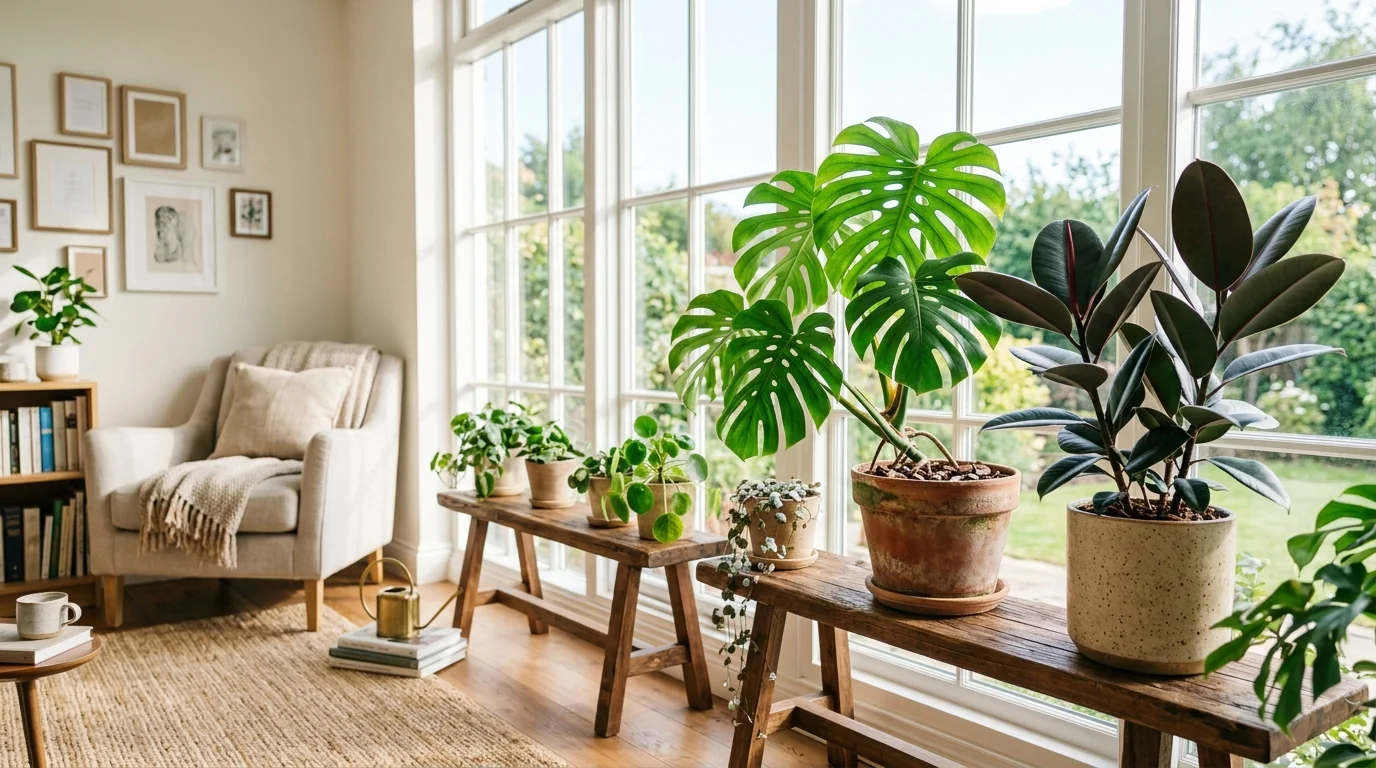
You bought a stunning Monstera Deliciosa or Ficus Lyrata from your local plant boutique. You placed it in gentle, indirect sunlight, followed a strict weekly watering schedule, and potted it into fresh, rich, store-bought potting soil. For a few weeks, it looked magnificent.
Then, the subtle decline began. Lower leaves developed soft, yellowish halos that turned into soggy brown patches. The stems lost their turgor pressure and began to droop. Panicking, you assumed the plant was thirsty, so you poured another glass of water into the pot—only to watch the leaves turn yellow and drop even faster. When you finally pulled the root ball out of the pot, you were greeted by a foul, swampy odor and black, slimy roots that disintegrated in your fingers.
Most plant parents diagnose this tragedy as “overwatering.” But plant physiology reveals a much more precise and surprising mechanism: your plant did not drown from too much water. It suffocated from a catastrophic lack of oxygen. Understanding the physics of root hypoxia, the myth of drainage pebbles, and the perched water table will permanently transform your indoor gardening success.
The Physics of the Rhizosphere: Gas Diffusion in Soil Pores
To understand why indoor plants die in conventional soil, you have to look beneath the surface at the micro-architecture of the root zone, known in botany as the rhizosphere. A healthy root substrate is not a solid block of dirt; it is a porous matrix composed of solid particles, capillary water films, and continuous air-filled channels.
Plant roots are living aerobic tissues. Unlike above-ground leaves, which absorb carbon dioxide and release oxygen through microscopic pores called stomata during photosynthesis, roots cannot produce their own oxygen. Roots must absorb dissolved oxygen ($\text{O}_2$) directly from the air pockets surrounding them to power aerobic cellular respiration within their mitochondria:
Glucose + Oxygen → Carbon Dioxide + Water + ATP (Cellular Energy)
Without ATP (adenosine triphosphate), the root system experiences an immediate metabolic blackout. The microscopic active transport pumps that pull nitrogen, potassium, phosphorus, and calcium across cell membranes freeze. The selective permeability of root cell walls collapses, causing cellular fluids to leak out into the soil. Paradoxically, **an overwatered plant wilts from thirst** because its suffocated roots have lost the cellular energy required to pump water upward into the stems.
Here is the critical physical metric: oxygen diffuses through open, air-filled soil pores roughly **10,000 times faster** than it diffuses through water. When you saturate dense, peat-heavy potting soil, water fills every microscopic void. The residual dissolved oxygen trapped in the moisture is consumed by root respiration and aerobic soil microbes within four to six hours. From that moment onward, the root zone enters acute hypoxia (oxygen depletion) and anoxia (total suffocation).
The Perched Water Table: Why Pebbles in the Bottom of a Pot Kill Plants
For decades, well-meaning gardening blogs and older generations have passed down a universal piece of planting advice: “Always put a layer of gravel, broken terracotta shards, or pebbles at the bottom of your pot for drainage.”
In soil physics, this is one of the most destructive gardening myths in existence. Putting gravel at the bottom of a container does not improve drainage; it mathematically guarantees root rot through a phenomenon known as the **Perched Water Table (PWT)**.
Water moves through soil via two competing forces: gravity (pulling water downward) and capillary action (water molecules adhering to tiny soil particles and pulling against gravity). Because fine-textured potting soil has microscopic pore spaces, its capillary pull is extraordinarily strong. Coarse gravel, on the other hand, has massive spaces with virtually zero capillary pull.
Water refuses to cross the boundary from a fine-textured soil into a coarse-textured gravel layer until the soil above is 100 percent saturated. As a result, the saturated “perched water table” does not drain into the rocks; it sits directly on top of the rocks. By filling the bottom two inches of your pot with gravel, you have not created drainage; you have simply moved the stagnant, suffocating water layer two inches closer to your plant’s sensitive root ball.
Opportunistic Oomycetes: The Truth About “Root Rot”
When roots become hypoxic and cellular membranes leak sugars and amino acids into saturated soil, they create an irresistible biological beacon for opportunistic pathogens. Primary among these are water molds, technically known as oomycetes—predominantly species from the genera Pythium and Phytophthora.
These organisms produce specialized, motile spores called **zoospores**. Zoospores possess microscopic whip-like flagella that allow them to physically swim through water-saturated soil pores, guided by chemotaxis directly toward the stressed root tips. Once they make contact with oxygen-deprived cortical cells, they penetrate the weakened tissue, digest cellular walls, and trigger rapid necrosis.
Healthy, oxygen-rich soil prevents water molds naturally: beneficial aerobic fungi and actinobacteria consume organic matter and outcompete pathogens. It is only when oxygen vanishes that beneficial microbes perish and pathogenic anaerobes take over.
The High Air-Filled Porosity (AFP) Soil Blueprint
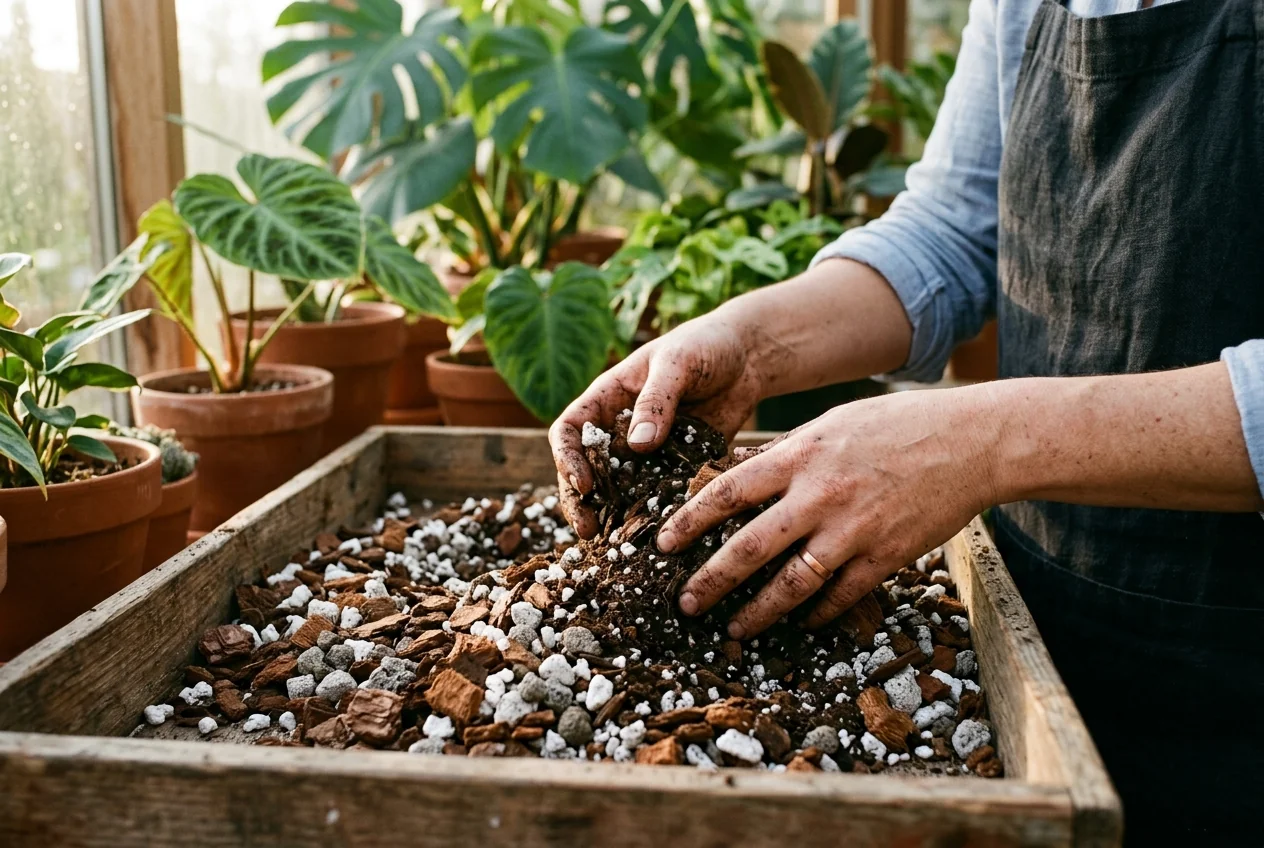
Standard bagged potting soil sold in garden centers is formulated primarily from finely ground sphagnum peat moss or coco coir. While peat retains moisture exceptionally well, it compacts over time, collapsing macropores and trapping water. To grow thriving indoor plants, you must engineer high **Air-Filled Porosity (AFP)**—ensuring that at least 25 to 30 percent of the soil volume remains filled with air even immediately after a thorough watering.
Mix this simple, professional “Chunky Aroid Mix” at home for Monstera, Philodendron, Pothos, and Ficus:
- 40% Base Medium: Coarse coco coir chips or uncompacted peat moss (provides moisture retention and cation-exchange capacity).
- 30% Coarse Aeration: Horticultural perlite (size #3 or #4) or volcanic pumice (creates permanent, uncrushable macropores for gas diffusion).
- 30% Organic Texture: Medium-grade fir orchid bark and horticultural charcoal (prevents soil settling, buffers pH, and encourages healthy mycorrhizal growth).
The Lift-and-Check Watering Cadence
Discard calendar-based watering routines completely. Plants do not drink on a Tuesday schedule; their moisture uptake fluctuates dramatically based on ambient humidity, seasonal day length, room temperature, and air circulation.
- The Weight Test: Pick up your potted plant immediately after a thorough watering to register its “heavy” baseline. Throughout the week, lift the pot. When the pot feels noticeably light—roughly 50 to 60 percent lighter than its saturated state—air has re-entered the rhizosphere, and it is safe to water again.
- Drench and Drain: When you do water, water generously until liquid flows freely from the bottom drainage holes. This flushing action pulls fresh oxygen-rich air downward through the soil pores like a biological piston.
- Empty the Saucer: Never let a pot sit in standing drainage water for more than fifteen minutes. Discard runoff immediately to prevent capillary wicking from pulling water back into the perched table.
📥 Free Download: Rhizosphere Aeration & Porosity Handbook
The soil physics behind perched water tables, why pebbles kill plants, and the 40-30-30 chunky aroid mix recipe.
Summary: Giving Roots Room to Breathe
Indoor gardening success is not about having a “green thumb”; it is about respecting soil physics. Plants are remarkably forgiving of dry spells, but they cannot survive without oxygen. By upgrading to a coarse, chunky substrate, ensuring unobstructed drainage holes, and letting soil breathe between waterings, you eliminate root rot at the biological root—creating an indoor jungle that flourishes for years to come.