
Every night while you sleep, your central nervous system performs an extraordinary biological maintenance cycle. It does not simply rest; it washes itself. Cerebrospinal fluid rushes through your neural tissue in rhythmic, pulsing waves, flushing away metabolic waste products that accumulate during hours of active thinking. Among the debris cleared during this nocturnal rinse are amyloid-beta proteins and phosphorylated tau—the exact biological markers tied to neurodegenerative diseases and age-related cognitive decline.
Yet recent neurological research reveals a striking vulnerability in this cleaning mechanism: your brain’s internal sanitation network operates at peak efficiency only under conditions of profound, unbroken darkness. Even minuscule amounts of ambient bedroom light—the glow of a digital alarm clock, the standby LED on a television, or the faint amber wash of a street lamp leaking through venetian blinds—can suppress the precise chemical cascade required to initiate this cellular deep clean.
If you have ever woken up after eight hours in bed still feeling mentally sluggish, foggy, or unrefreshed, the issue might not be the quantity of your sleep. It may be the photonic environment of your bedroom. Understanding the mechanics of the glymphatic system and eliminating nocturnal light leaks is one of the most practical, low-cost investments you can make in your long-term cognitive health.
The Glymphatic System: Your Brain’s Nighttime Dishwasher
For more than a century, anatomists believed the brain was exempt from the lymphatic drainage system that cleanses every other organ in the human body. Because the central nervous system is sealed behind the protective blood-brain barrier, scientists could not identify how billions of hard-working neurons disposed of their daily metabolic trash.
That biological puzzle was solved when neuroscientists at the University of Rochester Medical Center, led by Dr. Maiken Nedergaard, discovered the glymphatic system. This specialized waste-clearance pathway relies on glial cells—specifically star-shaped brain cells called astrocytes—to pump cerebrospinal fluid (CSF) directly through the brain’s parenchyma.
During waking hours, your brain cells are tightly packed, actively firing electrical impulses and consuming vast quantities of glucose. There is simply no room for fluid to circulate freely. But when you transition into deep, slow-wave sleep (Non-REM Stage 3), something remarkable occurs: the interstitial space between your brain cells expands by approximately 60 percent. Astrocytes shrink slightly, opening wide microscopic channels that allow cerebrospinal fluid to surge through brain tissue like a high-pressure rinse cycle.
Research published in leading neuroscience journals demonstrates that the glymphatic system cleanses brain tissue up to 2.4 times faster during deep slow-wave sleep than during wakefulness or light sleep. When this convective flow is active, it carries away neurotoxic proteins, cellular byproducts, and metabolic lactic acid, directing the waste into the venous bloodstream for liver filtration.
Why Ambient Bedroom Light Sabotages the Cleansing Cycle
To understand why complete darkness is mandatory for brain cleansing, you have to look at the specialized water channels that make fluid transport possible: Aquaporin-4 (AQP4). These water gates are located on the vascular endfeet of astrocytes, right against the brain’s blood vessels. When AQP4 channels are polarized and properly organized, fluid moves effortlessly across neural tissue.
Circadian biology dictates that this polarization is intimately linked to melatonin secretion from the pineal gland. Melatonin is far more than a sleepiness hormone; it is a powerful neurochemical coordinator. The pineal gland secretes melatonin not only into the bloodstream, but directly into the third ventricle of the brain, creating high local concentrations in the cerebrospinal fluid.
A landmark 2025 study examining the cellular mechanics of sleep loss and glymphatic function found that when sleep is disrupted or delayed by artificial light, AQP4 water channels become depolarized and disorganized. The microscopic gates lose their directional alignment, effectively closing the floodgates and leaving neurotoxic debris trapped in brain tissue. When natural melatonin rhythms were protected, AQP4 polarization was maintained, restoring normal waste transport and preventing toxic accumulation in the hippocampus.
Here is where modern bedroom design creates an invisible hazard. The human eye possesses specialized photoreceptors known as intrinsically photosensitive retinal ganglion cells (ipRGCs). These cells contain the pigment melanopsin, which is hyper-sensitive to blue and green wavelengths of light. Even with your eyelids closed, these cells detect stray photons and send immediate inhibitory signals to the suprachiasmatic nucleus (SCN)—the master circadian clock in your hypothalamus.
When the SCN registers even 5 to 10 lux of light—equivalent to a nightlight or street lamp filtering through thin curtains—it suppresses pineal melatonin production. Without that concentrated neurochemical signal, your brain struggles to enter or sustain Non-REM Stage 3 slow-wave sleep. The brain remains in lighter sleep stages where interstitial channels never fully widen, reducing your overnight glymphatic clearance to a mere trickle.
The Cognitive Cost of “Dirty Sleep”
When your brain cannot execute its nightly cleansing routine, the consequences manifest rapidly in everyday cognitive performance:
- Morning Brain Fog: The heavy, sluggish sensation upon waking is often caused by residual metabolic waste that failed to drain overnight, forcing neurons to operate in a congested extracellular environment.
- Impaired Working Memory: The prefrontal cortex and hippocampus are particularly vulnerable to waste buildup, leading to midday forgetfulness, reduced focus, and difficulty retaining new information.
- Emotional Volatility: Poor slow-wave sleep leaves the amygdala—the brain’s emotional threat center—hyper-reactive, making minor household stressors or work demands feel overwhelming.
- Long-Term Vulnerability: Chronic disruption of glymphatic clearance over years allows baseline amyloid-beta and tau burdens to steadily climb, elevating long-term risks for neurodegenerative disorders.
The 4-Step Bedroom Darkness Protocol
Transforming your bedroom into a certified sleep sanctuary does not require expensive renovations. It requires a systematic approach to identifying and eliminating nocturnal photon sources. Aim for a target illumination level of less than 0.1 lux—a condition where you cannot see your hand held 12 inches in front of your face.
1. Upgrade to True Blackout Window Solutions
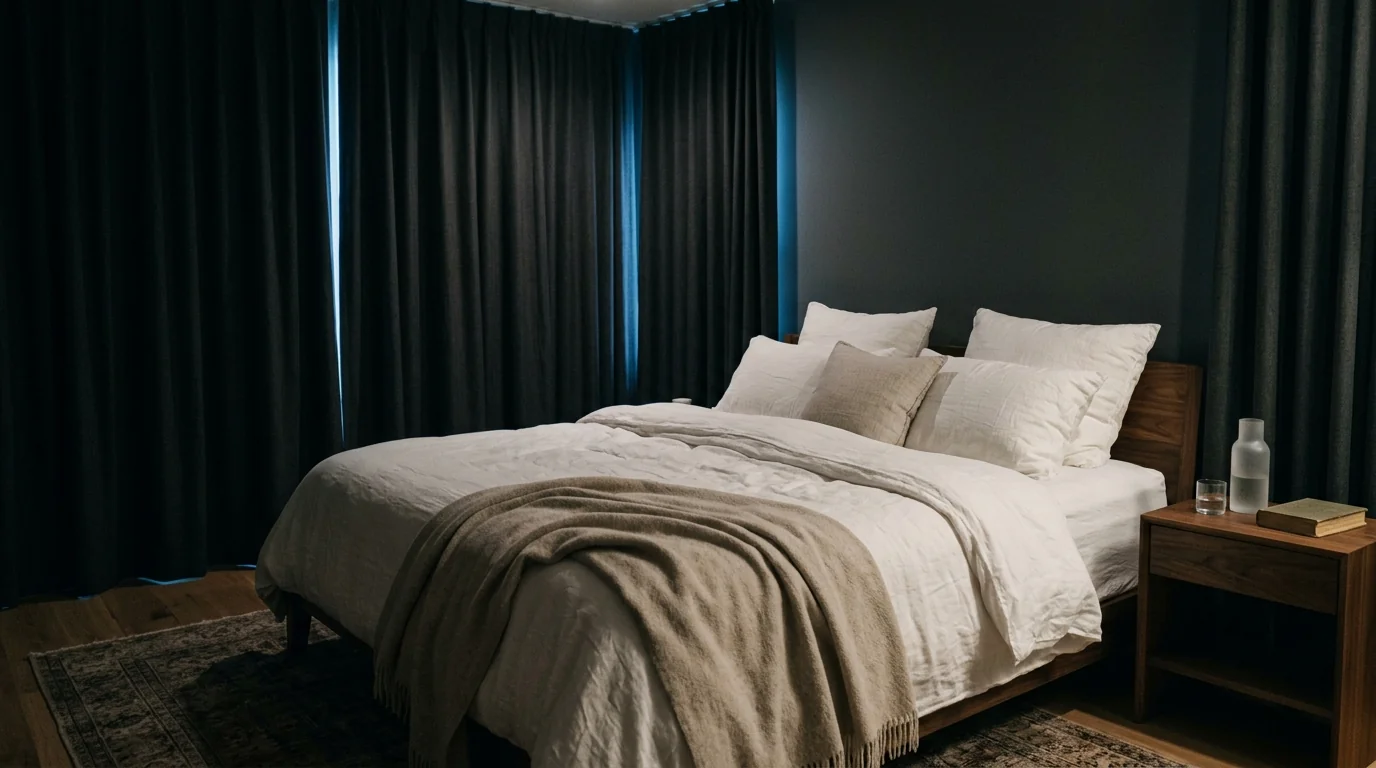
Standard horizontal blinds and translucent curtains block privacy, not light. High-pressure sodium street lamps and modern LED municipal lighting easily cut through fabric weaves. Install opaque blackout roller shades fitted inside the window frame, complemented by floor-to-ceiling drapery with blackout thermal linings. Ensure the curtain panels overlap generously in the middle and extend at least 4 inches past the window trim on both sides to prevent side halos.
2. Banish Standby LED Indicator Lights
Take an inventory of your bedroom electronics after turning off the main lights. Televisions, air purifiers, humidifiers, power strips, and smoke alarms frequently emit bright blue, green, or red standby LEDs. Place small, purpose-made light-blocking stickers (readily available online) directly over indicator lights. These dimming stickers reduce glare by 80 to 100 percent while preserving device functionality.
3. Rethink Your Bedside Timepiece
Digital alarm clocks placed on nightstands cast constant direct illumination across your face throughout the night. If your clock features blue or green LED digits, replace it with a clock that offers an adjustable red-spectrum display, or simply turn the display face toward the wall. Better yet, move alarm devices across the room or into an adjacent dressing area.
4. Seal Hallway and Bathroom Door Thresholds
Nightlights in adjacent hallways or bathroom nightlights often cast light under bedroom doors. A simple weighted fabric draft stopper or silicone door bottom sweep placed along the threshold seals the bottom gap, maintaining complete darkness while muffling household sound.
The 60-Minute Pre-Sleep Light Taper
Creating darkness in bed is only half the battle. Your pineal gland requires an advance warning window of 60 to 90 minutes to ramp up melatonin synthesis before your head touches the pillow. When you sit beneath 500-lux overhead ceiling fixtures right up until bedtime, your brain experiences an abrupt photonic shock when the lights finally turn off.
Adopt a gradual light taper starting one hour before your target sleep time:
- Extinguish Overhead Fixtures: Turn off all ceiling can lights, chandeliers, and high-mounted wall sconces. Overhead light mimics the high-noon sun, immediately signaling wakefulness to your retinal ganglion cells.
- Switch to Low-Lumen Accent Lamps: Illuminate living spaces with table lamps fitted with warm-temperature bulbs (2200K to 2700K). Keep bulbs below 40 watts equivalent (under 400 lumens).
- Deploy Screen Filters or Blue-Light Blockers: If you must view computer or phone screens in the evening, activate built-in night shift modes and lower screen brightness to minimum legible levels.
- Avoid Middle-of-the-Night White Light: If you must get up for water or the restroom, never turn on bright overhead bathroom lights. Keep a battery-operated motion-sensor amber nightlight placed near the floorboards, keeping your eyes shielded from high-intensity bursts.
📥 Free Download: The Complete Darkness Sleep Sanctuary Protocol
Audit your bedroom photonic environment, eliminate stray lux leaks, and optimize slow-wave glymphatic clearance tonight.
Summary Checklist for Tonight
Restoring your brain’s natural overnight cleaning cycle starts with simple adjustments you can complete before you turn in tonight:
- Check your window treatments for perimeter light gaps and pin drapery edges together if necessary.
- Cover glowing power buttons and standby lights with opaque tape or stickers.
- Turn illuminated clocks away from your direct field of vision.
- Dim living areas 60 minutes before bed using warm, low-wattage accent lamps.
- Keep bedroom temperatures between 65°F and 68°F (18°C–20°C) to support the natural core body cooling that pairs with deep slow-wave sleep.
Your brain is an extraordinarily resilient organ with built-in regenerative machinery. By giving it the complete, uninterrupted darkness it evolved to expect, you protect your memory, sharpen your daytime focus, and wake up genuinely restored.