

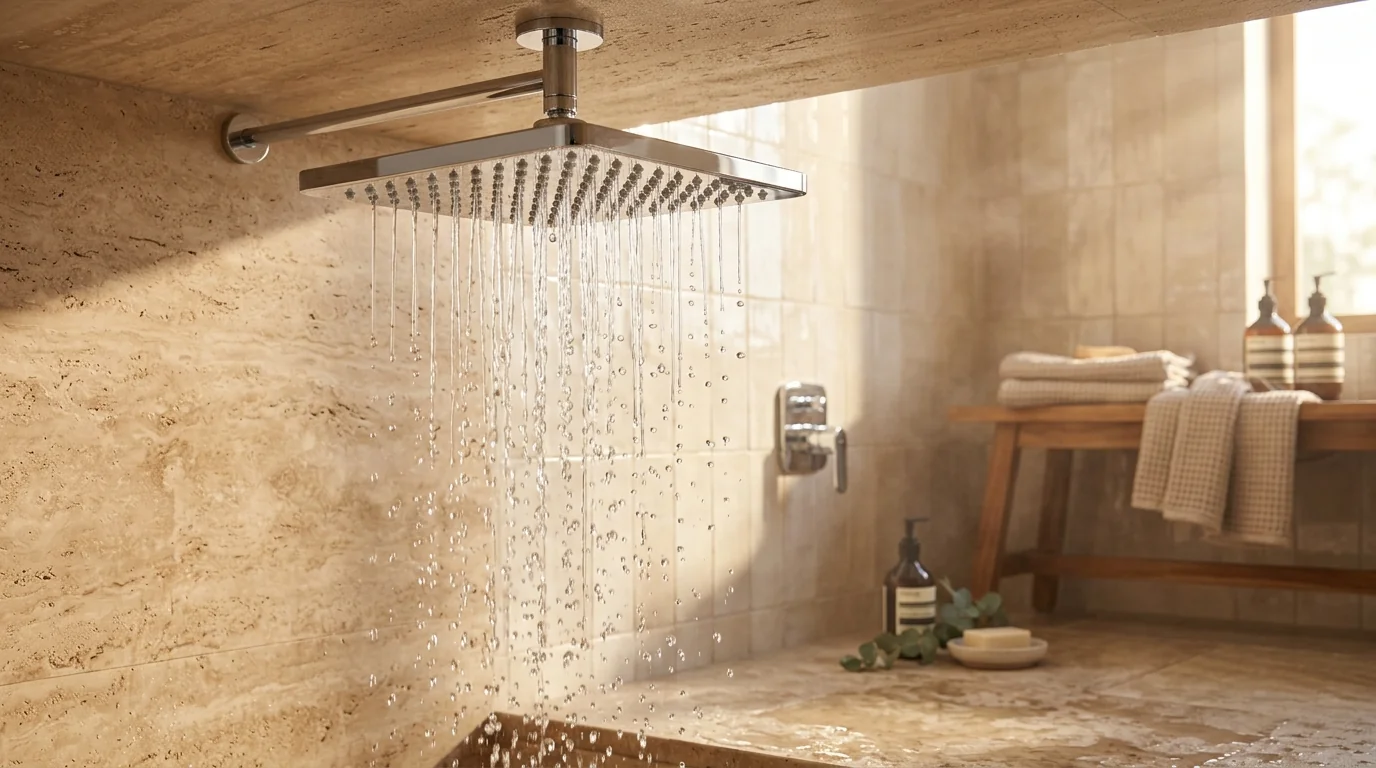
You step into the shower after an exhausting workday, eagerly anticipating a therapeutic, high-velocity cascade of steaming water to dissolve the tension in your neck and shoulders. You turn the mixer valve to full throttle. Instead of a robust, invigorating deluge, you are greeted by an anemic, sputtery trickle. Three stray, pressurized jets shoot wildly sideways toward the shower curtain, while the center of the spray face drips lifelessly onto the drain.
Your immediate instinct might be to blame municipal water pressure, aging galvanized pipes, or an outdated water heater. Yet in over 85% of residential households, the true culprit is microscopic and mineralogical: calcium carbonate scale buildup chocking the internal manifold and silicone spray nozzles of your showerhead.
According to the U.S. Geological Survey (USGS), more than 85% of American homes receive hard tap water laden with dissolved calcium and magnesium ions. Over weeks of daily hot showers, these invisible minerals undergo a thermodynamic phase change, precipitating into rock-hard crystalline calcite that strangles water flow, elevates back-pressure on mixer cartridges, and harbors slimy bacterial biofilms. Fortunately, restoring showroom water pressure does not require a costly plumber or toxic chemicals. By understanding the aqueous chemistry of mineral scale and mastering the thermal acetic acid dissolution protocol, you can completely unclog your fixture in under an hour.
The Aqueous Chemistry of Limescale: How Clear Water Turns to Stone
To understand why your showerhead chokes over time, you must examine what happens when municipal groundwater travels from underground limestone aquifers into your domestic plumbing.
As rainwater percolates through bedrock rich in limestone (calcite) and dolomite, it absorbs carbon dioxide from soil microbes, forming mild carbonic acid (H2CO3). This acidic groundwater readily dissolves calcium carbonate, converting it into soluble calcium bicarbonate [Ca(HCO3)2]:
CaCO3 (solid limestone) + H2O + CO2 ↔ Ca(HCO3)2 (dissolved in tap water)
At ambient temperatures inside your main water service line, calcium bicarbonate remains entirely invisible and fully dissolved. However, the moment that water enters your water heater and flows through your showerhead at 105°F to 120°F (40°C to 49°C), the thermodynamic equilibrium abruptly reverses.
The Thermal Precipitation Cascade:
- Thermal Outgassing: High water temperatures drive dissolved carbon dioxide (CO2) gas out of solution, causing the water’s local pH to rise.
- Crystalline Precipitation: Deprived of carbonic acid, soluble calcium bicarbonate rapidly decomposes back into insoluble calcium carbonate (CaCO3) and magnesium hydroxide [Mg(OH)2].
- Evaporative Nucleation: When you turn off the shower, residual droplets cling to the showerhead faceplate. As the standing water evaporates in the warm, humid bathroom air, dissolved minerals drop out of suspension, cementing microscopic calcite crystals directly onto the nozzle tips and internal plastic diverters.
“Hard water scale is not simply dirt or soap scum; it is geologically synthesized stone crystallizing inside your plumbing fixtures with every hot shower you take.”
The Hydrodynamic Choke: Why Flow Plummets Exponentially
Modern low-flow showerheads are engineered to comply with federal conservation mandates, restricting total output to 1.75 to 2.5 gallons per minute (GPM). To deliver an invigorating sensation despite low volumetric flow, manufacturers utilize high-velocity acceleration chambers and narrow 0.8mm to 1.2mm silicone elastomer nozzle orifices.
This compact architecture makes modern fixtures exceptionally vulnerable to the laws of fluid dynamics. According to the Hagen-Poiseuille equation governing laminar flow through narrow cylinders, volumetric flow rate is proportional to the fourth power of the nozzle radius (r&sup4;):
Flow Rate ∝ r&sup4;
This fourth-power mathematical relationship means that even a microscopic reduction in nozzle aperture produces a devastating reduction in water throughput:
- A mere 10% reduction in nozzle diameter (a thin 0.05mm mineral crust) reduces water flow by 34%.
- A 20% reduction in nozzle diameter slashes flow by 59%.
- A 30% constriction strangles flow by over 76%, transforming a luxury rain shower into an erratic dribble.
Furthermore, as mineral scale accumulates unevenly across the faceplate, individual nozzles clog completely while adjacent open nozzles experience extreme pressure spikes. This pressure imbalance is what causes those annoying needle-sharp sideways water jets that blast your bathroom walls instead of rinsing your hair.
The Destructive Fixes: Why Needles, Bleach, and Wire Brushes Fail
When confronted with a choked showerhead, most frustrated homeowners resort to aggressive mechanical or chemical interventions that permanently ruin their expensive plumbing hardware.
1. Poking Nozzles with Sewing Needles or Paperclips
Jamming a steel sewing needle into a clogged silicone nozzle might temporarily dislodge a mineral plug, but it causes severe micro-structural damage. Modern showerhead nozzles are molded from soft, flexible silicone elastomers designed to expand and flex with water pressure. Steel needles scratch and tear these delicate elastomer channels, creating jagged internal micro-grooves. These rough scratches create prime nucleation sites where calcium ions bind twice as fast, causing the nozzle to clog permanently within weeks.
2. Soaking in Chlorine Bleach
Because limescale often traps dark fungal spores and black yeast, homeowners frequently submerge their showerheads in sodium hypochlorite (household bleach). While bleach sanitizes surface bacteria, it has zero ability to dissolve inorganic minerals. In fact, bleach is strongly alkaline (pH 11–13); calcium carbonate is completely insoluble in alkaline environments. Bleach does nothing to remove scale while rapidly degrading the internal EPDM rubber O-rings and lubricating silicone grease that prevent fixture leaks.
3. Harsh Phosphoric and Hydrochloric Acid Cleaners
Industrial descaling chemicals formulated with hydrochloric or concentrated sulfamic acid dissolve limescale rapidly, but they eat away chrome electroplating and delicate PVD (Physical Vapor Deposition) decorative finishes like brushed brass, matte black, and oil-rubbed bronze. A single 15-minute soak in industrial acid can permanently pit, peel, and tarnish a \$200 designer shower fixture.

Amazon US Verified
High-Pressure Showerhead Descaling Wrap & Filter
Heavy-duty reusable silicone soaking bag and multi-stage KDF-55 inline filter that neutralizes calcium scale and chlorine before reaching your skin.
The Thermodynamic Solution: Acetic Acid Dissolution Kinetics
The safest, most effective, and chemically elegant way to eliminate hard water scale is through weak acid protonation using warm 5% distilled white acetic acid (standard household white vinegar).
When acetic acid (CH3COOH) contacts solid calcium carbonate (CaCO3), a spontaneous double-displacement acid-base neutralization occurs:
CaCO3 (solid scale) + 2CH3COOH (acetic acid) → Ca(CH3COO)2 (calcium acetate) + H2O + CO2 ↑
This reaction yields three dramatic advantages:
- Extreme Aqueous Solubility: Unlike insoluble calcium carbonate, calcium acetate is exceptionally water-soluble (347 grams per liter of water at room temperature). The rigid mineral structure literally liquefies into clear solution.
- Gentle Acidic Equilibrium: Household vinegar has a mild pH of approximately 2.4 to 2.8. This concentration provides ample hydronium ions (H3O+) to break carbonate bonds without etching chrome electroplating or degrading synthetic rubber seals.
- Effervescent Micro-Scrubbing: The carbon dioxide (CO2) released during the reaction generates microscopic effervescent bubbles directly at the mineral-nozzle interface. These rising micro-bubbles physically fracture brittle scale crusts from the inside out.
📥 Free Download: Showerhead Hard Water Scale & Descaling Field Guide
Aqueous chemistry of calcium precipitation, nozzle fluid dynamics, thermal acetic acid protocols, and finish preservation guides.
The Step-by-Step Thermal Acetic Immersion Protocol
To achieve maximum mineral dissolution in the shortest amount of time, follow this field-tested, professional plumbing restoration procedure:
Step 1: The Thermal Pre-Warm
Chemical reaction rates approximately double for every 10°C (18°F) increase in temperature (the Arrhenius effect). Cold room-temperature vinegar takes 6 to 8 hours to dissolve dense limescale. By pre-warming 2 to 3 cups of distilled white vinegar in a microwave-safe container to 115°F–125°F (46°C–52°C)—warm to the touch, but well below boiling—you accelerate the dissolution kinetics by more than 300%.
Step 2: Submersion Setup (Two Approaches)
- Method A (Fixture Remains on Wall): Pour the warm vinegar into a heavy-duty 1-quart freezer zipper bag or dedicated silicone soaking wrap. Slip the bag upward over the showerhead until the faceplate is fully submerged. Secure the top tightly around the shower pipe using two heavy-duty rubber bands or a zip-tie.
- Method B (Unthreaded Deep Soak – Recommended): For total restoration, wrap a soft microfiber cloth around the shower arm connection nut and loosen it counterclockwise using an adjustable wrench or slip-joint pliers. Once unthreaded, submerge the entire fixture face-down in a bowl of warm vinegar.
Step 3: The 60-to-90-Minute Dwell
Allow the showerhead to soak undisturbed for 60 to 90 minutes. You will observe steady, tiny carbon dioxide bubbles rising through the liquid as the calcium carbonate dissolves. Caution: If your fixture features a delicate matte black, oil-rubbed bronze, or unsealed brass finish, limit soak time to 40 to 45 minutes to prevent any risk of surface discolouration.
Step 4: Silicone Elastomer Flexing & Sediment Flush
Remove the showerhead from the vinegar bath. Using the flat pad of your thumb, firmly rub across all the flexible silicone nozzle tips in a circular motion. This mechanical flexing pops out any remaining softened, brittle mineral cores. Inspect the inlet threaded port: rinse out any trapped mineral grit or rust particles from the mesh filter washer.
Step 5: Re-Taping and High-Velocity Flush
Clean the old plumbing tape off the male pipe threads on your shower arm. Wrap 3 neat passes of high-density PTFE thread seal tape clockwise around the threads. Thread the showerhead back on by hand until snug, then give it an additional quarter-turn with a cloth-padded wrench. Turn the shower valve on full blast with hot water for 60 seconds to flush all loosened calcium acetate into the drain. Your showerhead will perform with showroom-fresh, needle-straight, whisper-quiet water pressure.
As an Amazon Associate, azuloz.com earns from qualifying purchases.