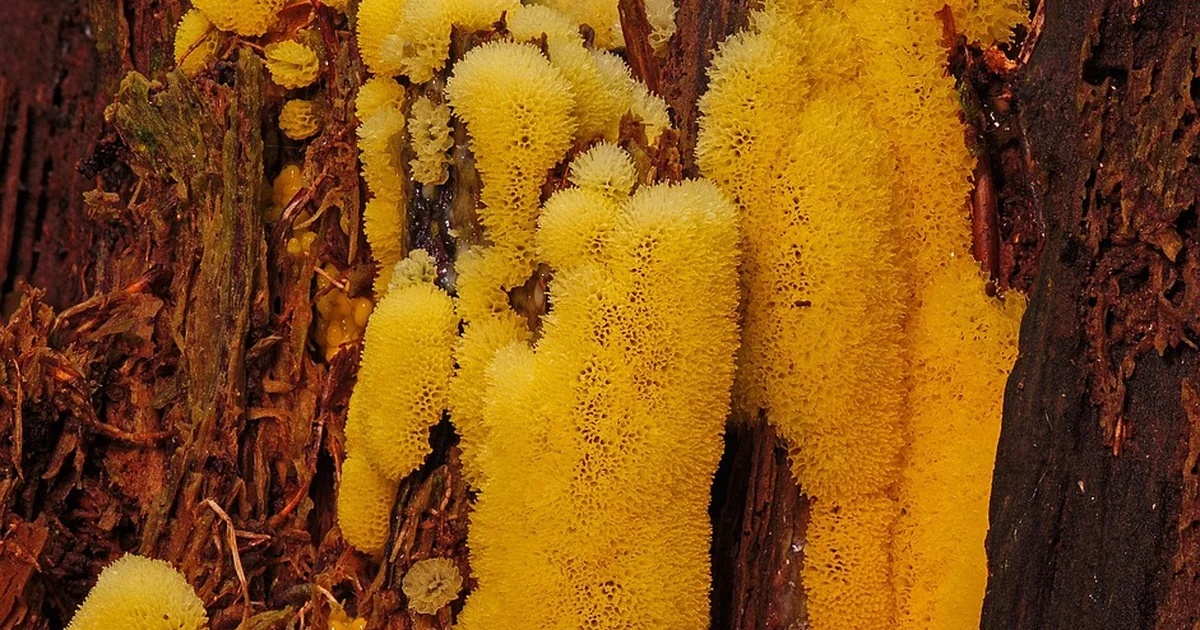
Few sights in the garden stop you in your tracks quite like a sudden patch of bright yellow foam sprawled across your mulch. It looks like something that should come with a hazmat warning. Most gardeners see it and immediately reach for gloves, wondering whether their soil has been poisoned or their pets are in danger. Despite its name and alarming appearance, this organism is not the threat it appears to be. Understanding what it is and what to do about it can save you unnecessary worry and help you manage your garden with confidence.
Amazon US Verified
Organic Perlite Horticultural Soil Conditioner
Lightweight volcanic mineral that improves root aeration and prevents compaction.
What exactly is dog vomit slime mold?
Gardeners often assume that any strange, spreading growth in their yard must be a fungus. This particular organism, formally known as Fuligo septica, belongs to an entirely different biological group. It is a protist, which places it closer on the evolutionary tree to amoebas than to mushrooms or molds. That distinction matters because it changes how you think about its behavior, its life cycle, and the role it plays in your garden.
In its active phase, it appears as a bright yellow, sponge-like mass that can expand several inches across. It feeds on bacteria, fungi, and decaying organic material that it encounters as it moves. The organism creeps along surfaces, consuming nutrients as it goes, until it reaches the end of its feeding stage. At that point, it dries out, darkens, and produces spores for the next generation.
The fleeting nature of this stage often surprises people. One day the blob is vivid and unmistakable. A few days later it may have turned crusty and black, looking more like a stain than a living thing. That transformation signals the end of its visible life cycle, not a death. The spores it leaves behind are simply waiting for the right conditions to start again.
Amazon US Verified
Self-Watering Planters with Drainage Aerators
Elevated reservoir design that prevents soggy roots and ensures steady hydration.
Is it dangerous to humans or pets?
This is almost always the first question people ask, especially when children or animals spend time near the garden beds. The straightforward answer is no. Fuligo septica poses no toxic threat to humans or animals. You do not need to panic if your dog sniffs at it or your toddler reaches toward it. The organism has not been linked to poisoning or skin reactions for the vast majority of people.
That said, there is one small caveat worth noting. Like any organism that produces airborne particles, its spores can irritate individuals who already have respiratory allergies or asthma. If you are sensitive to mold spores or pollen, it is smart to avoid stirring up the dried, powdery stage. Wearing a dust mask while working nearby is a simple precaution that costs little and offers peace of mind.
For everyone else, the risk is effectively zero. The slime mold does not bite, sting, secrete toxins, or cause infection. It is a decomposer, not a parasite, and it has no interest in you or your pets. That knowledge alone often makes the sight of it far less alarming the next time it appears.
What causes it to appear in your yard?
If you have dealt with dog vomit slime mold before, you know it can seem to appear out of nowhere. The trigger usually traces back to a combination of moisture, warmth, and the presence of organic material. Wind-borne spores of Fuligo septica can land in your yard, settle into mulch or leaf litter, and remain dormant for surprising lengths of time. These microscopic particles can survive hot, dry weather for years while they wait for favorable conditions.
When rain or heavy watering saturates the ground and the temperature stays warm, those dormant spores absorb moisture, split open, and become active. The organism then begins feeding on whatever decaying matter it finds. Wood mulches are a favorite substrate because they retain moisture well and host plenty of bacteria and fungi for the slime mold to consume. Compost piles, rotting logs, and thick layers of leaf litter offer equally inviting habitats.
Amazon US Verified
Digital 3-in-1 Soil Moisture & pH Meter
Accurate probe to test deep root zone moisture and prevent accidental overwatering.
Shade makes the situation worse. A garden bed that receives only dappled light and stays damp for long periods after rain gives the slime mold exactly what it needs to thrive. Improve air circulation, reduce shade where possible, and avoid overwatering if you want to make the environment less hospitable.
Understanding the life cycle: from bright yellow blob to black spore mass
Watching the slime mold change color and texture over a few days can be confusing. The bright yellow, foamy stage is the feeding and growing phase. During this time, the organism moves slowly across surfaces, engulfing bacteria and digesting organic particles. It looks almost like something from a science fiction film, but it is simply doing what decomposers do.
Once the food supply in that area runs low or the environment becomes less moist, the organism shifts into its reproductive phase. It stops moving and begins to dry out. As it loses moisture, the color darkens from yellow to tan, then brown, and finally to a blackish crust. That crust is a hardened mass of spores. The fruiting body deteriorates when it dries out completely, releasing those spores into the air or onto the ground.
This is the stage where most gardeners assume the problem is over. The ugly blob has vanished, so surely the issue has resolved itself. In reality, the spores left behind can remain viable in the soil for extended periods. They act like a seed bank, waiting for the next warm, wet spell to germinate and produce another visible colony. Understanding this cycle helps you choose removal methods that limit future outbreaks rather than encouraging them.
How can you get rid of it without spreading spores?
Removal sounds straightforward, but the slime mold’s reproductive strategy makes it tricky. If you disturb the organism while it is still in its spore-producing phase, you risk sending thousands of microscopic particles floating across your yard. A single gust of wind or a forceful spray of water can seed every nearby flower bed with dormant spores that will activate later.
The most reliable method is gentle physical removal. Use a shovel or a sturdy trowel to scoop up the top layer of mulch or soil where the slime mold is resting. Lift it carefully, trying not to break the mass apart. Place the material into a bag or bucket and relocate it to an inconspicuous corner of your property where you do not mind if it reappears. Hot composting is an option if you have the setup, but standard cold compost piles may simply provide another home for the spores.
For slime mold growing on lumber, tree stumps, or the sides of untreated wood, scrape it away with a trowel. Keep the scrapings contained. Avoid using a hose or pressure washer, because water jets scatter spores far and wide. Raking is acceptable on lawns or plant surfaces, but do it gently and on a calm day to minimize airborne spread.
If the slime mold keeps returning to the same spot season after season, consider replacing wood-based mulch with gravel, pebbles, or other inorganic options. These materials do not decompose, so they provide no food source for the organism. Drier conditions alone often solve the problem permanently.
Can it survive indoors or kill plants?
Two practical concerns come up regularly among gardeners who encounter this organism. The first is whether it can invade the home. Indoor growth is unlikely. The slime mold requires high humidity, decaying organic matter, and a steady food supply of bacteria and fungi. Most homes do not offer the right combination of moisture and substrate. It could theoretically appear near moist, untreated wood in a basement or crawl space, but spores rarely enter a house in sufficient numbers to start a colony.
The second concern involves plant health. Gardeners worry that the slime mold is attacking their flowers, vegetables, or shrubs. It does no such thing. Fuligo septica is harmless to plants. It feeds on dead organic material, not living tissue. The only scenario in which it could cause damage is if a very large colony physically covers a small seedling and blocks sunlight. That is uncommon and easy to remedy by removing the mass.
In short, the organism is an eyesore, not a pathogen. It does not spread disease, rot roots, or consume healthy plants. Knowing this lets you focus your energy on cosmetic removal rather than frantic damage control.
The beneficial side of dog vomit slime mold
It may feel counterintuitive, but this organism is actually doing your garden a favor. As a decomposer, it consumes dead organic matter and breaks it down into simpler compounds that plants can use. Leaf litter, dead roots, old mulch, and other debris accumulate in every garden. Without decomposers like Fuligo septica, that material would pile up and the nutrients locked inside it would remain unavailable to your plants.
Think of it as a cleanup crew. The slime mold moves through the top layer of your garden beds, digesting bacteria and fungi that are themselves breaking down organic waste. In the process, it releases nutrients into the soil. This is the same kind of nutrient cycling that earthworms, beetles, and beneficial bacteria perform. The slime mold is just doing it in a more visually dramatic way.
You may also enjoy reading: 7 Ways to Kill Tree Roots Safely and Efficiently.
Some gardeners choose to leave it alone for this reason. If it appears in a spot where its presence does not bother anyone, letting it run its natural course is perfectly fine. It will disappear on its own after a few days, and your soil will be slightly richer for its visit.
Natural predators that control slime mold
Gardeners looking for a hands-off approach to management can take advantage of the organisms that already live in healthy soil. Slugs, snails, and several species of beetles feed on slime molds. These creatures are natural grazers that keep populations in check. A garden with a diverse population of these invertebrates is a garden where slime mold rarely becomes a recurring problem.
The slime mold thrives in moist, shady environments, and so do its predators. If you create conditions that support a healthy soil food web, you are essentially hiring a maintenance crew that works for free. Avoid broad-spectrum pesticides that kill slugs and beetles, because removing those predators removes the main check on slime mold growth.
If you notice the bright yellow mass dotted with tiny holes or looking ragged around the edges, you are likely seeing evidence of grazing activity. The predators are eating it faster than it can spread. In that case, your best move is to do nothing. Nature is handling the situation already.
Medical potential: why researchers study Fuligo septica
This peculiar organism has caught the attention of scientists for reasons that have nothing to do with gardening. Researchers have found that Fuligo septica possesses some unusual chemical properties. One of the most intriguing is its ability to concentrate and transform heavy metals. Studies have shown that the slime mold can absorb metals like zinc, copper, and lead from its environment and convert them into inert, less toxic forms.
This discovery has opened up lines of inquiry into bioremediation, the use of living organisms to clean up polluted environments. If a lowly slime mold can neutralize certain metal contaminants, it may one day be part of strategies for cleaning industrial waste sites or contaminated water. The organism’s natural resilience and simple growth requirements make it a practical candidate for further study.
Other research tracks are examining its potential as a source of novel antibiotic compounds. Like many organisms that live in competitive microbial environments, Fuligo septica has developed chemical defenses. Scientists are analyzing those compounds to see if any of them show activity against drug-resistant bacteria. The work is still at an early stage, but it highlights the fact that even the strangest garden guest may hold secrets worth uncovering.
How to distinguish dog vomit slime mold from other common garden fungi and algae
Confusion is common because several garden organisms share a similar bright yellow or orange color. True fungi like the yellow mushrooms found on rotting wood look quite different under close inspection. They have stems, caps, and gills. Slime mold has no structured shape. It flows, spreads, and conforms to the surface it rests on, like a puddle that happens to be alive.
Algae can also create yellow or green patches on soil and mulch, but algae grow in thin, flat films, not in thick, puffy masses. If you press your finger into the growth and it feels firm but spongy, it is almost certainly slime mold. Algae feel slimy and smear easily. Fungal mycelium, the white thread-like network that many fungi produce, sits beneath the surface and only becomes visible when it fruits.
Another distinguishing feature is movement. Over the course of a day or two, slime mold shifts position slightly, revealing pale trails where it has traveled. Fungi and algae stay put. If you mark the edge of the growth with a stick and return the next day to find it has crept past your marker, you can be certain of what you are dealing with.
Frequently Asked Questions
How long do dog vomit slime mold spores remain viable in garden soil?
Spores can survive for several years in the soil, even through hot, dry conditions. They sit dormant until the combination of warmth and moisture triggers them to germinate. This is why the same garden bed may see the slime mold reappear season after season, even after thorough removal.
What is the difference between dog vomit slime mold and true mold on mulch?
True molds are fungi that grow as a network of thread-like hyphae and reproduce through spores released from specialized structures. Dog vomit slime mold is a protist that moves and feeds like an amoeba, consuming bacteria and organic particles as it travels. They look similar at first glance, but their biology, behavior, and life cycles are fundamentally different.
Can I compost the removed slime mold material safely?
You can compost it, but only if you maintain a hot compost pile that reaches internal temperatures high enough to kill spores. Standard cold compost piles provide ideal conditions for the spores to survive and multiply. If in doubt, it is safer to discard the removed material in a remote area or bag it for disposal rather than risk spreading it through your finished compost.
No matter how unsettling it looks, dog vomit slime mold is one of the least threatening things that can appear in your garden. It does not harm your plants, your pets, or your family. A simple scoop, a bit of patience, and a willingness to let nature run its course are all you really need to handle it well.
As an Amazon Associate, azuloz.com earns from qualifying purchases.