It happens within four seconds of crossing your front door threshold. You step inside after a long day of work, commuting, or running family errands. Your arms are weighed down with grocery totes, a work briefcase, a child’s school backpack, and a handful of unsolicited mail retrieved from the mailbox.
You do not walk down the hall to the coat closet. You do not slide your shoes neatly onto a closet rack. Instead, an invisible gravitational force takes over: you kick off your shoes directly in the doorway, toss your keys and mail onto the nearest console table, and drop your heavy bags onto an entryway bench or dining room chair.
By Thursday evening, your foyer resembles an obstacle course. You trip over sneakers, search frantically for your car keys on busy mornings, and feel an immediate wave of irritation every time you walk into your own home. Most homeowners assume this clutter is a moral failure—a lack of domestic discipline or lazy habits. In reality, environmental psychology reveals that the entryway “drop zone” is an involuntary, neurobiological reaction to transition friction. When you understand the behavioral science of cognitive depletion and spatial affordances, you can redesign your entryway to cure the clutter loop permanently.
The “Threshold Effect”: How Your Brain Decompresses at the Door
In environmental psychology and cognitive neuroscience, crossing the physical threshold of your home triggers a profound neurological shift. Throughout your day, your prefrontal cortex operates in a state of high cognitive vigilance—filtering distractions, navigating traffic, making professional decisions, and managing social interactions. This sustained effort drains your finite reserve of executive willpower.
The instant your hand turns your front door handle and you step into your private sanctuary, your brain’s survival machinery registers safety. It seeks an immediate, urgent release of cognitive load. In that micro-moment, dropping your heavy bag and kicking off your shoes is not just a physical act; it is a somatic metaphor for unburdening your nervous system.
Behavioral psychologist Wendy Wood, a leading researcher on habit formation at the University of Southern California, has demonstrated that nearly 43 percent of our daily behaviors are executed on subconscious autopilot, cued directly by environmental triggers rather than conscious choices. Stepping through the front door is one of the most powerful environmental cues in human life. The habit loop is instantaneous:
- The Cue: Crossing the home threshold.
- The Routine: Shedding physical burdens onto the nearest available surface.
- The Reward: Immediate physical relief and neurochemical relaxation.
Because this reward is delivered within two seconds, the habit becomes deeply grooved into the basal ganglia. Demanding that family members “just remember to hang up their coats” fails because you are asking a depleted prefrontal cortex to override an entrenched, rewarding neurological routine.
The Physics of Behavioral Friction: Why Closets Always Fail
If you want to understand why your entryway stays messy, count the physical micro-steps required to put an item away versus the steps required to dump it. Behavioral designers refer to this as “behavioral friction.” Human behavior naturally flows along the path of least mechanical resistance.
Consider the traditional entryway closet. To put away a winter coat in a closet, a family member must execute a complex five-step sequence:
- Walk to the closet door and grasp the knob.
- Pull the door open (often squeezing past shoes on the floor).
- Reach up into a crowded rack, locate an empty hanger, and untangle it from adjacent coats.
- Thread the hanger through both coat sleeves.
- Hang the coat back on the rod and push the closet door shut.
That is five distinct physical actions requiring motor coordination and patience. Contrast that with dropping the coat onto an entryway chair or bench: one single release of the hand.
When the friction of doing the “right thing” is five times greater than the friction of doing the “wrong thing,” the wrong thing will win every single time a person enters the house feeling tired, cold, or hungry. If your organizational system requires conscious effort, the system is flawed—not the human beings using it.
The 3-Foot Radius Rule: Designing for Human Instinct
To eliminate entryway clutter permanently, you do not need more storage bins or stricter rules. You need to align your home’s physical architecture with natural human movement. This starts with the **Three-Foot Radius Rule**.
When someone steps inside your front door, their natural “drop radius” extends exactly three feet from where their feet come to rest. If an intuitive, zero-friction storage solution does not exist within that three-foot circle, items will inevitably spill onto the floor, stairs, or dining table. Redesign your entryway around three zero-friction zones:
1. Open Vertical Pegs (1-Step Hanging)
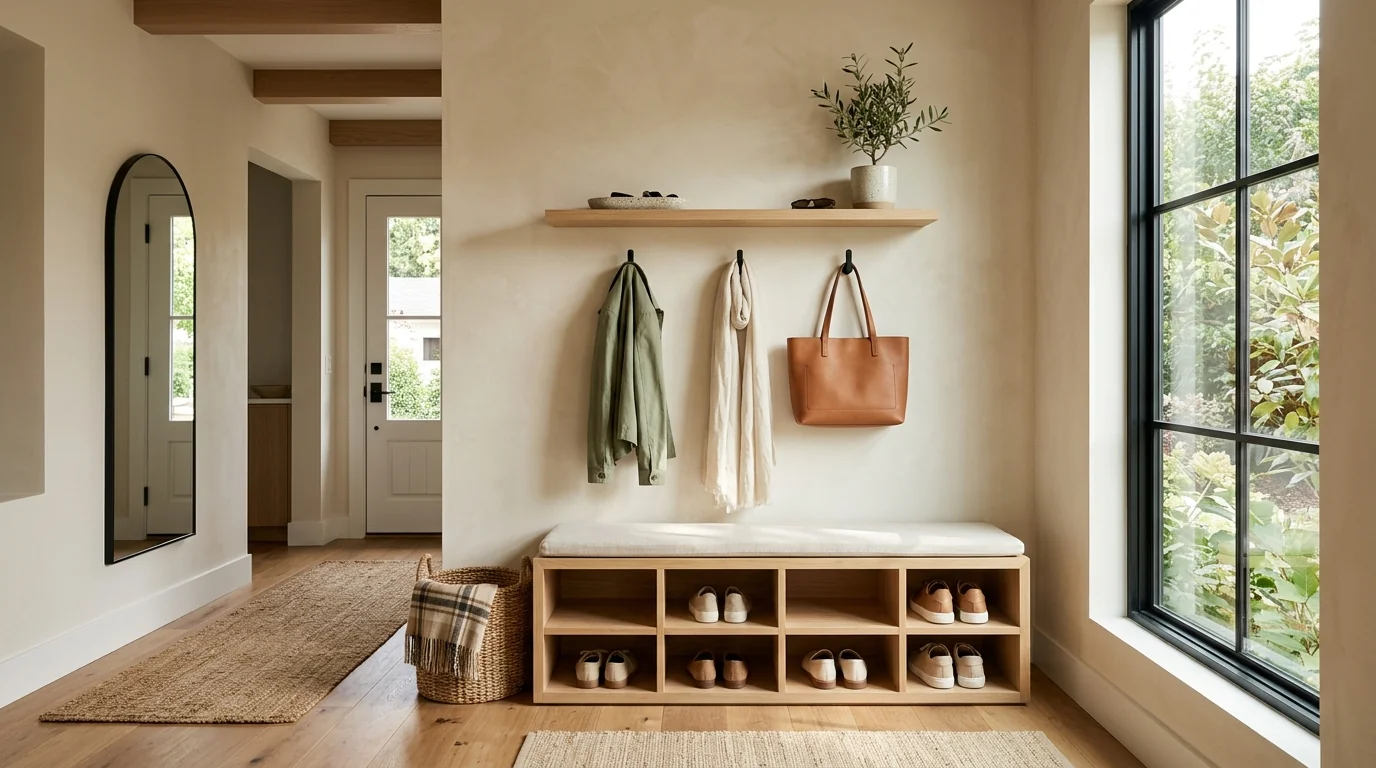
Ban hangers in the immediate entryway. Replace them with heavy-duty, wall-mounted matte black or oak pegs installed directly inside the three-foot zone. Hanging a coat or bag on an open peg requires exactly one fluid motion: reaching up and dropping the loop over the peg. A six-year-old child and an exhausted parent can execute this with zero cognitive resistance.
2. The Open Footwear Landing Strip
Never expect family members to open shoe cabinet doors or slide shoes into tight fabric organizers upon arrival. Install an open-slatted wooden bench with accessible floor-level cubbies directly beneath it. The natural kicking-off motion directs shoes straight under the bench, keeping pathways clear while providing a comfortable place to sit when lacing up boots in the morning.
3. The Low-Capacity Surface Principle
The biggest magnet for entryway clutter is a broad, flat console table. A wide horizontal surface practically invites piles of unopened junk mail, loose receipts, sunglasses, and shopping bags. If you have an oversized table, replace it with a narrow floating shelf (no deeper than 8 to 10 inches) equipped with a small ceramic dish specifically sized for keys and wallets. When a surface physically cannot hold a stack of paper, mail cannot accumulate.
The Mail Triage Station: Defeating Paper Accumulation
Paper clutter accounts for more than half of all entryway frustration. The secret to managing mail is understanding that 80 percent of what arrives in your mailbox is commercial waste that should never cross into your primary living spaces.
Position a slim, attractive recycling bin directly beside your entryway landing shelf. Establish a strict “One-Touch Gatekeeper” rule: before taking a single step past the foyer, sort the mail while standing up. Catalogs, flyers, and promotional envelopes drop straight into the recycling bin. Only urgent correspondence or bills make it into your bag or desk organizer. Unwanted paper is stopped at the border before it can colonize your kitchen counters.
📥 Free Download: Zero-Friction Entryway Layout Blueprint
The 3-foot drop radius rules, open peg ergonomics, and how to eliminate hallway transition clutter.
How to Transition Your Family Without Conflict
Implementing a new entryway layout requires leveraging what psychologists call the “habit discontinuity effect.” Habits are anchored to physical environments; when you alter the physical layout of a room, the old behavioral loop breaks, creating a unique window of opportunity to install a new routine.
- Mount Hooks at Two Heights: Install an adult row of hooks at 60 inches from the floor, and a second, dedicated children’s row at 36 to 42 inches. When children have their own designated hooks at eye level, they take natural pride in hanging their backpacks independently.
- Label Cubbies with Simple Icons or Names: Give each family member an assigned shoe slot. Visual ownership eliminates territorial arguments over crowded floor space.
- Celebrate the Calm Welcome: Notice how different it feels to walk through your front door into a clean, breathing entryway. A calm foyer sets an emotional tone of tranquility and order that ripples throughout your entire home.
Your entryway is the visual handshake of your house. By removing behavioral friction and working with human psychology rather than against it, you transform a daily bottleneck into an effortless sanctuary that welcomes you home with peace.