Why Your Snake Plant Isn’t Growing Pups: 9 Checks That Can Help
You glance at your snake plant every time you pass the shelf. Its tall leaves look sturdy, yet the soil around them stays empty. Meanwhile, someone else’s plant seems to have a new baby poking up every month. Is yours missing something?
A healthy snake plant can go a long time without visible pups. The best way to encourage them is to give the parent plant enough light to grow, keep its roots in a well-drained potting mix, water according to the season, and allow time for its underground rhizomes to develop. There is no reliable trick that guarantees a certain number of pups by a certain week. But a few careful checks can reveal whether your plant is simply slow or struggling with its setup.
Start with two questions: Has the plant made any new leaves lately, and does its potting mix dry out between waterings? Those answers will tell you more than a fertilizer schedule or a calendar ever could.
First, Know What a Snake Plant Pup Actually Is
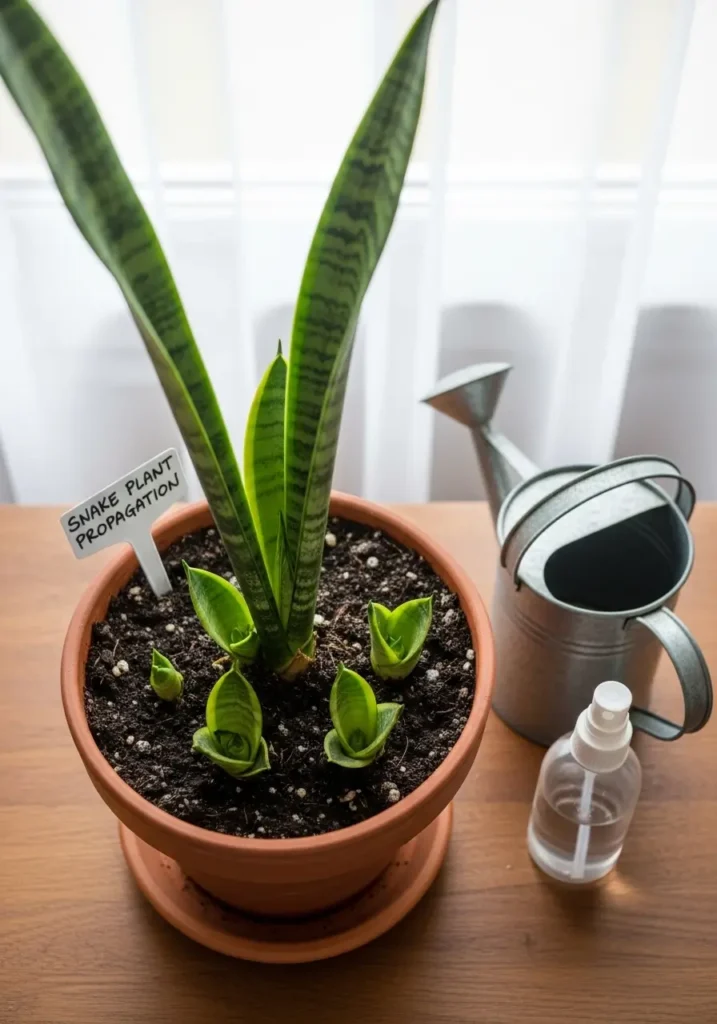
Snake plants, botanically called Dracaena trifasciata and still widely sold as Sansevieria trifasciata, spread through underground stems called rhizomes. A pup, or offset, is a new shoot connected to that system. At first you may see only a pointed tip pushing through the mix near the edge of the clump. Beneath the surface, it is part of the same plant.
That distinction matters because a mature-looking leaf is not evidence that the plant is actively expanding. Snake plants can hold their existing leaves in low light for a long time while growing slowly. A pup might also begin beneath the soil before you see it. Resist the temptation to dig around every week; disturbing roots will not make the shoot emerge faster.
Think of the following checks as a way to improve growing conditions, not a recipe for forcing reproduction. Plant size, variety, season, and room conditions all affect growth.
Take a Five-Minute Look at the Plant and Its Pot
Before moving or repotting anything, notice where the plant lives. A snake plant set several feet back from a north-facing window receives far less useful light than one near an unobstructed window, even if both rooms feel bright to you. Then look at the pot: Is there a drainage hole? Is the nursery pot sitting in water inside a decorative container? Can you tell whether the mix is dry below the surface?
Record the date, take a photo from the same angle, and check for new leaves, not just pups. If you discover soft tissue, a sour smell, or continually wet mix, deal with possible root trouble first. A struggling plant needs healthy roots more urgently than it needs new shoots.
9 Checks When Your Snake Plant Has No Pups
1. Is it surviving in low light rather than actively growing?
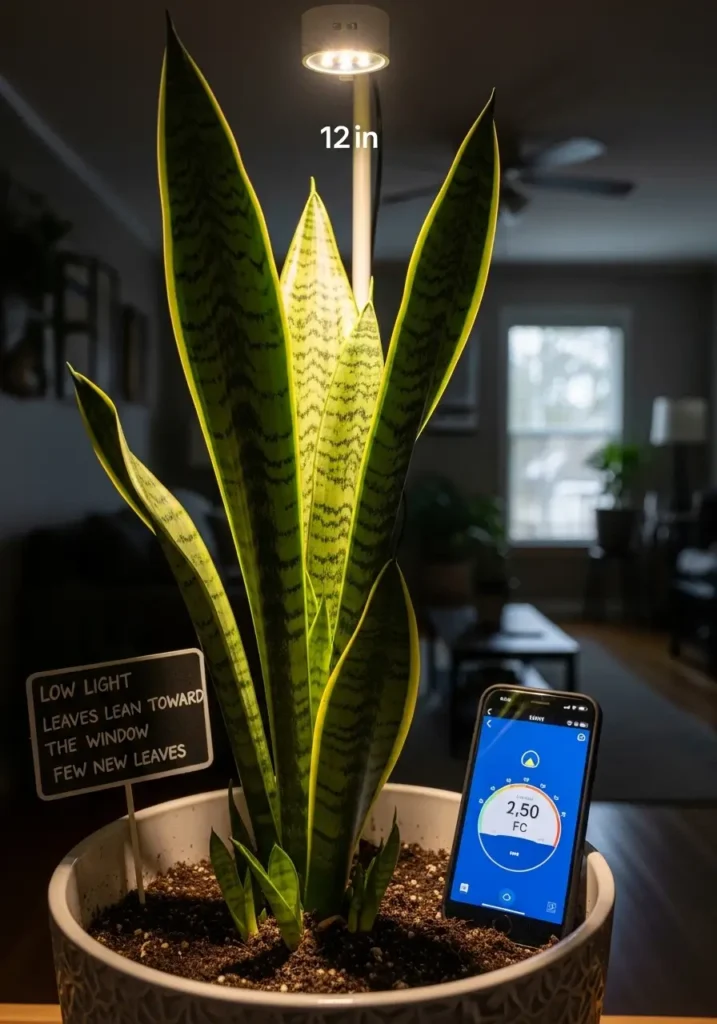
“Low-light tolerant” is easy to hear as “grows quickly in a dark corner.” It means the plant may persist there; it does not promise the same growth it would make in better light. If you have seen neither a new leaf nor a pup over a long stretch, light is a sensible place to start. The University of Minnesota Extension’s indoor-light guide explains how lower light slows growth and reduces water use.
Try moving the plant closer to a window with bright, indirect light. An east-facing window can be a convenient starting point; an unobstructed south- or west-facing window may need some distance or a sheer curtain if the leaves are suddenly exposed to strong sun. Make the move gradually and watch for pale, scorched patches. North Carolina State Extension notes that snake plants can tolerate direct sun for part of the day, but conditions behind glass vary considerably.
Use the plant’s response over time: Are new leaves appearing? Does the pot now dry more predictably? Those are more useful signs than the window direction alone.
2. Is the container far bigger than the root system?
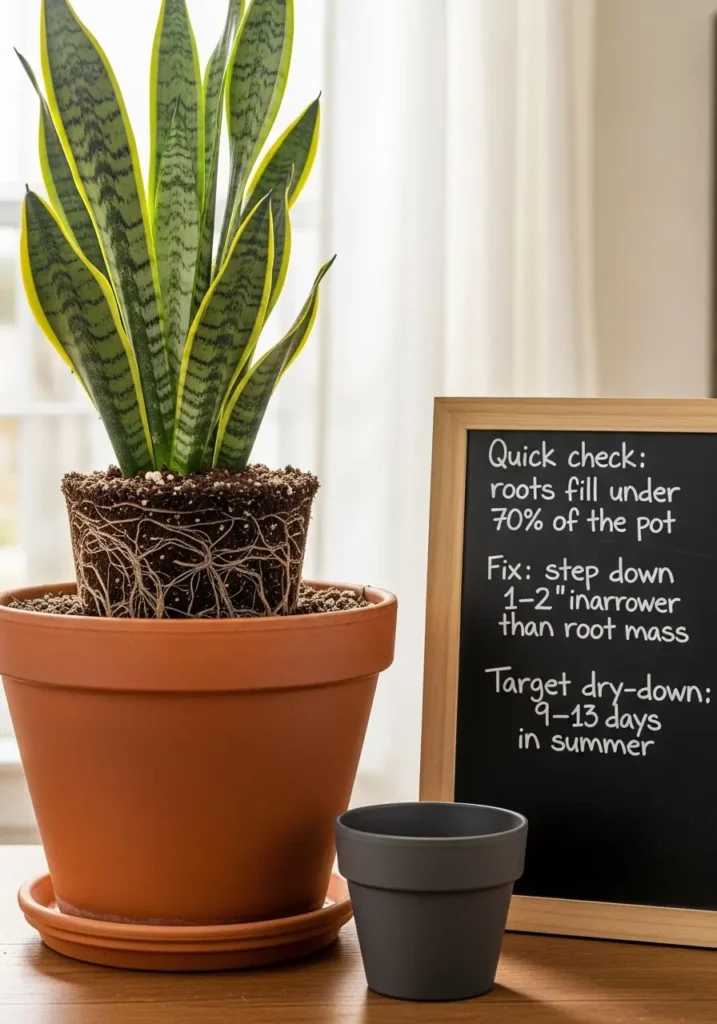
A tiny clump surrounded by a large volume of damp mix is harder to water well. The soil beyond the roots may stay wet while the top looks dry. A more appropriately sized container makes it easier to judge moisture and avoid rot. There is no evidence that crowding the rhizomes sends a special “make pups” signal, and a plant packed so tightly that the pot cracks needs more room.
If the plant is stable, making new leaves, and drying at a reasonable pace, you can leave it alone. If you repot because the mix remains wet or the container is unwieldy, choose a pot only modestly larger than the root mass, with a drainage hole. Avoid stripping away healthy roots merely to fit an arbitrary pot size. A decorative cachepot can still work: keep the plant in a draining nursery pot and empty any water that collects in the outer container.
If you see a firm shoot lifting the soil at the rim, give it a little room. Do not cut it off just because the display looks crowded; you can decide whether to divide once the offset is established.
3. Does the mix stay dense and damp?
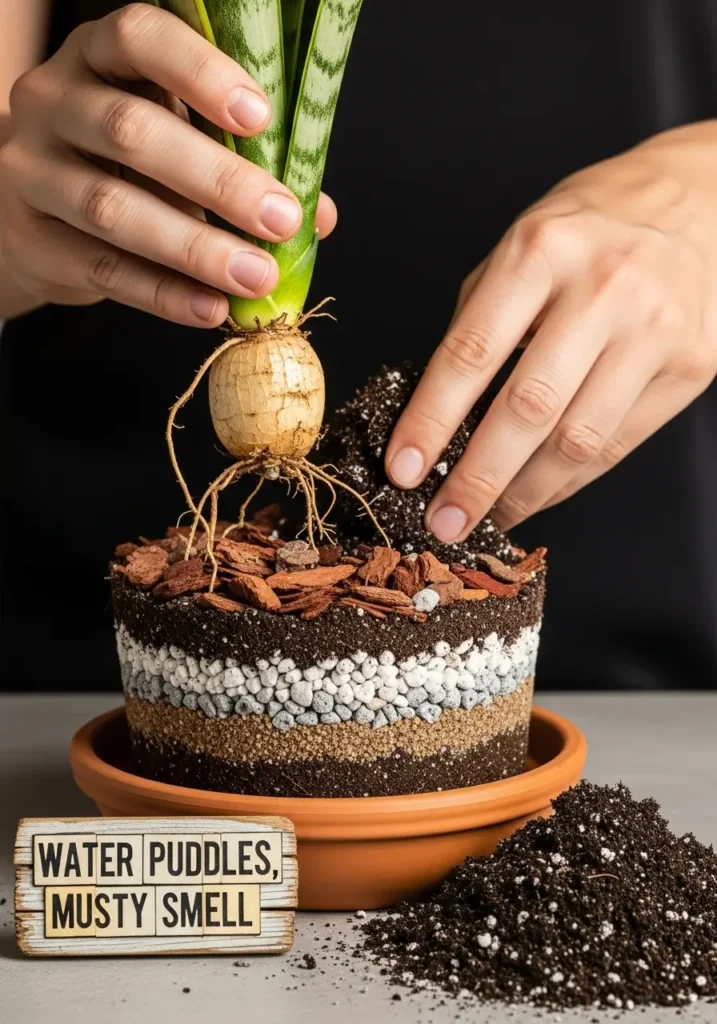
Roots need both moisture and air. When an old potting mix becomes compacted, or water cannot leave the pot, the root zone can remain wet long after the plant has used what it needs. Water pooling on the surface, a persistently heavy pot, and a sour smell are reasons to investigate. Soft leaves at the base or mushy rhizomes call for prompt attention.
Use a well-draining potting mix suitable for succulents or amend a general indoor mix with a coarse material such as perlite or pumice. There is no magic percentage that fits every home: pot size, container material, room temperature, and available light all affect drying. The NC State Extension snake plant profile emphasizes good drainage and careful watering because roots can rot when overwatered.
After repotting, keep the crown—the point where leaves meet the roots—at about its former depth. Firm the mix gently rather than compressing it into a hard block. Let excess water drain fully whenever you water.
4. Are you watering by the calendar instead of checking the pot?
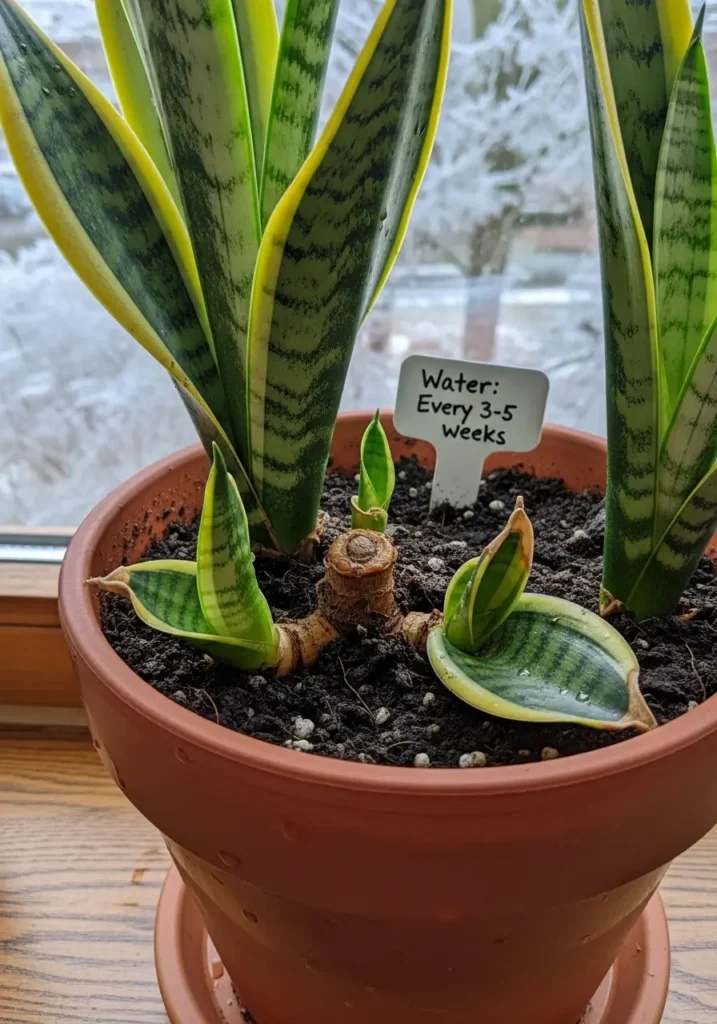
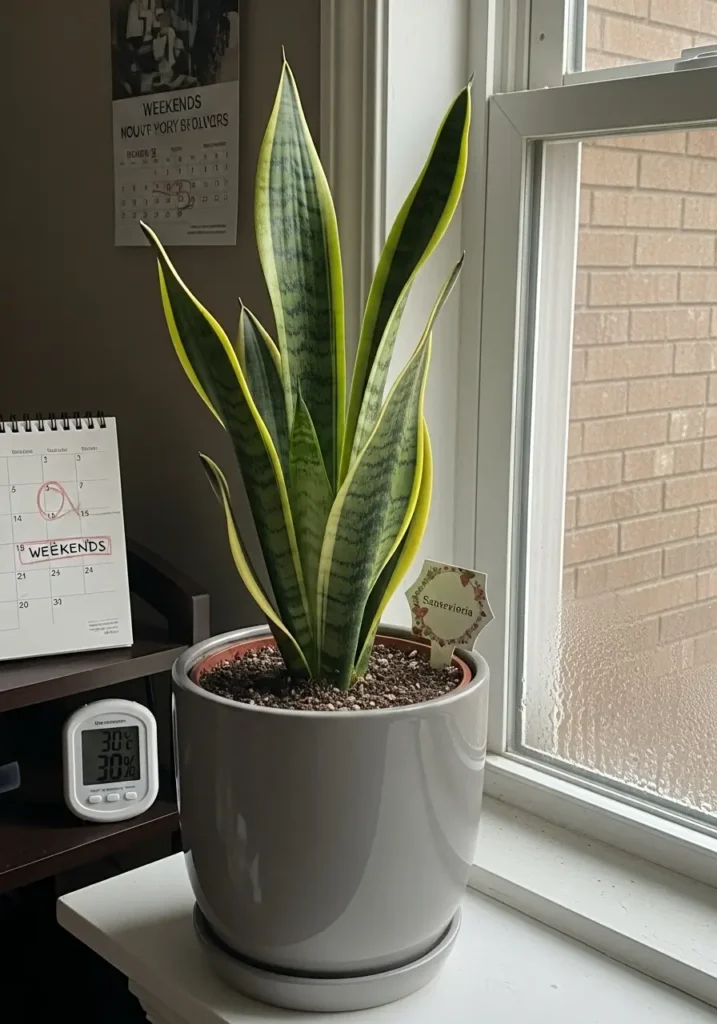
A reminder that says “water every Saturday” cannot account for a cloudy winter, a bright summer window, or a fresh potting mix. Check deeper than the surface with a finger or a wooden skewer, and notice the pot’s weight after watering versus when the mix has dried. In a draining container, water thoroughly when the mix has dried, then discard the runoff. Do not let the pot sit in a saucer of water.
Established snake plants generally use less water when days are shorter and growth slows. NC State Extension advises allowing the soil to dry between waterings from spring to fall and notes that winter watering may be as infrequent as every one to two months. Treat that as context, not a fixed appointment: a small plant in a warm, bright room will behave differently from a large pot in a cool corner.
If a leaf wrinkles slightly and the mix is truly dry, the plant may need water. If the base is soft while the mix stays wet, adding water is the wrong response. Check the roots and drainage instead.
5. Have you been feeding a plant that barely uses nutrients?
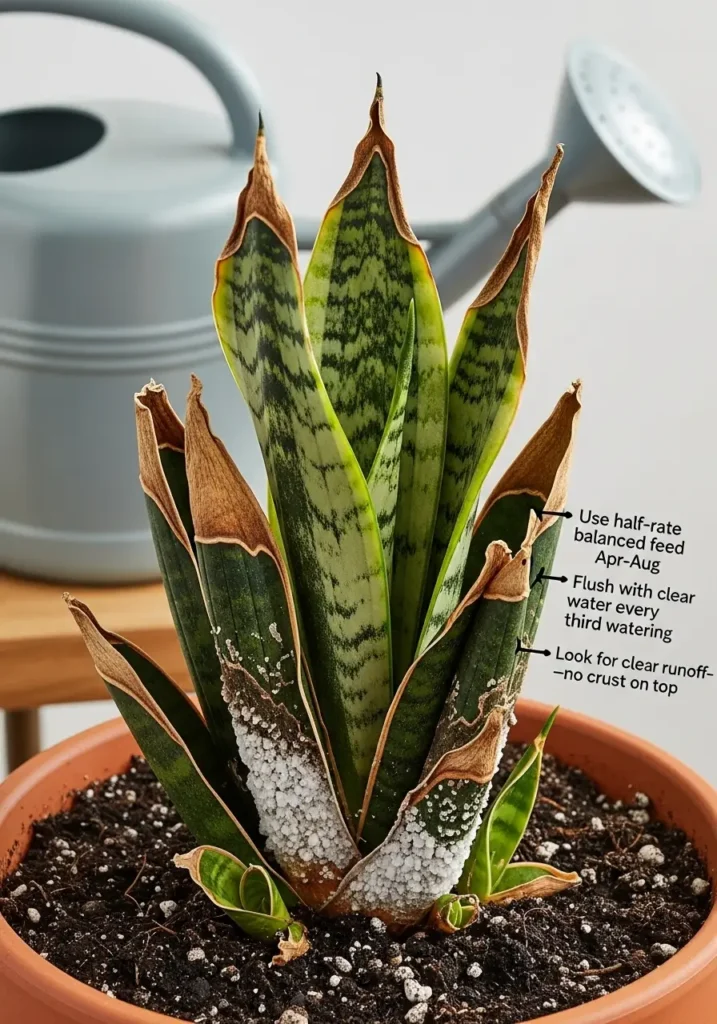
Fertilizer can support an actively growing plant, but it cannot replace light or repair soggy roots. It is tempting to add another dose when pups fail to appear. If growth is slow because the plant is in a dim room, the extra nutrients may simply accumulate in the potting mix.
Follow the fertilizer label, use a conservative dose during active growth, and pause when the plant is resting or recovering from root problems. If the mix already contains fertilizer, give the plant time before adding more. A crust on the soil or container is a reason to review feeding and water quality, though browned tips can have several causes. When watering, allow water to pass through the drainage hole and empty the saucer; a plant without drainage should be moved into a suitable pot before attempting to flush it.
Newly divided plants deserve a pause too. Iowa State Extension recommends waiting a few weeks after division before fertilizing while roots recover.
6. Is a grow light too weak, too distant, or used inconsistently?
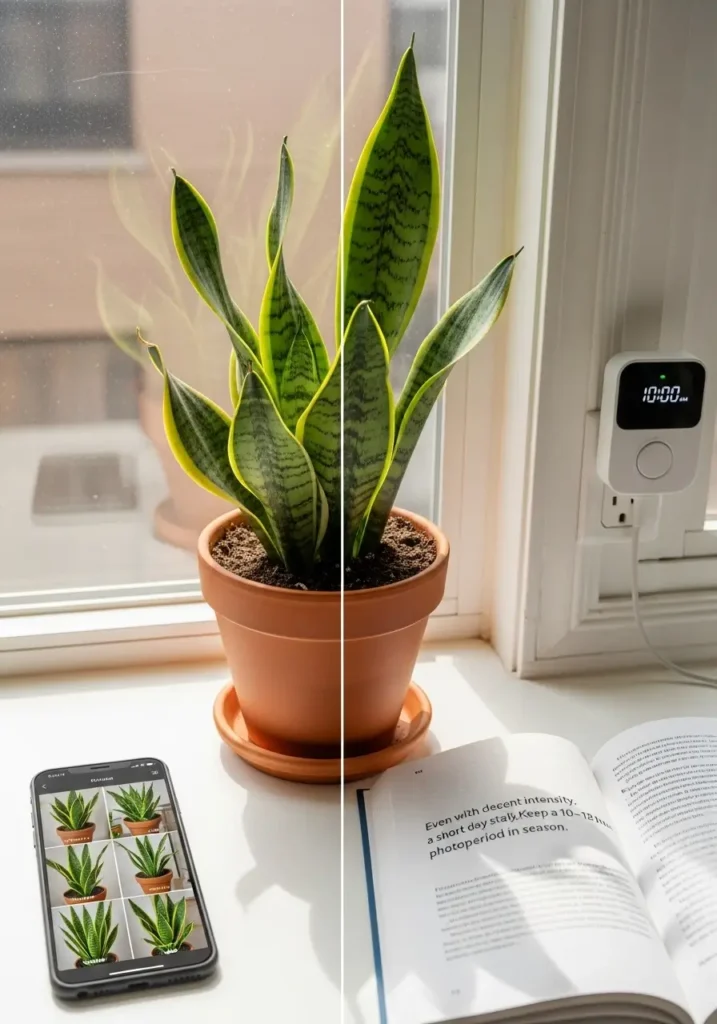
If a brighter window is unavailable, a grow light can help. The important question is whether useful light reaches the leaves for a consistent part of the day. A small lamp across the room may look attractive without changing the plant’s growing conditions much. Position a plant-appropriate light according to its maker’s guidance, use a timer, and watch for leaf bleaching or heat stress if it is placed too close.
There is no universal number of lamp hours that guarantees offsets. Light intensity, distance, natural daylight, and the fixture itself all matter. Start with a consistent routine that gives the plant a distinct light period and a dark period, then assess new growth over the coming months. A weekly photo in the same spot makes small changes easier to see without pulling the plant out of the pot.
If you also have leaf cuttings under a humidity cover, keep them out of harsh direct light. Covered cuttings can overheat or scorch more easily than an uncovered parent plant.
7. Does the pot sit against cold glass or in a draft?
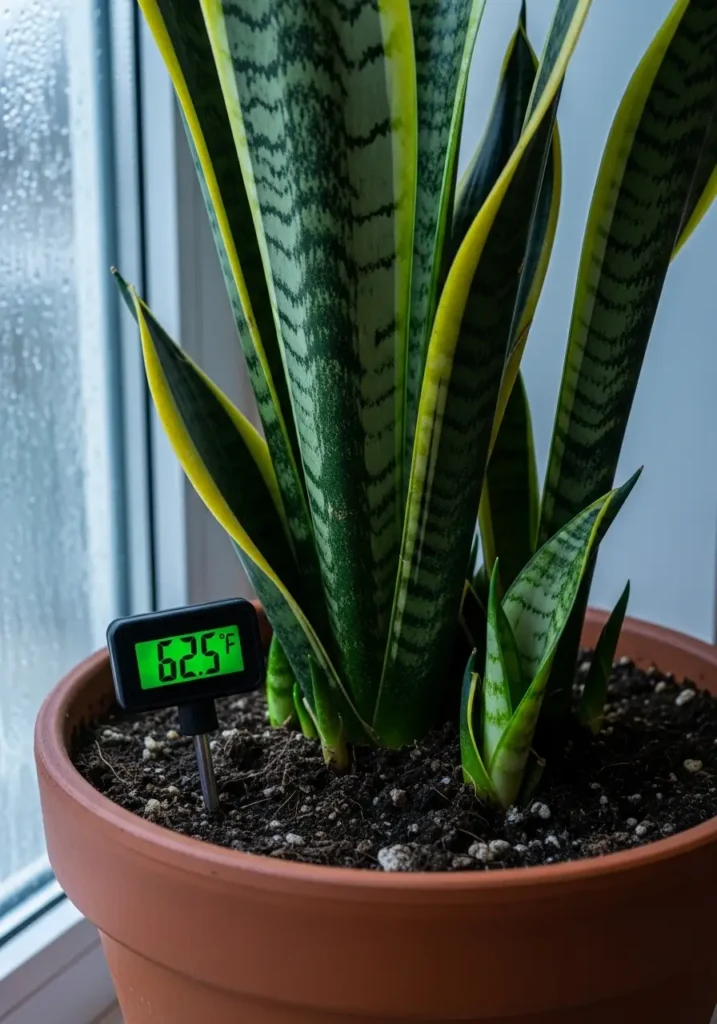
A room may feel comfortable while a pot on a winter windowsill becomes much cooler overnight. Snake plants tolerate some cool conditions, but growth generally slows when the root zone is cold, especially if the mix is also wet. Move the pot back from chilly glass or a drafty door, while keeping it in a spot with useful daylight.
Do not overcorrect by placing it against a heating vent. Hot, drying air and rapid temperature swings are not a substitute for a stable room. For rooting cuttings, Iowa State Extension describes warm conditions around 65–75°F for air temperature. That is guidance for propagation, not a strict minimum for an established snake plant or a promise of pups.
Check the actual spot at night if you suspect a problem. A simple thermometer nearby is more informative than guessing based on the temperature displayed on a thermostat in another room.
8. Are you expecting summer growth in a winter room?
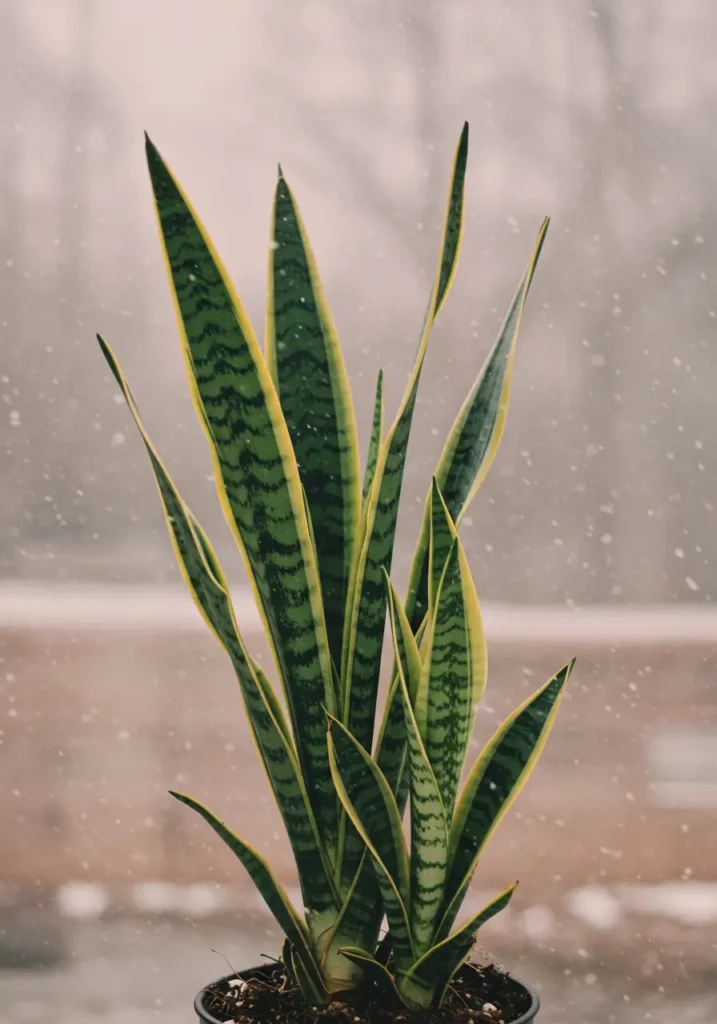
For many indoor plants in the United States, shorter winter days mean slower growth. A plant that seemed lively in June can appear unchanged for months when it receives less light. Keep it healthy through that quieter period: water in response to the mix, protect it from cold, and wait to judge its progress over a longer span.
Spring is a convenient time to reassess its position and, if necessary, repot or divide it. That does not mean an indoor snake plant must follow an exact March-to-September schedule. Climate, window exposure, and supplemental lighting change its growing conditions. If new leaves are appearing in winter under good light, observe the plant rather than forcing a rest period.
Consider the practical goal. If you simply want a fuller-looking pot now, a second established plant may achieve that sooner than trying to induce several offsets from one small parent. If your goal is to share a clone of a favorite cultivar, letting a pup mature is worth the wait.
9. Is the variety slow—or are you confusing pups with leaf-cutting plantlets?
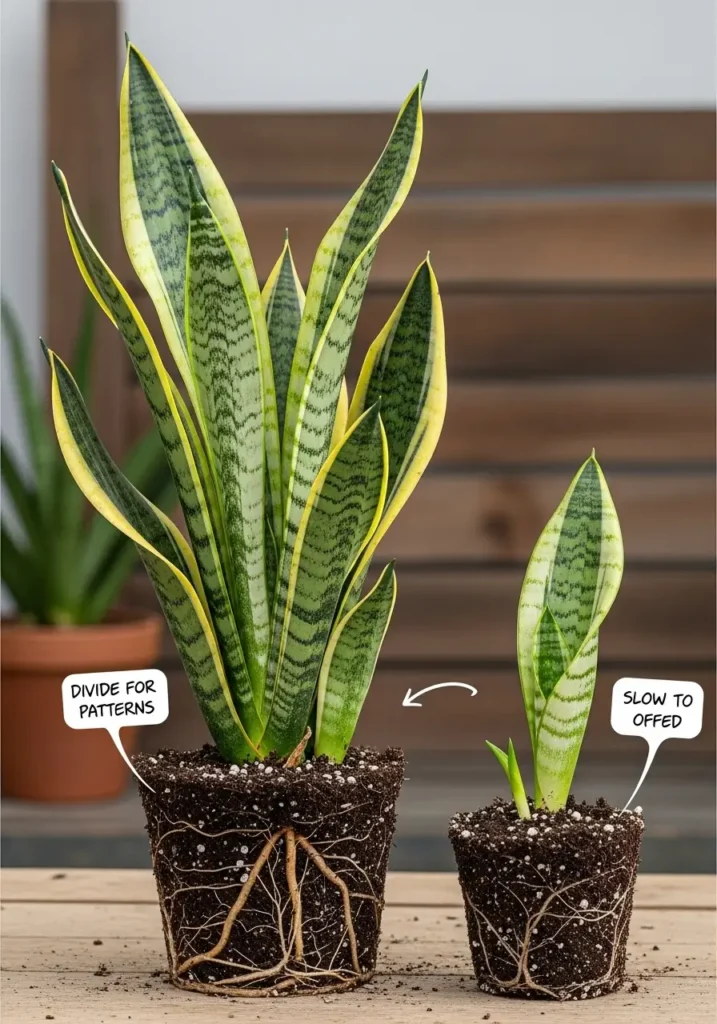
Snake plants come in tall, compact, and differently patterned forms. A small or recently divided plant may need time to establish before you see an offset. If its leaves are firm, the roots are healthy, and you are seeing gradual growth, an absence of pups alone is not a diagnosis.
A leaf cutting is a different way to make a new plant. It can produce roots and then a new shoot, but it does not make the original potted plant send out a pup. This distinction becomes especially important with yellow-edged varieties such as ‘Laurentii’: according to Iowa State Extension’s leaf-cutting guide, these often lose their distinctive edge color when grown from leaf pieces. To keep the pattern, divide an established clump with its roots and rhizome rather than relying on leaf sections.
If you grow a patterned variety, check which part you are propagating before making the first cut. The method determines whether you are likely to keep the look you bought it for.
A Simple Care Reset You Can Actually Maintain
When a plant has been static for a while, it is easy to change everything at once. That makes it hard to tell what helped—and repotting a healthy plant repeatedly creates needless disturbance. Work through these steps in order.
- Check the roots and the container. If the base is firm and the mix dries, leave the roots alone. If there is a sour smell, mushy tissue, standing water, or persistent dampness, inspect the root system and correct the drainage problem.
- Improve the light. Move the plant closer to useful daylight gradually or add an appropriately placed grow light. Note the date and take a photo.
- Let the mix guide watering. Feel below the surface and compare the pot’s weight. Water thoroughly when it has dried, and empty runoff. Recheck more often after a move to brighter light; the plant may use water faster.
- Feed only when growing. Keep fertilizing modest, follow the product label, and pause after division or when the plant is recovering.
- Observe through an active growth period. New leaves, a firm crown, and predictable drying are meaningful progress even before an offset breaks the surface.
A planter hidden inside a pretty outer pot can make this routine easy: lift it out to water, let it drain in the sink, and return it only after excess water has stopped dripping. A layer of stones at the bottom of an undrained decorative pot does not replace a drainage hole in the container holding the roots.
If you move your plant outdoors for the warm season, acclimate it gradually to brighter conditions, shelter it from harsh sun at first, and bring it back before cold weather. For ideas about creating a similarly easy-care outdoor space, see these low-maintenance backyard ideas. The plant’s needs still come first: outdoor light and rainfall can change its watering rhythm quickly.
What to Do When a Pup Finally Appears
The tiny spear at the soil line does not need immediate intervention. If the pot has room and the parent looks healthy, let the pup grow attached. It receives support from the shared rhizome while it develops its own roots. Separating it as soon as the tip appears risks leaving it with too little root system to establish easily.
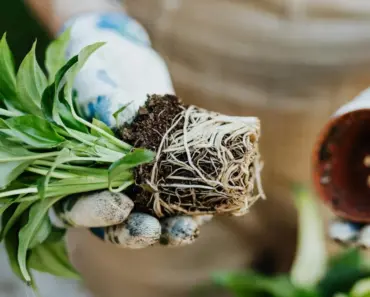
When you have a sturdy offset and want another pot, division is straightforward in principle. Remove the entire clump from its pot, locate the connection between the parent and pup, and gently tease apart sections where possible. If they are tightly joined, use a clean, sharp blade. Each division should have healthy leaves and roots. Replant in an appropriately sized pot with fresh, draining mix, water to settle the mix, and set the divisions in bright, indirect light. Iowa State Extension’s division instructions offer a useful visual and step-by-step reference.
Give separated plants a few weeks to recover before feeding. Do not be alarmed if top growth pauses while roots settle. If the offset has no substantial roots when you inspect it, leaving it attached longer may be the kinder choice.
Division or Leaf Cuttings: Which Fits Your Goal?
If you want the same leaf pattern and already have an established clump, division is the more direct route. If you have a plain green plant and want to experiment with making several new plants, leaf sections offer another option. Both require patience, and neither creates an on-demand set of pups on the original plant.
| Consideration | Divide an established clump | Start leaf-section cuttings |
|---|---|---|
| What you need | Connected sections with healthy leaves, rhizomes, and roots | A healthy leaf cut into correctly oriented sections |
| When it makes sense | Offsets are already present or the clump is large enough to separate | You want to multiply a plant without waiting for visible offsets |
| What you keep | A rooted part of the original plant; the cultivar’s pattern is retained | A new plantlet; some patterned cultivars may lose their variegation |
| Time and care | A rooted division can establish after a recovery period | Roots and shoots must form before a new plant can be potted on |
| Main risk | Separating a very small pup with too few roots | Rotting a cutting in an overly wet medium or reversing its orientation |
For leaf sections, keep track of which end was closest to the base of the mother plant. Insert that end into a suitable moist rooting medium; a segment placed upside down will not behave the way you expect. Keep it warm and in bright, indirect light, check the medium rather than flooding it, and allow time for both roots and a new shoot. Iowa State Extension describes new shoots appearing at the base of sections in about two months under suitable conditions, but individual results vary. Keep a humidity cover, if used, out of intense sun and allow air exchange as needed.
Water propagation is also possible for a leaf cutting, but watching roots develop in a jar is not the same as producing pups from the parent. Water-grown roots have to adapt when the cutting moves into potting mix. If your main goal is a sturdy new plant that retains yellow-edged leaves, division remains the clearer choice.
How Long Should You Wait for Snake Plant Pups?
There is no dependable eight-week countdown. A healthy plant may produce a pup during a favorable growing period, or it may put energy into leaves and roots first. A recently purchased, newly divided, or very small plant may take longer. A dimly placed plant can look nearly unchanged for many months. The number of pups is influenced by the size and condition of the clump as well as its growing environment; setting a target of five is likely to make normal variation feel like failure.
Give a changed setup enough time to show whether any new growth has begun. Use monthly photos rather than daily inspections. If there are new leaves and the roots remain healthy, keep caring for the plant. If there is no growth through a period with decent light and warmth, revisit the basics: the amount of light actually reaching the leaves, drainage, root health, and whether the mix ever dries.
One last household consideration: keep snake plants where children and pets are unlikely to chew them. NC State Extension identifies the plant as harmful if ingested. That is especially relevant when a small division is placed at floor level to catch a brighter patch of light.
For today, choose one useful change. Move the pot closer to appropriate light, check whether water is trapped in the cachepot, or learn how heavy the container feels when the mix is dry. A steady, healthy parent plant is the best place to start—and the first new leaf is worth noticing, even before the first pup appears.