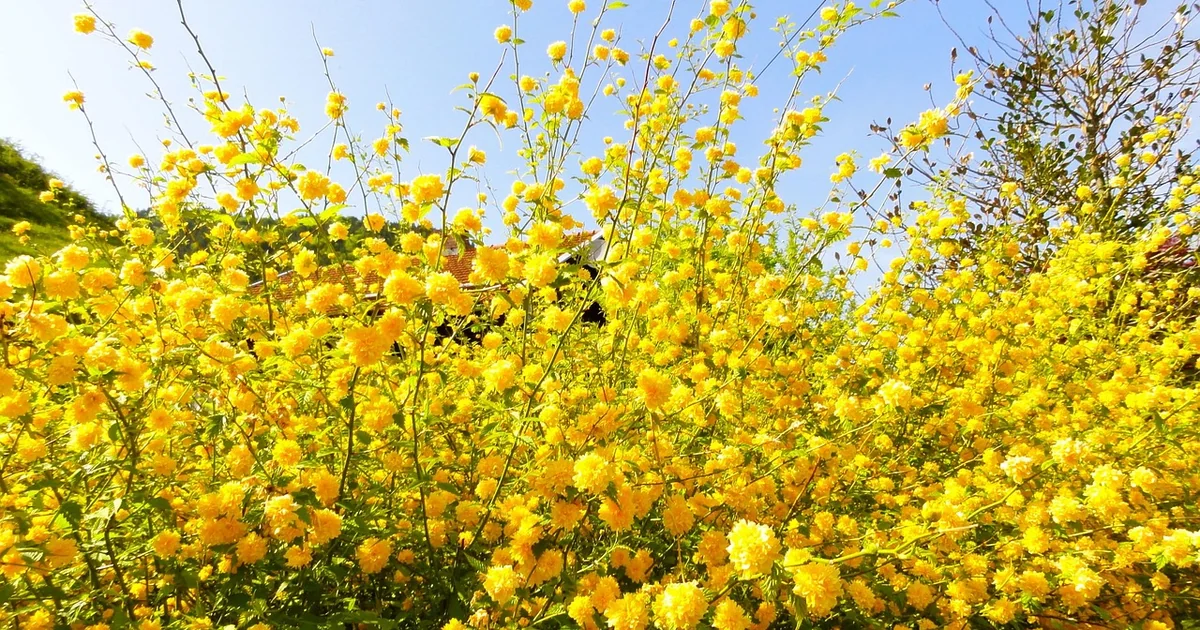
Japanese rose (Kerria japonica) is an old-fashioned gem experiencing a well-deserved renaissance in American gardens. If deer treat your yard like a buffet and dry shade beneath old oaks leaves you with bare dirt, growing kerria might be the horticultural hack you have been searching for. This spring bloomer pairs cheerful golden flowers with bright green winter stems that pop against the snow. Unlike many temperamental ornamentals, kerria asks for very little in return for its reliable performance. Still, a few professional techniques separate a so-so shrub from a truly spectacular one. Here are five pro tips to ensure your kerria thrives for years to come.
1. Prioritize Partial Shade for Prolonged Blooms
When planning your growing kerria strategy, lighting is your most powerful lever. The plant tags often read “full sun to full shade,” which sounds forgiving but hides a crucial nuance. Kerria japonica is native to the mountainous woodlands of Japan and China, where it naturally grows beneath a canopy of deciduous trees. This means it receives dappled sunlight rather than harsh, direct exposure.
Why Morning Sun Works Best
The golden flowers of kerria are surprisingly delicate. In full sun, the petals undergo photobleaching — a process where intense UV radiation degrades the flavonoid pigments responsible for the bloom’s vivid yellow color. A kerria planted in afternoon sun will see its flowers fade to a pale, washed-out cream within two days. The petals may even develop crispy brown edges.
To maximize your bloom window, choose a spot that receives gentle morning sun followed by afternoon shade. The east side of a house or the dappled area under a high-branched maple is ideal. A kerria receiving four to six hours of morning sun will retain its floral color for up to two weeks, while one in harsh southern exposure might drop petals in under a week. This small adjustment to your planting location delivers the single biggest visual payoff for minimal effort.
Avoiding the “Green Mound” Problem
If you plant kerria in deep shade — say, the north side of a garage with no direct light — it will survive. The stems will lengthen, and the foliage will turn a deep, healthy blue-green. However, flower production drops by roughly seventy percent. You end up with a large, shapely green mound that offers winter interest but very little spring color. For the gardener who wants both foliage and flowers, partial shade is the sweet spot.
2. Master the Moisture: Recreate Kerria’s Native Woodland Soil
One of the biggest myths about growing kerria is that it needs constant moisture. In reality, it needs consistent moisture balanced with perfect drainage — a combination that mimics the rich, fluffy duff of a forest floor. Kerria will not tolerate “wet feet,” a term for waterlogged soil that suffocates the roots.
The Critical Drainage Test
Before you dig a hole, perform a simple percolation test. Dig a hole twelve inches deep and fill it with water. If the water takes longer than four hours to drain completely, you have heavy clay or compacted soil. Planting kerria directly in this ground invites root rot, which manifests as yellowing leaves, blackened stems, and eventual plant collapse.
The fix for clay soil is straightforward. Do not just amend the planting hole — that creates a “bathtub” effect where water collects. Instead, build a raised berm or bed. Mix your native soil with thirty percent coarse sand and thirty percent well-rotted leaf mold or compost. This creates the loamy, friable texture kerria craves. Soil pH is rarely an issue; kerria tolerates a range from 5.0 to 8.0, but the physical texture of the soil matters far more than its chemical makeup.
Mulching: The Woodland Blanket
Apply a two-inch layer of shredded hardwood mulch around the base of your kerria. Avoid bark nuggets, which stack too thickly and repel water rather than absorbing it. Shredded mulch breaks down slowly and feeds the soil microbes, which in turn make nutrients available to the shrub. Keep the mulch a few inches away from the main stems to prevent crown rot.
3. Prune with Purpose: Rejuvenation vs. Maintenance
Kerria belongs to a group of shrubs that bloom on “old wood,” meaning the flower buds form during the previous summer and fall. If you prune in late winter or early spring before blooming, you cut off the entire season’s flower show. This is the most common mistake gardeners make with this plant.
The Post-Bloom Window
The ideal time to prune kerria is immediately after the flowers finish, typically in late spring or early summer. By pruning then, you allow the shrub the entire growing season to produce fresh canes that will bear next year’s blossoms. Use sharp bypass pruners and cut back spent flowering stems to a strong side bud or all the way to the ground if the cane is old.
Recognizing Dead vs. Live Stems
Mature kerria canes have a productive lifespan of roughly three to four years. After that, the bark turns from bright green to a whitish or gray-brown hue, and the cane begins to die from the tip downward. Live stems are a vibrant, grassy green even in winter. Dead stems are hollow, brittle, and lighter in color. Each spring, as soon as the snow melts, walk your shrub and remove every dead cane flush to the ground. This simple act does wonders for airflow and appearance.
The 12-Inch Renewal Method
For a shrub that has become a tangled thicket, do not be afraid to act decisively. In early spring before growth begins, cut the entire plant down to twelve inches above the soil line. This process, called stooling or coppicing in horticultural terms, forces the plant to send up vigorous new shoots from the base. You will sacrifice one season of blooms, but the following year, your kerria will return as a compact, heavily flowering specimen. This technique works especially well for shrubs that have developed bare, woody centers.
4. Exercise Frugality with Fertilizer and Water
Kerria is a low-input plant. It evolved in lean mountain soils where organic matter decomposes slowly. Applying a high-nitrogen synthetic fertilizer is the quickest way to ruin its natural habit. The plant responds to nitrogen by channeling all its energy into leaf production, resulting in a soft, leggy shrub with few flowers.
The Compost Standard
A single application of well-rotted compost in early spring provides all the nutrition kerria needs. Spread one inch of compost around the root zone of the plant, keeping it off the stems. This delivers approximately 0.5 pounds of nitrogen per 100 square feet, which is precisely the modest amount this shrub prefers. Overfertilized kerria can grow three to four feet in a single season but may produce sixty percent fewer flowers. The stems also become sappy and more susceptible to winter damage.
Watering Deeply, Not Frequently
During the first year after planting, kerria needs consistent watering to establish a deep root system. Water deeply once a week, providing about one inch of water per session. A soaker hose on a timer is ideal. After the shrub is established — typically by year two — it becomes remarkably drought tolerant. You can let the top inch of soil dry out between waterings. Yellowing leaves often indicate overwatering rather than underwatering. Check the soil moisture at a depth of four inches before you reach for the hose.
You may also enjoy reading: 5 Tips: Grow Watermelons from Seed for Successful Summer.
5. Propagate and Space for Long-Term Success
Kerria spreads slowly by underground rhizomes, forming a clump that expands roughly six to twelve inches per year. This clumping habit is not aggressive like bamboo, but it does mean you need to plan your spacing carefully. A single kerria will eventually fill a space six to eight feet wide, so do not crowd it.
Living Screens and Spacing Math
If you are growing kerria as a living screen along a property line, space the shrubs five feet apart on center. This allows them to grow into a continuous thicket without competing for nutrients. For a specimen planting in a mixed border, give it a full eight feet of space. Tucking kerria too tightly against a fence or foundation forces it to lean awkwardly toward the light.
Making More Kerria for Free
Kerria is one of the easiest shrubs to propagate at home. The simplest method is layering. Take a low-growing, flexible stem in early spring. Bend it to the ground, make a small nick in the bark on the underside, and pin the wounded section to the soil with a landscape staple. Cover the pinned section with an inch of soil, leaving the tip exposed. By the following spring, roots will have formed at the wound site, and you can sever the new plant from the parent.
For stem cuttings, take four- to five-inch semi-hardwood cuttings in early summer. Remove the lower leaves, dip the cut end in a rooting hormone containing IBA (indole-3-butyric acid) at 1,000 ppm, and insert the cutting into a pot of damp perlite and peat moss. Cover the pot with a clear plastic bag to create a humidity dome. Place it in bright, indirect light. Rooting rates exceeding eighty-five percent are achievable with this method. Within six weeks, you will have a new kerria plant ready for the garden.
Frequently Asked Questions About Growing Kerria
Does kerria attract pollinators?
Yes, kerria is an excellent early-season nectar source. Its five-petaled yellow flowers open in early spring when few other plants are blooming. Bumblebees and solitary native bees visit the flowers frequently. It is a valuable addition to a pollinator-friendly garden.
Is kerria toxic to dogs or cats?
Kerria japonica is considered non-toxic to pets according to the ASPCA. No part of the plant contains known toxins. If a curious dog nibbles a stem or a cat brushes against the leaves, you should not expect any adverse health effects. This makes it a safe choice for households with animals.
Can kerria grow in deep shade?
Yes, kerria will survive and even thrive vegetatively in deep shade, but its flowering output drops significantly. In full shade, the plant focuses on leaf production to capture what little light is available. You will still get the bright green winter stems, but the spring floral display will be sparse.
Why are the leaves on my kerria turning brown and crispy?
Browning leaf edges typically point to water stress or excessive sun. If the plant is in full afternoon sun, the leaves are likely scorching. Move it to a shadier spot or provide supplemental watering during dry spells. If the soil stays soggy and the leaves turn brown, root rot is the likely culprit.
What is the best dwarf kerria variety for a small garden?
The variety ‘Picta’ is the top choice for containers and small spaces. It reaches only three feet tall and wide, with attractive variegated leaves of gray-green and white. Its flower size is slightly smaller than the species, but the compact habit and foliage color make up for it. ‘Golden Guinea’ is another good option, producing larger single flowers on a moderately sized plant.
Kerria japonica rewards the gardener who understands its simple needs: a bit of shade, well-drained soil, and a light hand with the pruners and fertilizer. Add this resilient shrub to your landscape, and you will enjoy the cheer of its yellow blooms in spring and the architecture of its green stems long after the garden has gone dormant.