

Have you ever stepped out of a hot shower, wrapped yourself in a freshly washed, wonderfully fragrant bath towel, and realized to your utter frustration that the fabric is simply sliding across your wet skin rather than drying it? Instead of greedily drinking in water droplets, the plush terrycloth feels strangely slick, almost waxy. Within seconds, it pushes moisture around your body in slippery rivulets. Even worse, the moment that towel encounters warm skin and damp humidity, a faint, sour, mildew-like odor wafts through the bathroom—despite having just emerged from a complete wash and dry cycle.
Most people respond to this annoyance by doubling down on the very products causing the problem: they pour an extra capful of thick, pastel-colored liquid fabric softener into the dispenser tray, toss in a handful of perfumed scent boosters, and throw two synthetic dryer sheets into the drum. In doing so, they unknowingly accelerate a destructive chemical feedback loop that suffocates natural textile fibers, breeds hidden bacterial colonies, and coats the interior mechanical organs of their washing machine in a putrid, gelatinous sludge known to appliance technicians as scrud.
In this comprehensive investigation into the molecular chemistry of laundry care, you will discover the hidden truth behind commercial fabric softeners, understand how quaternary ammonium compounds turn natural cotton into hydrophobic plastic, uncover the biological ecosystem festering inside your washing machine drum, and learn the exact scientific restoration protocol to revive your towels to maximum absorbency and keep your appliance pristine.
The Molecular Illusion: How Liquid Fabric Softeners Work
To understand why commercial fabric softeners are catastrophic for towels and washing machines, you must first examine their molecular architecture. Commercial fabric softeners are not cleaning agents; they do not remove dirt, lift sebum, neutralize sweat, or sanitize textiles. In chemical terms, they are leave-behind cationic coating emulsions designed to deposit a microscopic film of synthetic lubricants and synthetic fragrances directly onto yarn.
Quaternary Ammonium Compounds and Electrostatic Attraction
Natural cotton fibers are composed of cellulose, a complex carbohydrate polymer rich in hydroxyl (\(-\text{OH}\)) groups. When cotton is immersed in an alkaline wash bath with laundry detergent, these cellulose fibers carry a net negative electrical charge. Water agitation and spinning during the wash cycle strip away natural plant oils, causing the microscopic cellulose fibrils along each yarn loop to flare outward and tangle. If allowed to air dry without intervention, these friction-rubbed fibers create a stiff, scratchy hand feel.
Chemical manufacturers solve this mechanical friction by introducing quaternary ammonium compounds (commonly referred to as quats), such as dihydrogenated tallow dimethyl ammonium chloride (DHTDMAC) or modern esterquats (such as dialkylester ammonium methosulfate). These quat molecules possess a specialized bipolar structure:
- A Positively Charged Cationic Head: During the final rinse cycle, the positively charged nitrogen head of the quat molecule is electrostatically magnetized to the negatively charged surface of the cotton cellulose fiber. It locks down onto the yarn with powerful ionic bonds.
- A Long Hydrocarbon Tail: Extending outward from that bonded nitrogen head are long, oily hydrocarbon chains derived from petroleum distillates or rendered animal fat (tallow). These fatty tails project outward into the air like microscopic silicone spines.
When millions of these quat molecules anchor across your towel’s yarn loops, their outward-facing fatty chains act as molecular lubricants. They neutralize static cling by neutralizing electrical charges, and they prevent adjacent fibers from catching on one another. When you run your hand across the fabric, your fingertips glide over a layer of slick, conditioned lipid grease. The towel feels undeniably soft—but that perceived softness is purely a chemical optical illusion.
The Hydrophobic Transformation: Smothering Cotton’s Natural Capillary Action
High-end bath towels are woven from long-staple cotton (such as Turkish or Egyptian cotton) specifically because of cellulose’s extraordinary natural property: hydrophilicity. Uncoated cotton fibers possess deep capillary channels that instantly draw water molecules inward through hydrogen bonding, pulling liquid deep into the hollow lumen of each microscopic fiber.
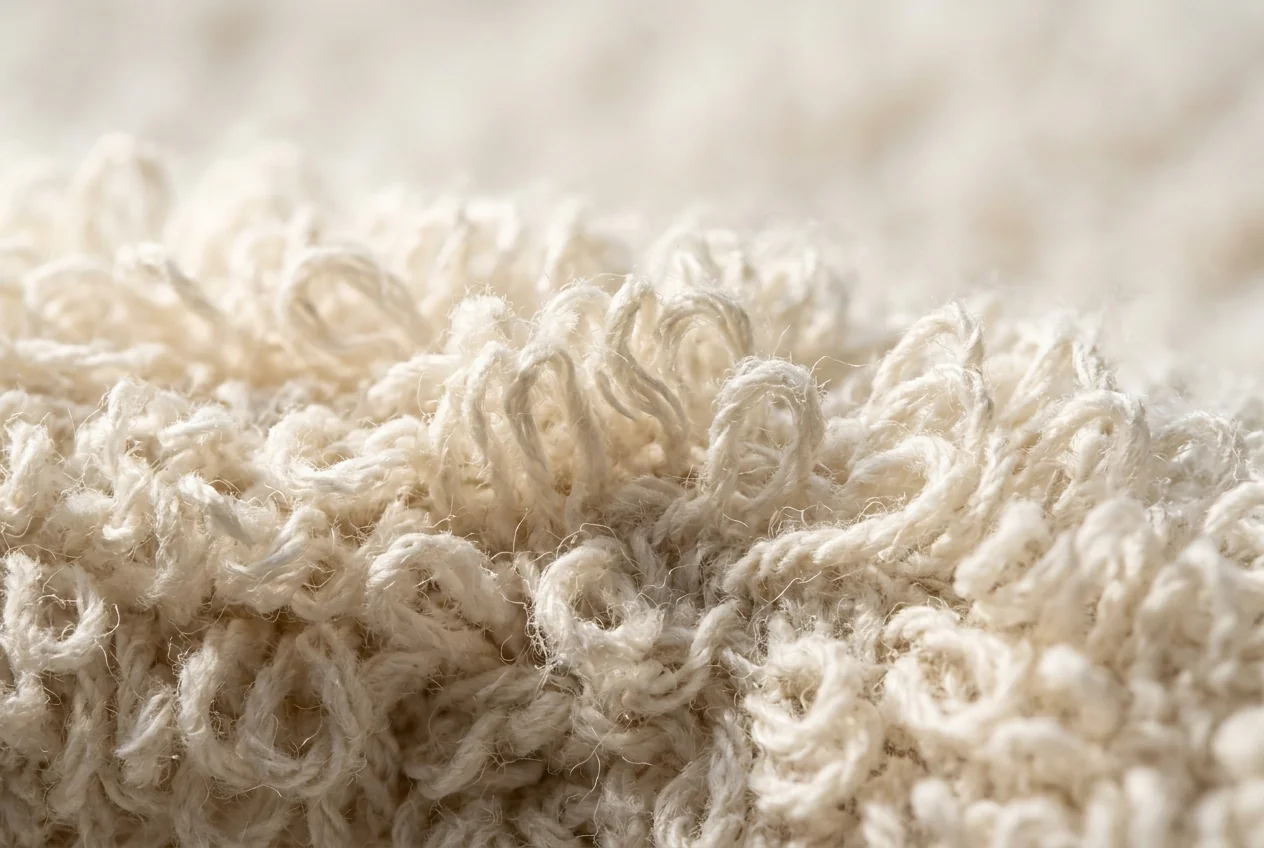
However, when you wash that towel with liquid fabric softener or dry it with synthetic dryer sheets, you are laminating every square millimeter of terrycloth loop in a persistent hydrophobic barrier. Hydrocarbons and silicone polymers are naturally water-repellent. Instead of water molecules adhering to open hydroxyl sites on the cellulose, they encounter an impenetrable wall of synthetic grease.
The Water-Repellency Test
The Drop Test: Take a freshly washed bath towel and lay it completely flat on a table. Using an eyedropper or your fingertips, place three drops of room-temperature water directly onto the terrycloth surface. On a healthy, uncoated cotton towel, the water droplets will absorb instantaneously—flashing into the weave in under two seconds. On a towel saturated with fabric softener quats, the water droplets will sit perched on top of the loops as tight, spherical beads for 30 to 90 seconds without penetrating. That bead represents the exact moisture your towel is refusing to absorb off your skin.
With each successive laundry cycle involving softener, this hydrophobic layer accumulates like successive coats of clear varnish over raw wood. As the wax builds up, the towel’s overall absorbency plummets by up to 50% to 70%. Furthermore, the synthetic coating weighs down the delicate cotton loops, matting them flat and transforming what was once an airy, breathable cloud of terrycloth into a dense, compacted, gummy mat.
The Scrud Epidemic: What Is Rotting Inside Your Washing Machine?
While the degradation of your bath towels is disappointing, the damage occurring behind the stainless steel drum of your washing machine is catastrophic. Modern high-efficiency (HE) front-load and top-load washers use up to 70% less water than legacy agitator machines from the 1990s. While exceptional for water conservation, this low water volume fundamentally changes laundry thermodynamic physics: there is simply not enough water flow to completely flush viscous chemical emulsions out of the machine chassis.
The Anatomy of Scrud Formation
In the appliance repair trade, technicians have a specific name for the foul, blackish-brown, greasy buildup that blankets the outer tub, drum spiders, and drain hoses of modern washers: scrud. Scrud is not mere dirt from soiled clothing. It is an industrial byproduct formed by an aggressive chemical reaction between three distinct agents:
- Quaternary Softener Lipids: Fatty acids and tallow derivatives that do not dissolve completely in cold or warm rinse water.
- Unrinsed Anionic Detergent Surfactants: Concentrated liquid detergent residues trapped in the tub crevices due to modern low-volume rinse cycles.
- Hard Water Mineral Ions: Dissolved calcium (\(\text{Ca}^{2+}\)) and magnesium (\(\text{Mg}^{2+}\)) present in domestic tap water.
When positively charged softener quats collide with negatively charged detergent surfactants in the presence of hard water minerals, they precipitate out of liquid solution, coalescing into an insoluble, waxy curd. This curd adheres tenaciously to the non-visible exterior surface of the stainless steel wash basket, the plastic outer tub enclosure, the rubber door bellow gasket, and the drain pump impeller.
The Microbial Breeding Ground: Why Towels Smell Sour
Scrud is not chemically inert; it is an organic, lipid-rich nutrient buffet. Inside the warm, dark, damp enclosure of your washing machine, the scrud layer rapidly colonizes with opportunistic environmental bacteria and fungi, primarily Pseudomonas aeruginosa, Acinetobacter, and Malassezia yeast molds.
These microorganisms establish a complex, self-protecting biofilm within the waxy sludge. As they metabolize the animal fats and fatty alcohols contained within the softener residue, they emit volatile organic compounds (VOCs)—specifically butyric acid, dimethyl disulfide, and 3-methyl-2-buten-1-thiol. These chemical compounds produce the unmistakable, nauseating odor of stale gym clothes, rancid butter, and decaying swamp water.
When you wash a load of towels in an afflicted machine, the tumbling agitation dislodges microscopic biofilm flakes. The bacteria embed themselves directly into the warm, damp cotton fibers. Even if your towels smell pleasant when you take them out of the hot dryer (because the synthetic fragrances mask the microbial stink), the very moment warm shower water touches the towel in your bathroom, the dried bacteria rehydrate, releasing a burst of foul, sour mildew odor directly into your face.
Corrosion and Catastrophic Machine Failure
Beyond foul odors and ruined linens, liquid fabric softener is responsible for the premature mechanical death of thousands of high-efficiency washing machines every single year. The primary victim is a critical structural component known as the spider bracket (or drum support spider).
In almost all front-loading washing machines, the rotating stainless steel inner drum is supported and driven by a three-pronged spider arm cast from a lightweight aluminum alloy. Under normal conditions, aluminum forms a protective oxide layer that shields it from corrosion. However, the acidic, lipid-heavy chemistry of accumulated scrud destroys this protective barrier.
Trapped behind the outer tub, moist scrud packs tightly into the recessed pockets of the aluminum spider. Over two to four years, the combination of trapped moisture, alkaline detergent salts, and anaerobic bacteria causes severe galvanic and intergranular corrosion. The cast aluminum degrades into a brittle, chalky paste. Eventually, during a high-speed 1,200 RPM spin cycle, the corroded spider arm snaps in half. The inner drum violently impacts the plastic outer tub, destroying the drum bearings, tearing the rubber seals, and causing catastrophic flood damage—requiring a complete machine replacement costing upwards of \$1,200 to \$2,000.
The Natural Chemistry Restoration Protocol: Reviving Towels and Purging Scrud
If your towels are repelling water and smelling sour, or if your washing machine has begun to develop a mysterious gray sludge on its rubber gasket, do not despair. You do not need to throw away your linens or replace your appliance. You can systematically reverse the buildup using targeted chemical neutralization.
📥 Free Download: Laundry Chemistry & Machine Scrud Elimination Guide
Molecular breakdown of quaternary ammonium compounds, deep laundry stripping protocols, and washer drum spider decontamination.
✓ Includes: Tactical Checklist
✓ Access: Instant Free Download
Phase 1: Laundry Stripping to Dissolve Quat Wax from Towels
Laundry stripping is a deep-cleansing chemical submersion process that breaks down accumulated wax, body sebum, and mineral scale, restoring the hollow capillary tubes of cotton fibers. Perform this treatment in a clean bathtub, utility sink, or a top-load washer set to soak.
- The Stripping Bath Formula: Fill your bathtub with the hottest water your domestic water heater can supply. For a standard load of 6 to 8 bath towels, dissolve:
- ¼ Cup Washing Soda (Sodium Carbonate, \(\text{Na}_2\text{CO}_3\)): A powerful alkaline salt (pH ~11) that saponifies trapped fatty oils and swells cotton fibers to release deep impurities.
- ¼ Cup Borax (Sodium Tetraborate, \(\text{Na}_2\text{B}_4\text{O}_7\cdot10\text{H}_2\text{O}\)): A natural mineral detergent booster that chelates hard water calcium and magnesium ions, preventing redeposition.
- ½ Cup Heavy-Duty Enzyme Laundry Detergent: Contains protease, amylase, and lipase enzymes to digest organic matter.
- Submersion and Agitation: Submerge your clean, dry towels completely under the hot solution. Stir vigorously using a broom handle or wooden paddle. You will be stunned to see the clear water turn cloudy, gray, or tea-colored within thirty minutes as the waxy coatings and trapped soil release.
- The 4-Hour Soak: Allow the towels to soak for 4 to 5 hours, stirring vigorously every 45 minutes as the bath cools.
- Drain and Extraction Rinse: Drain the murky water and wring out the towels. Transfer them immediately into your washing machine and run a complete cycle on the hottest water setting with zero added detergent, followed by a double rinse. When dried, your towels will be lighter, significantly fluffier, and will absorb water like an open sponge.
Phase 2: Purging the Washing Machine Drum and Gasket
To eliminate the scrud colonies residing behind your washer’s tub, perform this aggressive mechanical and chemical decon routine:
- Manual Gasket Cleaning: Pull back the rubber door bellow on your front-loader. Using microfiber cloths soaked in a 50/50 solution of 3% hydrogen peroxide and hot water, physically scrub away all visible black slimy buildup from the interior drainage weep holes and crevices.
- The Citric Acid Thermal Flush: Commercial washer cleaners frequently rely on artificial fragrances. Instead, use pure food-grade citric acid powder (1 cup / 200g) placed directly into the empty drum. Run the longest cycle available on your machine (the “Tub Clean” or “Sanitize” cycle, reaching 140°F/60°C or higher). Citric acid is a tri-carboxylic acid that rapidly descales insoluble calcium-magnesium carbonates and dissolves the calcified binder holding the scrud biofilm together.
- The Secondary Bleach Sanitize: Immediately following the citric acid flush, pour 1 cup of standard household liquid chlorine bleach (sodium hypochlorite) into the detergent dispenser drawer and run a second hot cycle. The chlorine oxidizes and kills any remaining exposed anaerobic bacteria and fungal spores, leaving the tub sterile and odor-free. (Caution: Never mix citric acid and bleach in the same cycle, as this generates hazardous chlorine gas. Always run them sequentially as separate cycles.)
The Sustainable Alternative: Acetic Acid and Mechanical Softening
Once you have purged fabric softeners and dryer sheets from your home, what should you use to maintain soft, static-free textiles without causing damage? The scientific answer is simple, non-toxic, and remarkably inexpensive.
1. Distilled White Vinegar in the Fabric Softener Dispenser
Instead of thick chemical softeners, pour ¼ to ½ cup of standard 5% distilled white vinegar (acetic acid, \(\text{CH}_3\text{COOH}\)) directly into your washing machine’s fabric softener compartment. The machine will automatically dispense the vinegar during the final rinse cycle.
Vinegar works via gentle acid-base neutralization. Laundry detergents are alkaline (pH 8.5 to 10.5). If any microscopic soap residues cling to the cotton fibers at the end of the wash cycle, they cause stiffness as the fabric dries. Acetic acid lowers the rinse water pH to approximately 5.5, perfectly neutralizing alkaline residues and stripping away mineral scale. Unlike quats, acetic acid leaves absolutely zero greasy residue behind, evaporates completely in the dryer (leaving no sour or vinegar smell), and naturally inhibits mildew growth in the machine dispenser drawer.
2. 100% Pure New Zealand Wool Dryer Balls
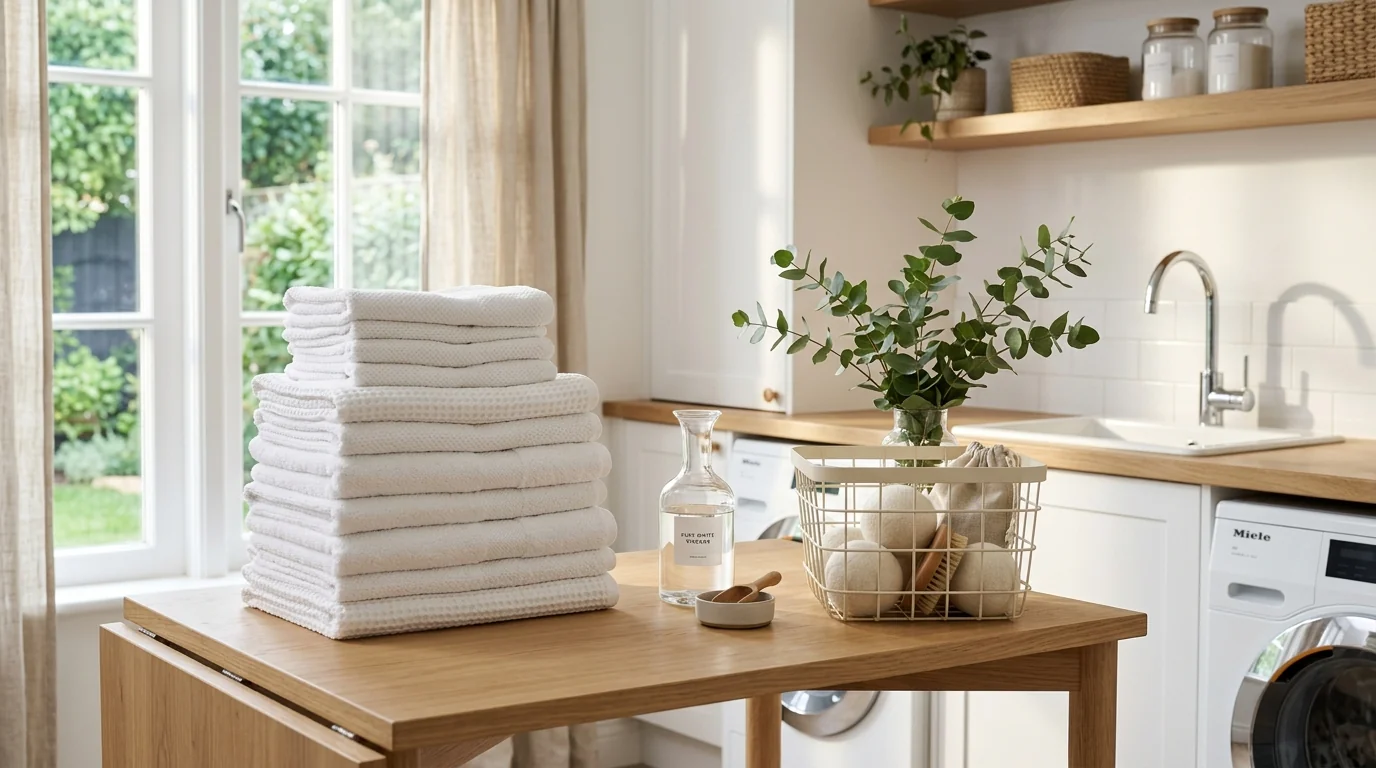
To eliminate static and naturally soften linens in the dryer, discard disposable synthetic dryer sheets—which are simply polyester sheets impregnated with the exact same quaternary animal-fat compounds found in liquid softeners. Instead, place three to four pure wool dryer balls in the dryer drum with every load.
Wool dryer balls provide three distinct physical benefits:
- Mechanical Agitation: As the drum rotates, the dense wool balls physically bounce between the tumbling towels, continuously beating and separating the damp cotton loops. This physical lifting action naturally fluffs the terrycloth without a single drop of chemicals.
- Air Circulation and 25% Faster Drying: By preventing wet towels from bundling into a tight, tangled knot, the balls create continuous airflow channels, cutting domestic dryer cycle times by up to 20% to 30% and dramatically reducing household energy bills.
- Static Reduction via Moisture Balance: Wool naturally absorbs and slowly releases residual moisture during the dry cycle, maintaining optimal ambient humidity inside the drum so static charges cannot accumulate.
The Clean Laundry Paradigm Shift
The multibillion-dollar laundry chemical industry has spent decades conditioning consumers to equate clean textiles with heavy, perfume-laden, slick textures. True cleanliness, however, has no synthetic scent and leaves behind no waxy film. A clean towel is simply pure, open cellulose fiber—thirstily drinking in water, drying your skin instantly, and breathing fresh air freely without harboring fungal colonies.
By retiring liquid fabric softeners and chemical dryer sheets, you not only preserve the lifespan and absorbency of your finest linens, but you also protect your high-efficiency appliances from catastrophic mechanical failure. Treat your textiles with the respect that natural fiber chemistry demands: wash with intelligent enzyme detergents, rinse with clean acetic acid, fluff with mechanical wool, and enjoy towels that perform flawlessly for a lifetime.