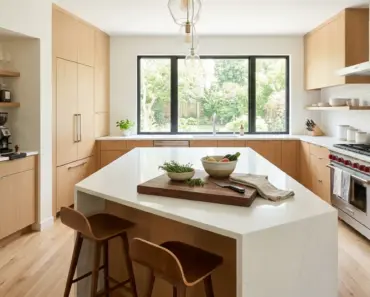

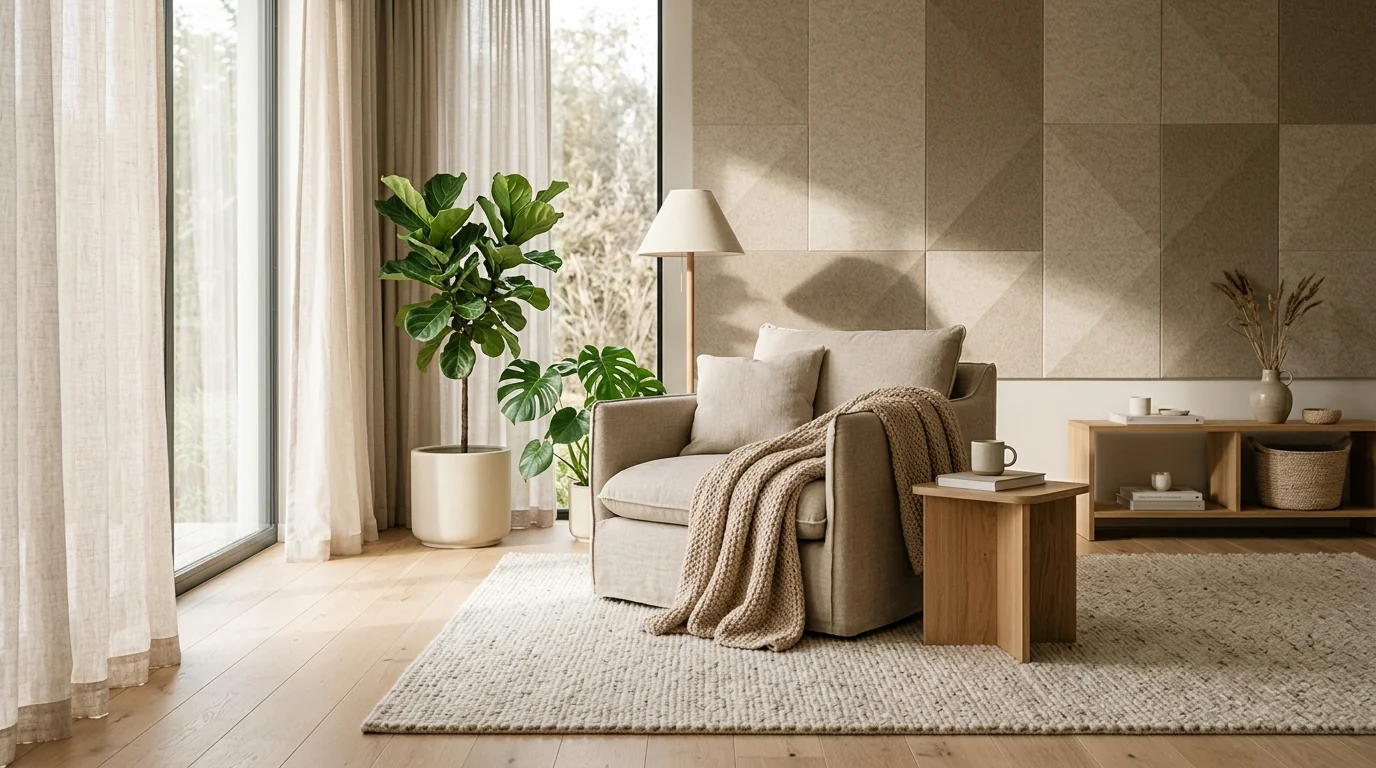
You step into a stunning, newly renovated open-concept home: polished white oak floorboards, soaring ten-foot ceilings, floor-to-ceiling glass sliding doors, and crisp, pristine drywall painted in soft alabaster. Visually, the space is an architectural triumph of light and minimalism. Yet after spending only twenty minutes in the room—chatting with friends, watching television, or trying to read a book while family members prepare dinner—you notice a subtle, creeping irritability. Your shoulders tighten, your ears feel fatigued, and you find yourself unconsciously raising your voice just to be heard across the coffee table.
Most homeowners assume this ambient tension is psychological—the residue of a hectic workday or modern multitasking exhaustion. In the rigorous fields of architectural acoustics and psychoacoustics, however, the culprit is strictly physical: you are inhabiting an acoustic flutter-echo chamber with excessive reverberation time (RT60).
By stripping modern living spaces of traditional acoustic absorbers—heavy drapery, thick fibrous wool carpets, overstuffed upholstery, and wall tapestries—contemporary minimalist design has created an invisible sensory crisis. When hard reflective surfaces bounce sound waves indefinitely through your living volume, your brain’s auditory processing centers are forced into continuous high-alert vigilance, triggering tonic cortisol release and chronic sensory overwhelm.
The Physics of RT60: Why Sound Bounces Indefinitely in Modern Homes
In acoustic engineering, the primary metric used to quantify the acoustic character of an enclosed space is Reverberation Time 60 (RT60)—the time, measured in seconds, required for sound pressure level to decay by 60 decibels after the sound source has stopped.
In a properly engineered residential sanctuary, the optimal RT60 for human biological comfort and speech intelligibility sits strictly between 0.40 and 0.60 seconds. Within this temporal window, a spoken word retains its crisp phonetic definition, and its acoustic reflection decays quickly enough that the brain does not have to distinguish the original sound from its delayed reflections.
In a modern minimalist living room featuring bare hardwood, drywall, and uncurtained glass, the RT60 frequently climbs to 1.2 to 1.8+ seconds. That means every syllable, dropped fork, pet paw step, and television sound effect bounces off parallel surfaces twenty to thirty times before decaying. The room behaves like a cavernous tiled gymnasium.
“In a room with an RT60 above 1.2 seconds, sound waves do not dissipate; they collide. Your living room creates an acoustic fog where consonant sounds smear together, forcing your central nervous system to work overtime simply to decode human speech.”
The Psychoacoustic Toll: Auditory Fatigue and the Amygdala Alarm
Why does an echoey living room make you feel physically exhausted? The human auditory system evolved over millions of years in natural, open-air biophilic environments where ground soil, tree foliage, and uneven topography absorbed sound reflections naturally.
In the brain, the auditory cortex is directly hardwired to the amygdala—the limbic center of survival threat detection. High reverberation and sharp specular echoes trigger two involuntary physiological stress responses:
1. Saccadic Auditory Masking (Cognitive Processing Overload)
Human speech relies on high-frequency, low-energy consonant transients (such as ‘t’, ‘k’, ‘s’, ‘p’) to convey meaning, while vowels carry low-frequency, high-energy acoustic power. In a reverberant room, the powerful vowel sounds bounce off drywall and ceiling plaster, physically masking the delicate consonants that follow.
To understand a conversation, your prefrontal cortex must continuously perform complex acoustic reconstruction—deducing missing phonetic syllables like an error-correcting algorithm. This subconscious cognitive labor induces profound mental fatigue, irritability, and shortened parental patience after just one hour of exposure.
2. The Lombard Effect (The Household Volume Arms Race)
When background reverberation elevates ambient noise floor, humans unconsciously raise their vocal pitch and volume to ensure their voice penetrates the acoustic mud. This is known in vocal physiology as the Lombard Effect.
One person speaks slightly louder; another person elevates their volume to compensate; the television volume is bumped up two notches; the children begin shouting. Within forty minutes, an otherwise peaceful family home transforms into an acoustic battleground where everyone is shouting without consciously understanding why.
The Noise Reduction Coefficient (NRC): How Textiles Dissipate Acoustic Energy
To cure an echo chamber, you do not need ugly, institutional foam pyramids glued to your walls. You must understand the metric that governs high-end architectural acoustic design: the Noise Reduction Coefficient (NRC).
NRC is a scalar rating ranging from 0.00 to 1.00 that measures how much sound an architectural material absorbs versus reflects:
- NRC 0.00: Complete acoustic reflection (a perfect acoustic mirror, such as smooth concrete or glass).
- NRC 1.00: Complete acoustic absorption (100% of sound energy is absorbed, with zero reflection).
The Viscous Dissipation Mechanism
How does a soft material “destroy” sound? Sound in air is kinetic mechanical energy—oscillating air molecules. When sound waves strike a porous, fibrous material (such as dense wool fibers or acoustic PET felt), the air molecules are forced into microscopic, tortuous labyrinth pores inside the textile.
Friction between the vibrating air molecules and the microscopic fibrous walls converts the acoustic kinetic energy into minuscule quantities of thermal energy (heat). The sound wave literally dies of friction inside the fibers.
Material Comparison: Hard Surfaces vs. Architectural Absorbers
Examine the startling disparity between modern interior finishes and strategic acoustic textiles:
- Bare Glass Sliding Doors: NRC 0.03 (Reflects 97% of sound energy).
- Standard Drywall / Plaster: NRC 0.04 (Reflects 96% of sound energy).
- Polished Hardwood / Engineered Oak: NRC 0.05 (Reflects 95% of sound energy).
- Low-Pile Synthetic Carpet: NRC 0.20 to 0.25 (Reflects 75% of sound energy).
- Dense Hand-Knotted Wool Rug with 8mm Felt Pad: NRC 0.50 to 0.65 (Absorbs up to 65% of acoustic energy).
- Floor-to-Ceiling Heavy Linen / Velvet Drapes (2x Fullness): NRC 0.60 to 0.75.
- Slatted Natural Oak on Black Recycled PET Felt: NRC 0.85 to 0.95.
📥 Free Download: Residential Acoustic Reverberation & NRC Absorption Guide
Architectural psychoacoustics: RT60 decay calculations, Noise Reduction Coefficient ratings, 65% rug rules, and acoustic slatted wall specifications.
The Aesthetic Acoustic Tuning Blueprint: Designing Quiet Luxury
You can transform your living room from an echoey cave into a serene acoustic sanctuary without sacrificing high-end architectural aesthetics. Follow this 5-step spatial tuning blueprint:
1. The 65% Seating Footprint Rug Rule
Never float a small, postage-stamp-sized rug under your coffee table. An acoustic area rug must cover at least 65% of the primary conversational floor footprint, extending under the front legs of the sofa, armchairs, and side tables.
Prioritize natural hand-knotted wool with thick pile over flat-woven synthetics. Underneath, install an 8mm dense recycled felt rug pad (such as a 40-ounce commercial needle-punched pad). The felt pad doubles the low-frequency absorption of the rug, arresting footfall thump and mid-range flutter echoes.
2. The Double-Pass Wave Curtain
If you have large sliding glass doors or floor-to-ceiling windows, bare glass is your worst acoustic enemy. Hang tailored, pinch-pleated drapery constructed from heavyweight Belgian linen or cotton velvet with an integrated blackout thermal lining.
Crucially, specify 2x to 2.5x fabric fullness. When drapery hangs with deep, undulating waves, sound waves entering the folds are trapped in multiple reflections between fabric pleats, dramatically increasing the effective sound absorption area.
3. Architectural Slatted Wood on Acoustic Felt
One of the most elegant additions to modern interior design is vertical slatted wood cladding. Choose panels constructed with natural white oak or walnut veneer slats mounted over an 8mm to 12mm backing of black recycled acoustic PET polyester felt.
Install these panels as an accent wall behind the media console or on the wall directly opposite large windows. The wooden slats diffuse high-frequency sound, while the deep acoustic felt behind them absorbs harsh speech reflections, eliminating slap echoes with an NRC of 0.85+.
4. The Bookshelf Diffusion Grid
Absorption is only half the battle; the other half is acoustic diffusion. When sound waves hit a flat, blank wall, they reflect back in a concentrated, specular beam. When sound hits an irregular, varied surface, the acoustic energy is scattered evenly in all directions, creating a smooth, spacious acoustic ambiance.
Incorporate floor-to-ceiling open shelving. Populate the shelves with books of irregular heights, textured stoneware ceramics, wooden sculptures, and woven baskets pushed to varying depths. This creates a natural architectural quadratic residue diffuser that softens room sound effortlessly.
5. Deep Textured Upholstery
Avoid cold, slick leather sofas in minimalist spaces; smooth leather has an NRC of less than 0.10, acting almost like hard plaster. Choose rich, tactile upholstery materials with open textural weaves: heavy bouclé, chunky linen blends, washed chenille, or wool twill. A deep, down-wrapped sofa upholstered in textured fabric acts as a high-capacity acoustic bass trap in the center of the room.
Restore Auditory Peace to Your Living Sanctuary
True luxury in home design is not merely what appeals to the eye; it is what brings serenity to all the human senses. A room that looks exquisite in a photograph but echoes like an underground station will never feel like a restorative home.
By introducing dense natural wools, undulating architectural drapery, and acoustic wood slatted textures, you silence the exhausting sensory storm. You create an intimate, cocoon-like atmosphere where laughter is warm, conversations flow with effortless clarity, and your nervous system can finally exhale in deep, tranquil peace.