It is 7:15 on a Tuesday morning. You open your bedroom closet doors to an overwhelming wall of fabric: eighty hangers jammed tight against each other, stacks of folded sweaters threatening to topple, three pairs of jeans you bought four years ago that no longer fit comfortably, and a dozen impulse purchases with price tags still attached.
You stand there in your bath towel for twelve frustrating minutes, shuffling hangers back and forth, mentally discarding one outfit after another, until you finally sigh and say the universal phrase muttered in millions of bedrooms every morning: “I have absolutely nothing to wear.”
You end up grabbing the exact same neutral sweater and dark trousers you wore last Thursday. But you walk out of your bedroom already feeling rushed, irritated, and mentally depleted before you have even poured your first cup of coffee or packed your child’s lunch box.
This daily morning ritual is rarely a fashion crisis. It is a psychological breakdown driven by behavioral choice architecture, cognitive load, and decision fatigue. Understanding the cognitive science behind wardrobe overload reveals why having more clothes actually makes getting dressed harder—and how a streamlined capsule system can save you nearly ninety hours of wasted time every single year.
The Hidden Math of Wardrobe Time Loss
Behavioral research surveying adult morning routines reveals that the average person spends between 10 and 15 minutes each morning deciding what to wear, trying on different combinations, and changing clothes before leaving the house.
Ten to fifteen minutes may sound harmless in isolation. But run the cumulative math across a year:
15 minutes per day × 365 days = 5,475 minutes per year = 91.25 hours lost annually
You are spending more than two full, waking workweeks every single year trapped in a state of low-grade anxiety in front of a closet rod. Worse yet, this time is stolen from the most cognitively vulnerable window of your day: the precious first hour after awakening, when your mind should be transitioning calmly into productive focus.
The Cognitive Science: Why More Clothes Equal More Stress
To understand why a stuffed closet causes morning paralysis, you have to look at how the human brain processes decisions:
1. Roy Baumeister’s Theory of Ego Depletion
Psychologist Roy Baumeister and his colleagues pioneered the understanding that willpower and active decision-making draw from a single, finite cognitive energy reserve—much like a fuel tank or a muscle. The average modern adult makes an estimated 35,000 conscious decisions every single day.
Crucially, your brain does not distinguish between a trivial choice and a life-altering one. Evaluating whether a silk blouse matches olive chinos burns from the exact same prefrontal cognitive fuel tank as negotiating a contract, solving a financial dilemma, or calmly defusing a toddler’s tantrum. When you force your brain to make twenty micro-decisions about buttons, colors, weather forecasts, and shoe comfort before 8:00 AM, you arrive at your desk with your mental tank already half empty.
2. Barry Schwartz and the Paradox of Choice
In his landmark book The Paradox of Choice, psychologist Barry Schwartz debunked the pervasive cultural myth that having more options makes human beings happier or more liberated. Schwartz demonstrated that when the number of choices exceeds a modest threshold, two destructive psychological effects emerge:
- Choice Overload & Paralysis: Having fifty shirts makes selecting one dramatically harder than choosing between four well-fitting shirts. The combinatorial possibilities trigger mental gridlock.
- Anticipated Regret: When you have dozens of alternatives, you are hyper-aware of what you did not choose. Even after picking an outfit, you second-guess your decision all morning: “Maybe I should have worn the navy blazer instead. Does this look too casual?”
3. Visual Clutter as Chronic Neurological Noise
Neuroscientists at Princeton University examining the neural mechanisms of task performance found that physical clutter in your visual environment competes for your brain’s attentional capacity. A jammed closet filled with mismatched plastic hangers, wrinkled garments, and disorganized piles is not passive scenery; it acts as a barrage of unfinished tasks and visual noise. Looking at a chaotic closet causes immediate micro-spikes in cortisol (the primary stress hormone), putting your nervous system into low-level fight-or-flight before your day even begins.
The Uniform Strategy of High Achievers
It is no coincidence that some of history’s most productive and creative minds—from Steve Jobs in his black mock turtlenecks to Barack Obama wearing exclusively navy or gray suits—deliberately adopted a personal daily uniform. When asked why he limited his wardrobe choices, President Obama explained: “You need to focus your decision-making energy. You can’t be going through the day distracted by trivia.”
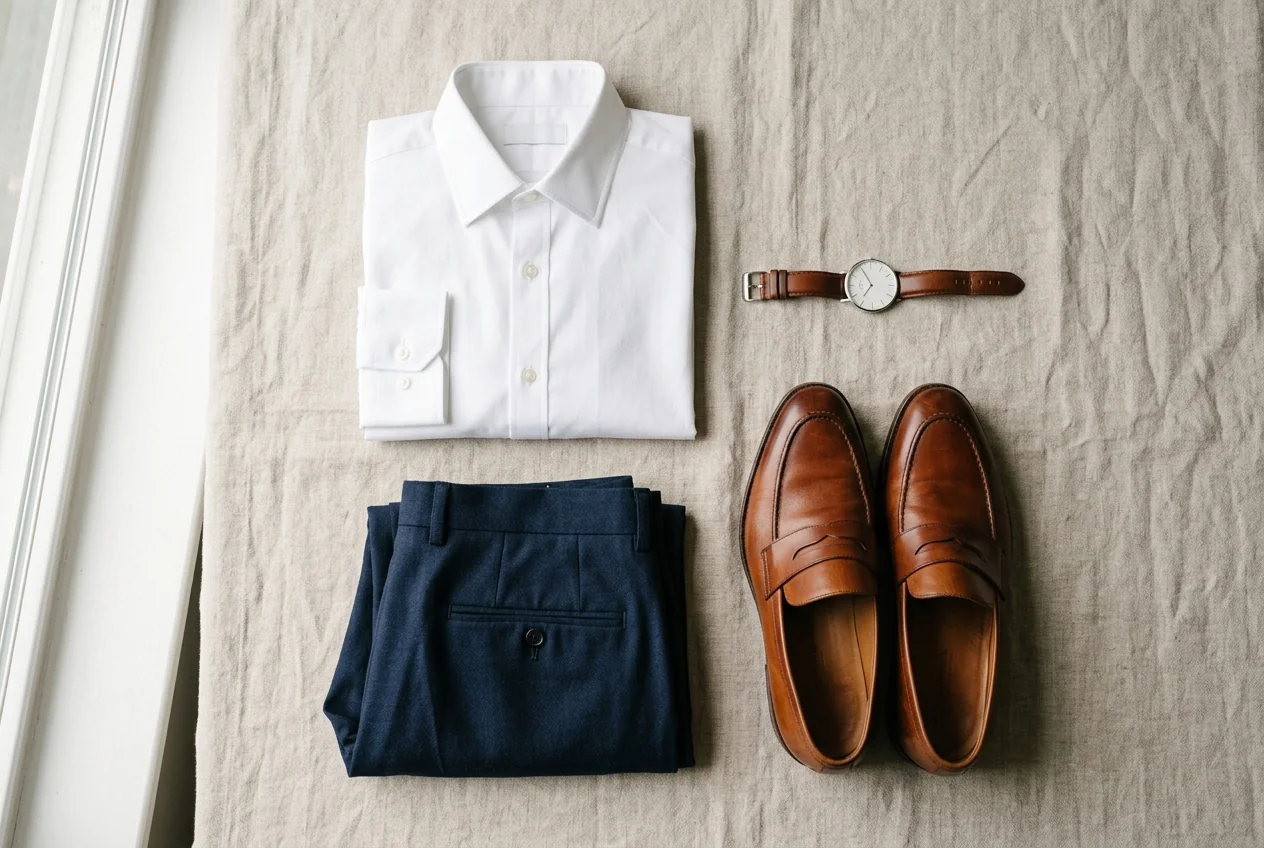
Adopting a uniform strategy does not mean dressing in identical robotic outfits like a cartoon character. It means creating a reliable, flattering formula of interchangeable pieces where every item fits comfortably, coordinates seamlessly, and flatters your natural lifestyle.
The 3-Phase Anti-Decision Fatigue Closet Audit
Reclaiming your morning peace and eliminating wardrobe friction requires a physical and cognitive reset. You can execute this practical three-phase audit over a single weekend afternoon:
Phase 1: The Friction Purge (Ruthless Editing)
Take every item out of your closet and categorize each piece into one of three distinct piles:
- The Active Daily Rotation (Keep): Clothes that fit your body right now today, feel physically comfortable against your skin, and match your real weekly routine (not an idealized fantasy life).
- The Archive Box (Relocate): Specialty formalwear, sentimental vintage pieces, and out-of-season clothing (like heavy winter coats in the middle of summer). Pack these into labeled under-bed storage bins or high shelf containers. Your daily closet must only display weather-appropriate, active options.
- The Guilt Purge (Donate/Sell): The expensive dress that pinches your waist, the impulse jacket that never felt like you, and clothes that “might fit if I lose ten pounds.” Keeping aspirational or guilt-inducing clothes in your daily sightline serves only as a subconscious reproach every morning. Let them go.
Phase 2: Standardizing the Physical Architecture
Physical friction causes mental friction. If you have to yank a hanger with two hands to wedge it out of a jammed rack, your nervous system registers resistance:
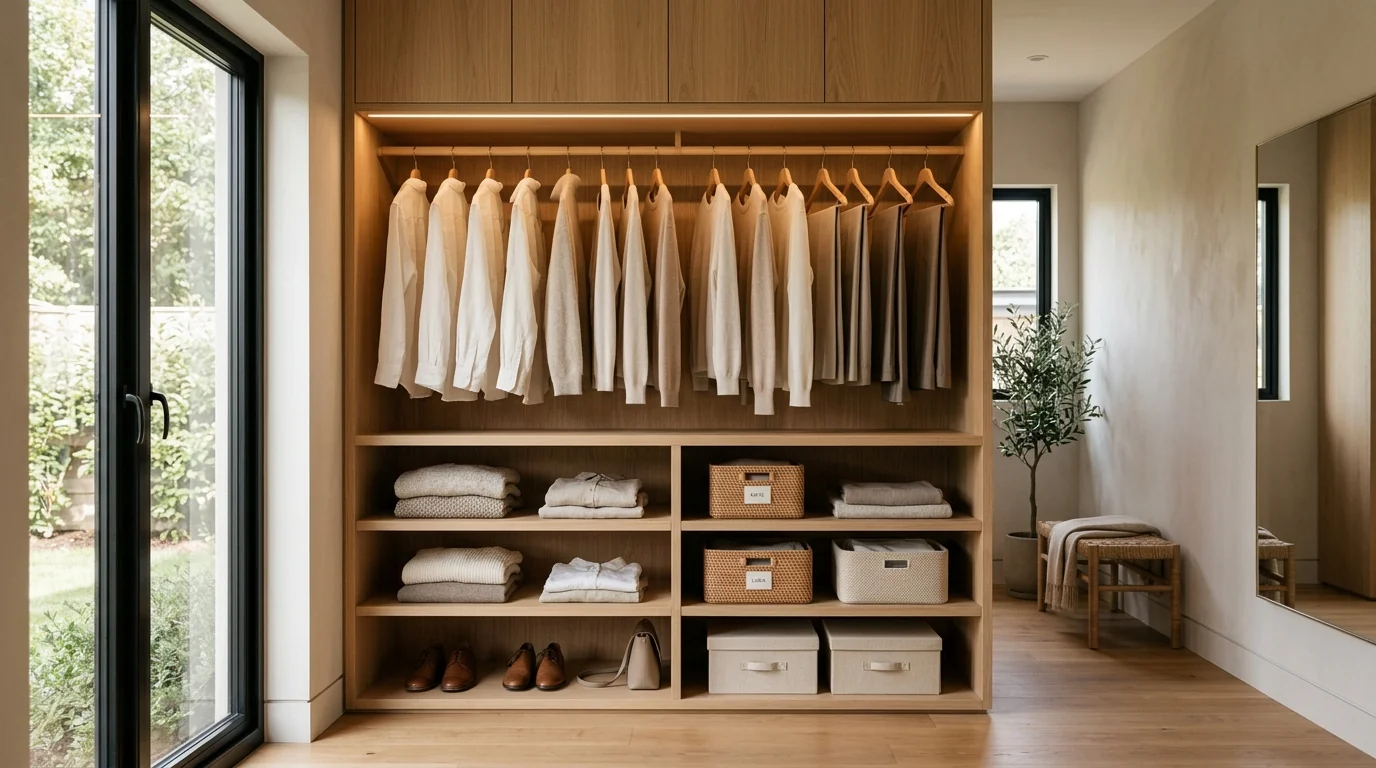
- One Type of Hanger: Discard the assortment of wire dry-cleaner hangers, mismatched plastic hooks, and bulky wooden bars. Replace them with slimline non-slip velvet or streamlined light oak hangers. Standardizing hanger height levels the visual sightline instantly, creating a calm boutique aesthetic.
- The Two-Finger Spacing Rule: Never pack clothes so tightly that fabric rubs against fabric. Leave enough clearance between hangers that you can comfortably slide two fingers between each garment. Clothes should glide effortlessly along the rod.
- Group by Category, Not by Color: Avoid arranging clothes into an elaborate rainbow gradient. Organize strictly by functional category: short-sleeve tops, long-sleeve shirts, trousers, skirts, jackets. When you know exactly which section holds your work trousers, finding them takes two seconds.
Phase 3: Building Your Personal 30-Piece Capsule
A capsule wardrobe is simply a curated collection of 30 to 40 versatile, high-quality pieces that mix and match effortlessly. Anchor your capsule around one reliable neutral base (such as navy, charcoal, black, or olive) paired with warm accents (like ivory, oatmeal, terracotta, or camel).
When every top pairs naturally with at least three different bottoms, the combinatorial anxiety drops to zero. Getting dressed becomes a simple plug-and-play routine rather than a complex design puzzle.
📥 Free Download: Anti-Decision Fatigue Closet Audit Checklist
The 3-phase behavioral wardrobe purge, two-finger physical spacing rules, and 2-minute evening pre-decision protocol.
The 2-Minute Evening “Pre-Decision” Ritual
If you want to experience the single most transformative shift in your morning routine, institute the **Two-Minute Night-Before Rule**:
- Check the Forecast and Calendar at 9:30 PM: Before getting ready for bed, take thirty seconds to review tomorrow’s weather and look at your scheduled commitments (meetings, errands, school pickups).
- Select Your Outfit in Advance: Pull out your complete outfit—including top, bottom, layer, underwear, socks, and accessories.
- Hang on a Dedicated Valet Hook: Hang the entire coordinated ensemble on an over-the-door hook or drape it across a bedroom chair.
- Wake Up and Dress on Autopilot: When your morning alarm rings, you do not even open your closet doors. You put on your pre-selected clothes in under ninety seconds without expending a single unit of precious prefrontal willpower.
Your closet should not be a source of stress, guilt, or morning exhaustion. By applying behavioral science to your wardrobe, editing away the clutter, and automating daily choices, you buy back 90 hours of your life every year—giving yourself the gift of a calm, intentional start to every single day.