

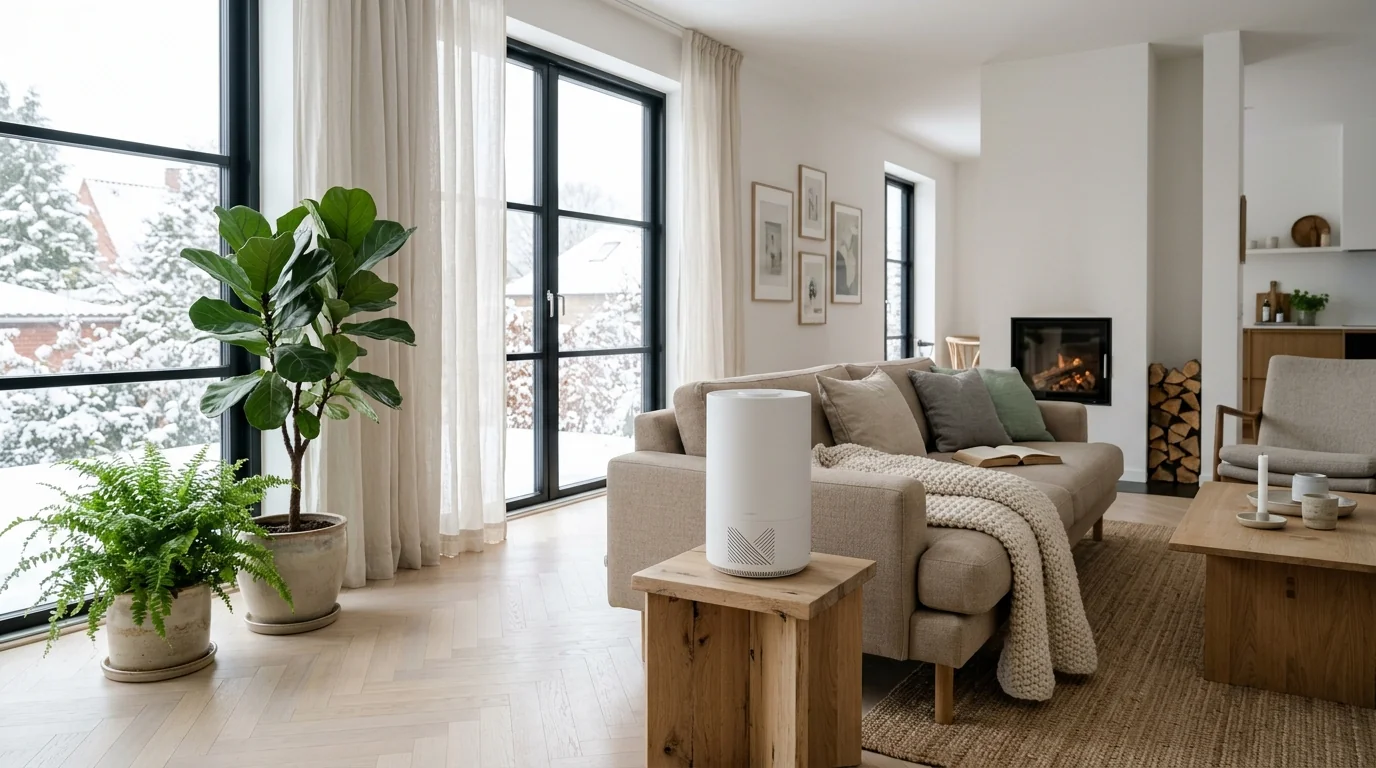
If you run a humidifier during the dry winter months, you have likely noticed a peculiar phenomenon: a ghostly, chalky film coating your dark wooden consoles, your television screen, and your bedside tables. Most people instinctively blame drywall residue, dry skin sloughing, or ambient household lint. In reality, that fine white talc is something far more concerning—it is a concentrated deposit of aerosolized calcium carbonate, magnesium salts, and heavy metal oxides expelled directly into your breathing zone by your ultrasonic humidifier.
When you bring a misting device into your home to relieve parched sinuses, cracked lips, and winter coughs, you reasonably assume you are introducing pure water vapor into your indoor atmosphere. However, unless you understand the distinct physics separating mechanical ultrasonic cavitation from natural evaporative phase-change, your well-intentioned wellness routine may be transforming your bedroom into a micro-particulate chamber with particulate matter (PM2.5) concentrations exceeding those of the world’s most smog-choked metropolitan intersections.
The Ultrasonic Piezoelectric Mechanism: Mechanical Shearing vs. Vaporization
To grasp why your bedside mister leaves a mineral residue across your entire living space, you must first examine what is actually happening at the base of the water reservoir. Traditional perception equates humidification with steam or evaporation—processes that convert liquid water (\(\text{H}_2\text{O}\)) into a gas phase through thermodynamic energy exchange.
Ultrasonic humidifiers do not heat or evaporate water. Instead, they house a submerged piezoelectric transducer—a ceramic diaphragm that oscillates at ultrasonic frequencies, typically between 1.6 and 1.7 megahertz (1.6 to 1.7 million cycles per second). These hyper-speed vibrations send intense acoustic shockwaves surging through the liquid column above it.
When these high-frequency pressure waves encounter the surface tension of the water, they induce localized cavitation: minuscule vacuum bubbles form, expand violently, and collapse in nanoseconds. This catastrophic micro-implosion creates tiny capillary waves that literally shatter the surface liquid into a fine fountain of microscopic liquid droplets. A miniature fan then catches this aerosolized liquid spray and blows it out of the nozzle as a cool, billowing plume of apparent “steam.”
“An ultrasonic humidifier does not evaporate water; it acts as an ultrasonic atomizer. Every chemical, mineral, dissolved salt, and microorganism present in your water reservoir is mechanically sheared into airborne liquid droplets and launched directly into your living room.”
Because the water is dispersed as liquid droplets rather than gaseous vapor, phase change does not occur inside the unit. Instead, it occurs in the ambient air of your bedroom. As the microscopic droplets float across the room, the surrounding dry air rapidly evaporates the water envelope away—leaving behind completely desorbed, solid mineral crystals suspended mid-air as respirable airborne dust.
The PM2.5 Respiratory Burden: Aerosolized Tap Water in Your Deep Alveoli
When you fill an ultrasonic humidifier with municipal tap water, you are not merely handling hydrogen and oxygen. Tap water is a complex solution containing dissolved mineral salts—primarily calcium bicarbonate, magnesium sulfate, sodium chloride, trace copper, silica, and residual chloramine disinfectants. In municipal water supplies, this is quantified as Total Dissolved Solids (TDS), typically ranging from 150 to over 400 parts per million (ppm).
When that water evaporates off a pot or through a towel, those dissolved solids remain behind as limescale crust. But when an ultrasonic diaphragm shears the water, every micro-droplet carries its exact proportional load of dissolved solids. As the water evaporates mid-air in seconds, what remains is an ultrafine solid particle measuring between 0.1 and 2.5 micrometers in aerodynamic diameter.
Why Laser Particle Counters Spike to Hazardous Levels
If you place an optical or laser particle counter (such as a calibrated Plantower or Dylos sensor) in a closed 150-square-foot bedroom and turn on an ultrasonic humidifier filled with standard 250 ppm tap water, the telemetry is startling:
- Baseline Clean Room (HEPA running): PM2.5 concentration sits comfortably between 1 and 4 \(\mu\text{g}/\text{m}^3\).
- 15 Minutes of Ultrasonic Operation: The PM2.5 reading climbs exponentially, crossing 50 \(\mu\text{g}/\text{m}^3\) (Unhealthy for Sensitive Groups).
- 45 to 60 Minutes of Ultrasonic Operation: The PM2.5 sensor routinely registers between 250 and 800+ \(\mu\text{g}/\text{m}^3\)—levels that surpass EPA “Hazardous” thresholds and equal severe industrial particulate events.
Smart home air purifiers equipped with laser scattering sensors will frequently spin up their fans to maximum speed and illuminate red warning lights within ten minutes of starting an ultrasonic humidifier. The air purifier is not malfunctioning; it is correctly detecting millions of airborne mineral shards filling the airspace.
Pulmonary Deposition: Beyond the Nasal Filter
Your upper respiratory system—the nasal hairs, mucus linings, and cilia of your trachea—is engineered to capture coarse particles larger than 10 micrometers (PM10), such as pollen and coarse pet dander. However, particles smaller than 2.5 micrometers (PM2.5) slip effortlessly past these biological filters.
These mineral dust crystals penetrate deep into the terminal bronchioles and alveoli, where gas exchange occurs. While calcium and magnesium are dietary nutrients, inhaling crystalline mineral particulates into delicate pulmonary tissue triggers localized alveolar inflammation, macrophage recruitment, and oxidative stress. For adults with asthma, infants with developing lung architecture, and elderly family members, this nightly bombardment of mineral particulate can provoke chronic coughing, nocturnal wheezing, morning sinus congestion, and severe bronchospasm.
The Endotoxin and Biofilm Hazard: The “Humidifier Fever” Vector
The danger of ultrasonic dispersion extends beyond inorganic mineral salts. Water left standing at room temperature in a plastic basin rapidly develops a slimy bacterial biofilm composed of Pseudomonas, non-tuberculous mycobacteria, amoebae, and fungal spores.
In traditional heating humidifiers, water is brought to a rapid boil, which denatures most microbial pathogens. In evaporative wick systems, bacteria remain physically trapped within the wet cellulose substrate because water molecules evaporate cleanly off the surface while bulky bacterial cells cannot take flight without mechanical force.
In ultrasonic units, however, the vibrating transducer generates zero heat. It acts as an indiscriminate microbial catapult. Gram-negative bacteria embedded in the basin’s biofilm are fractured by the 1.7 MHz shockwaves, releasing lipid A complexes known as lipopolysaccharides or endotoxins. These endotoxins are atomized alongside the mineral droplets. Inhaling aerosolized endotoxins is the verified primary cause of “Humidifier Fever”—an acute inflammatory condition characterized by chills, fever, chest tightness, headache, and myalgia that mimics the onset of the flu.
Why Phase-Change Evaporative Wicking Solves the Problem at the Molecular Level
To eliminate both the mineral dust plague and the microbial aerosol hazard while maintaining optimal indoor humidity, you must shift your equipment from mechanical atomization to thermodynamic phase-change. This is where the evaporative wick humidifier reigns supreme.
The operational architecture of an evaporative humidifier is fundamentally different and deceptively simple:
- The Capillary Wick: The device contains an expansive, porous honeycomb wick constructed from natural cellulose fibers, antimicrobial-treated synthetic matrices, or porous woven paper. Capillary action draws water upwards from the base reservoir, saturating millions of microscopic surface pores across the matrix.
- The Low-Velocity Airflow Stream: A quiet axial or centrifugal fan draws ambient room air through the damp matrix. As the dry air passes over the expansive wet surface area, natural thermodynamic evaporation occurs. Only pure water molecules (\(\text{H}_2\text{O}\)) possess the vapor pressure required to break free into the gaseous state at room temperature.
- The Molecular Filter Barrier: Calcium, magnesium, iron, copper, and chlorine salts have zero vapor pressure at 70°F. They cannot evaporate. Consequently, 100% of the dissolved minerals remain permanently trapped within the fibers of the cellulose wick. When the wick dries out or reaches saturation, the minerals form a stiff yellow or white crust inside the disposable filter—never in your air, never in your lungs, and never on your furniture.
“In an evaporative wick system, the physics of phase change acts as an unyielding physical filter. Heavy mineral ions and microscopic bacterial cells lack the thermal energy to evaporate; they remain permanently locked in the honeycomb filter.”
The Inherent Self-Regulating Advantage
Beyond air quality purity, evaporative humidification features a built-in thermodynamic governor that prevents over-saturation. Relative humidity is a measure of how much water vapor air holds relative to its maximum capacity at a given temperature.
An ultrasonic mister blindly sprays liquid into the room until the ambient surfaces are dripping with condensation, creating ideal micro-climates for toxic black mold (Stachybotrys chartarum) growth inside window trims and behind headboards. In contrast, an evaporative wick relies on the vapor pressure differential between the wet filter and the room air. As ambient relative humidity climbs toward 50% to 55%, the evaporation rate naturally slows to a crawl because the air’s moisture-holding capacity diminishes. It is physically impossible for a standard evaporative wick unit to hyper-saturate a room into a mold-breeding greenhouse.
Comparative Analysis: Ultrasonic vs. Evaporative vs. Warm Steam
To help you evaluate your home setup, consider how the three primary residential humidification technologies compare across key health, operational, and maintenance metrics:
- Ultrasonic (Cool Mist): Disperses liquid aerosol; creates heavy PM2.5 mineral dust unless using 100% distilled or reverse-osmosis water; high biofilm risk; silent operation; prone to local dampness; low energy consumption.
- Evaporative Wick (Natural Cool Mist): Disperses gaseous vapor (\(\text{H}_2\text{O}\)); produces zero PM2.5 dust even with hard tap water; zero aerosolized pathogens; self-regulating humidity; moderate fan white noise; requires wick replacement every 60–90 days; ultra-low energy consumption.
- Warm Steam Vaporizer: Boils water to produce sterile steam; zero PM2.5 dust (minerals stay in heating chamber); destroys bacteria via thermal kill; poses severe burn hazards for toddlers and pets; high electricity consumption (300–500W); susceptible to severe heating element limescale encrustation.
📥 Free Download: Evaporative Humidification & PM2.5 Air Quality Blueprint
Aerosolized particulate physics: ultrasonic cavitation vs. thermodynamic phase change, tap water TDS hazards, and bacteriostatic maintenance protocols.
The Healthy Humidity Protocol: How to Optimize Your Indoor Winter Air
Achieving healthy indoor air during winter heating season requires balancing hydration with pulmonary safety. Follow this step-by-step clinical protocol to safeguard your family’s respiratory health:
1. Retire or Relocate Ultrasonic Units from Sleeping Quarters
If you currently operate an ultrasonic humidifier in a bedroom or nursery with tap water, cease operation immediately. If you choose to keep an ultrasonic unit for aesthetic or localized plant hydration, you must fuel it exclusively with steam-distilled water or zero-TDS water produced by a multistage reverse-osmosis filtration system. Never rely on standard carbon pitcher filters (like Brita), which remove chlorine taste but leave dissolved calcium and magnesium completely intact.
2. Invest in a High-Capacity Evaporative Humidifier
Select an evaporative unit engineered with an easily accessible, thick paper or synthetic honeycomb wick. Look for models featuring quiet brushless DC motors, washable pre-filters to catch ambient pet hair before it strikes the wet wick, and simple top-fill tanks. Oversize your unit slightly: running a larger evaporative unit on low fan speed produces far less acoustic disturbance than running a small unit on high speed.
3. Manage Water Chemistry and Biofilm Without Toxic Biocides
To keep your evaporative reservoir pristine without introducing harsh chemical inhalants into your air, follow this maintenance regimen:
- The Antimicrobial Silver Ball: Drop an encapsulated silver-ion cartridge or bacteriostatic silver sphere into the water reservoir. Silver ions disrupt microbial cellular membranes continuously without releasing volatile organic compounds (VOCs).
- Weekly Acetic Acid Flush: Once a week, empty the reservoir and soak the basin in a 50/50 solution of warm water and distilled white vinegar (5% acetic acid) for 20 minutes to dissolve nascent limescale and neutralize surface bacteria. Rinse thoroughly with clear water.
- Never Add Bleach or Synthetic Fragrances: Avoid pouring chlorine bleach, essential oils, or synthetic chemical “humidifier cleansers” into the reservoir. These chemicals off-gas irritating chlorinated oxidants and secondary organic aerosols directly into your indoor breathing volume.
4. Target the 40% to 50% Relative Humidity Goldilocks Zone
Place an independent, calibrated digital hygrometer on a bedside table at least six feet away from the humidifier. Maintain your ambient winter indoor humidity between 40% and 50% at 68°F to 72°F. Humidity below 35% dehydrates the mucociliary escalator in your airways, leaving you vulnerable to viral pathogens like influenza and SARS-CoV-2. Humidity sustained above 55% promotes dust mite proliferation and hidden fungal colonies inside outer walls.
Breathe True Vapor, Not Suspended Dust
Indoor environmental wellness is rooted in precision. When you turn on an appliance in the intimate sanctuary of your home, you deserve the clinical benefits of balanced moisture without inadvertently subjecting your lungs to industrial-grade particulate plumes. By transitioning to thermodynamic evaporative wicking and honoring the basic chemistry of tap water, you restore your bedroom to what it was always intended to be: a restorative haven of crisp, pure, and truly nourishing air.