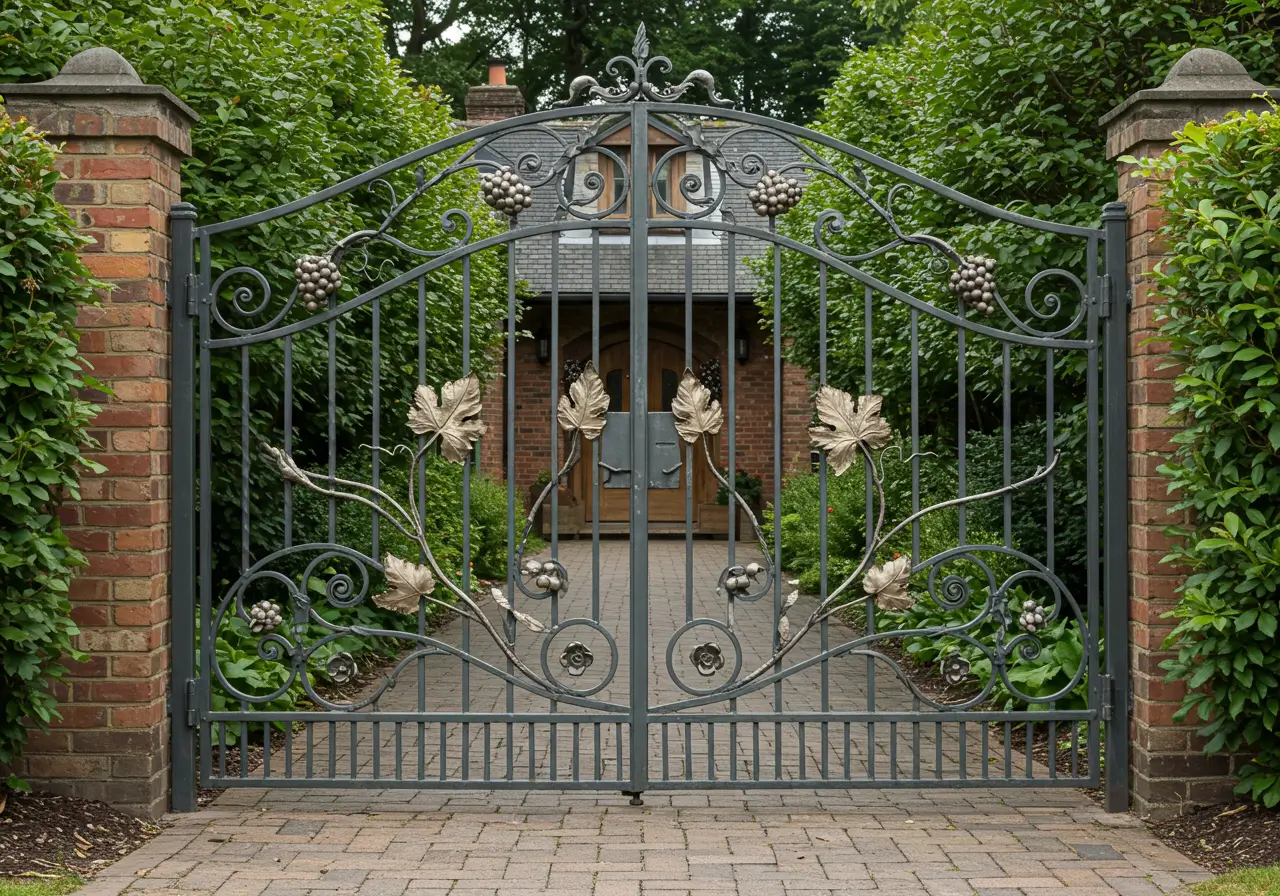
A durable iron gate should do three things well: fit the way your entrance is used, resist the local climate, and complement the property without becoming difficult to maintain. For most new residential projects, the strongest practical choice is a well-braced steel gate with heavy-duty hardware and a carefully specified corrosion-protection system. “Wrought iron” often describes the style rather than the material, so always confirm exactly what a fabricator is quoting.
This guide explains how to compare materials, classic wrought iron gate styles, finishes, construction, installation, automation, and maintenance before you order.
Why iron gates remain a strong choice

Ironwork has long appeared at American homes, gardens, estates, and civic buildings because it combines a visually open design with a substantial physical boundary. A well-proportioned gate can frame the approach to a house, coordinate with railings or fencing, and provide controlled vehicle or pedestrian access.
Its value depends less on ornament alone and more on the complete system: metal thickness, frame design, weld quality, posts, hinges or rollers, coating, drainage, and installation. A beautiful gate built with light material or mounted on inadequate posts may sag or corrode early. A simpler gate with sound engineering can remain attractive and functional much longer.
Steel, wrought iron, cast iron, or aluminum?
Fabricated steel: the practical modern standard

Most newly manufactured gates sold as wrought iron are made from mild steel. Steel is strong, widely available, and easy for skilled fabricators to cut, bend, and weld into traditional or contemporary designs. Hollow structural sections can reduce weight, while solid bars may be used where the design or security requirement calls for them.
Steel can rust when exposed to moisture and oxygen, so durability depends heavily on surface preparation, coating, sealed joints, and prompt repair of damage. Ask whether the quoted sections are hollow or solid, their dimensions and wall thickness, and how openings are capped or drained. The phrase “heavy duty” is not a useful specification by itself.

Amazon US Verified
Digital 3-in-1 Soil Moisture & pH Meter
Accurate probe to test deep root zone moisture and prevent accidental overwatering.
True wrought iron: rare and suited to specialist work

True wrought iron is a low-carbon material with slag inclusions created by historical production methods. It can be heated and forged into intricate shapes, but commercial production largely disappeared during the twentieth century. Genuine material is now commonly encountered in historic ironwork, salvaged stock, or specialist restoration projects.
If authenticity matters, request written confirmation of the material and examples of comparable restoration work. For most homeowners seeking the appearance of classic wrought iron gates, fabricated steel offers far greater availability and can reproduce scrolls, twists, collars, and finials effectively.
Cast iron: useful for ornament, brittle under impact

Cast iron is poured into molds, making it useful for repeatable decorative components such as rosettes, finials, and panels. It performs well under compression but is more brittle than mild steel and may crack under a sharp impact. On an active driveway gate, confirm that the structural frame and load-bearing parts are fabricated from a suitable structural material rather than relying on decorative castings.
Aluminum: light and naturally resistant to rust

Aluminum does not develop red rust and weighs much less than steel. That can reduce loads on posts, hinges, rollers, and operators, making it attractive near the coast or for wide openings. Its trade-off is lower stiffness and impact resistance for comparable sections. A properly engineered aluminum gate can work well, but it should not be selected solely because it resembles heavier ironwork.
Classic wrought iron gate styles that age well
Scrollwork and restrained flourishes

C- and S-shaped scrolls introduce movement into a rigid metal frame. Small amounts of scrollwork suit many traditional homes; dense ornament feels more appropriate on Victorian, Mediterranean, or formal estate architecture. Repeating one motif from a balcony, porch railing, or front door often creates a more coherent result than combining several unrelated decorations.
Symmetrical pickets and traditional finials

Evenly spaced vertical pickets give a gate a formal, orderly appearance. A straight, shallow-arched, or double-arched top changes the silhouette without adding visual clutter. Spear, ball, acorn, and fleur-de-lis finials can reinforce the architectural style, but sharp points should be placed with careful consideration for children, pets, and areas where people could fall against the gate.
Leaves, vines, and other nature-inspired details


Amazon US Verified
Self-Watering Planters with Drainage Aerators
Elevated reservoir design that prevents soggy roots and ensures steady hydration.
Forged leaves, flowers, vines, and geometric interpretations of plants can soften a metal entrance and connect it to the landscape. These motifs work especially well at garden, courtyard, and pedestrian gates. Keep enough open space around detailed elements for cleaning and refinishing; tightly layered decoration can trap debris and make coating repairs harder.
Custom designs tied to the house

A custom gate can repeat an arch, quatrefoil, masonry pattern, or railing detail already present on the home. Ask for a scaled drawing that shows the complete opening, posts, grade, hinge or roller locations, latch, operator, and clearances—not just the decorative face. Custom proportions matter as much as custom ornament.
Also Read: How to Grow a Thriving Vegetable Garden at Home
What makes an iron gate durable?
Corrosion protection suited to the site

Hot-dip galvanizing coats fabricated steel with zinc, providing both a physical barrier and sacrificial protection. It is especially worth discussing for coastal, humid, rainy, or deicing-salt environments. The design must be suitable for galvanizing, with appropriate venting and drainage in hollow sections, so the fabricator and galvanizer should coordinate before construction.

Powder coating creates a hard, even decorative layer, but its performance still depends on cleaning, pretreatment, correct application, and curing. Powder coating over properly prepared galvanized steel is known as a duplex system. The American Galvanizers Association explains that the two layers can extend corrosion protection and maintenance intervals when the galvanized surface is prepared correctly. See its guidance on duplex coating systems.

A liquid paint system can also perform well when the metal is thoroughly prepared and receives a compatible rust-inhibiting primer and exterior topcoat. Paint may be easier to repair on site than factory powder coating, although maintenance frequency varies with preparation, product, exposure, and physical damage. Request the coating specification rather than accepting “black paint” as a complete description.
Sound frame design and weld quality

Large leaves act as long levers on their hinges and posts. The frame must resist sagging, twisting, wind, and the repeated loads of opening and closing. Look for continuous, properly executed joints where the design requires them, clean transitions, suitable bracing, and no unsealed crevices that will collect water. Welding-process names alone do not guarantee quality; workmanship and a design appropriate to the load matter more.
Hardware rated for the actual gate
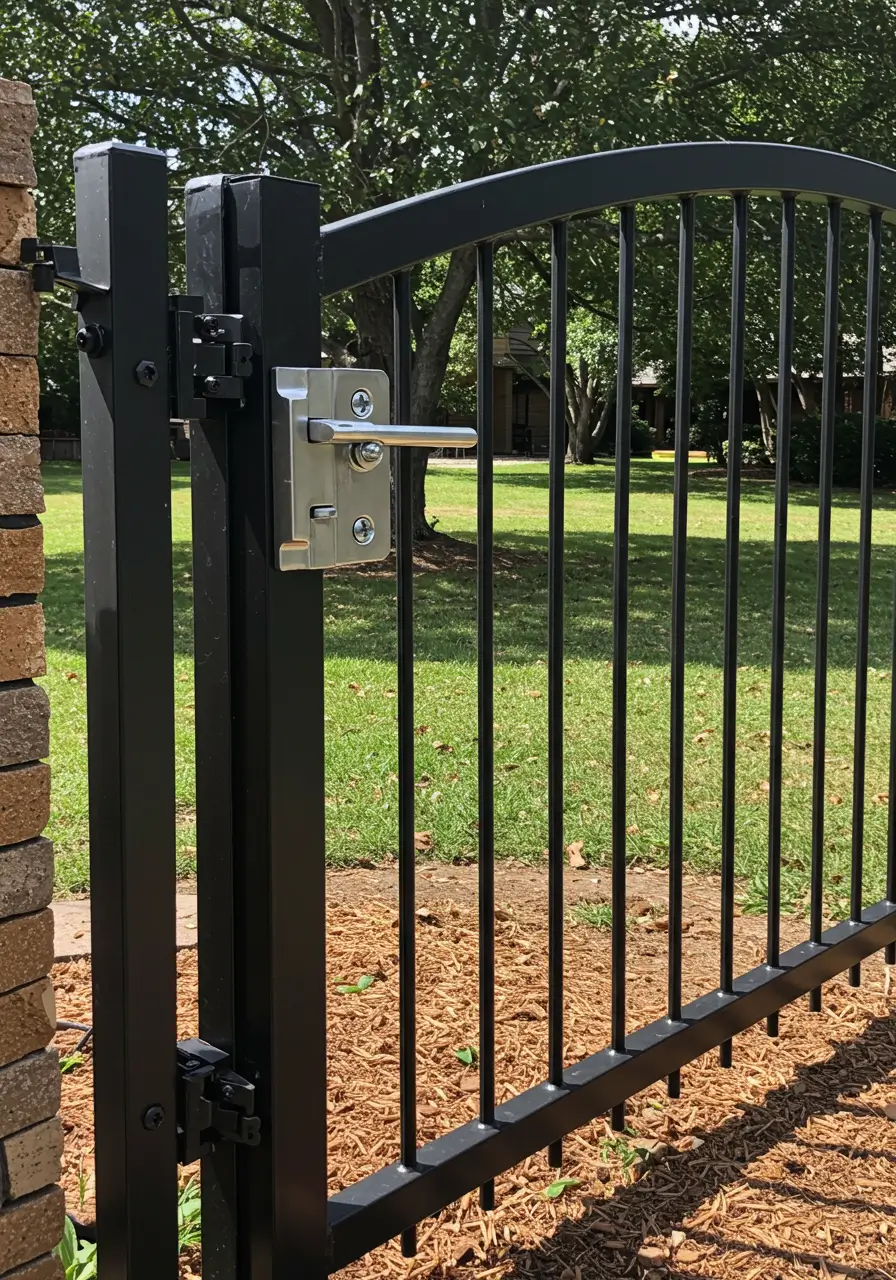
Hinges, rollers, tracks, guide assemblies, latches, stops, and drop rods should be rated for the finished gate’s weight, dimensions, duty cycle, and exposure. Adjustable bearing hinges can simplify alignment, while sealed or serviceable bearings help maintain smooth movement. For sliding gates, the roller or cantilever system must be engineered as a complete assembly rather than assembled from unrelated parts.
For a compatible wood, metal, or vinyl pedestrian gate, the National Hardware LokkLatch keyed gate latch adds key-operated access control. Before buying, verify the post and gate materials, mounting clearances, opening direction, fastener requirements, and whether the latch satisfies any self-closing, self-latching, accessibility, or pool-barrier rules that apply to the location.
Posts, foundations, and drainage

The supporting structure is often the difference between a gate that stays aligned and one that drags after a season. Post and footing design should account for gate loads, soil, wind exposure, frost depth, drainage, nearby utilities, and local requirements. Masonry columns may need an internal structural support rather than carrying the gate only through veneer or decorative block. A qualified local installer or engineer can specify the appropriate foundation for the site.

Amazon US Verified
Organic Perlite Horticultural Soil Conditioner
Lightweight volcanic mineral that improves root aeration and prevents compaction.
Choose the right opening method
Driveway gates

- Single swing: One leaf creates a clean appearance but needs a wide swing arc and imposes substantial leverage on one post.
- Double swing: Two shorter leaves reduce the required swing depth and create a balanced entrance, but they require two hinge posts and careful alignment at the center.
- Tracked slide: The gate moves alongside the fence on ground-mounted hardware. It needs adequate side room and a track kept clear of stones, ice, snow, and debris.
- Cantilever slide: The leaf spans the driveway without a ground track across the opening. It needs additional side room for the counterbalance section and a substantial support foundation.
A swing gate should not open into a public sidewalk or roadway. Slope, vehicle queuing space, drainage, prevailing wind, snow storage, and the location of controls all affect the best configuration.
Pedestrian and garden gates

Pedestrian gates can emphasize detail because their smaller leaves place less demand on the supports. Check the required clear width, threshold, latch height, closing force, and accessibility rules for the property type. Pool barriers, multifamily housing, and public accommodations may be subject to specific local or federal requirements, so a decorative design should never be assumed compliant without review.
Courtyard and pathway gates

Inside a property, a lighter visual design can mark transitions without making the landscape feel closed off. Coordinate the latch direction and swing with how people approach the gate, keep hinges clear of irrigation, and avoid placing vulnerable metalwork where garden equipment will repeatedly strike it.
Ready-made gate options for decks and wide openings
If your project does not require a custom-fabricated driveway gate, a ready-made gate kit may provide a simpler solution for a deck, porch, or fenced outdoor area. The 42-inch-high metal deck gate kit with hinges and latch includes the basic hardware needed for installation. For a slightly wider fixed opening, the 32-inch-high by 48-inch-wide metal deck gate is another option supplied with hinges and a latch.
Measure the finished opening at the top, middle, and bottom before ordering, then confirm the mounting surface, required clearances, swing direction, and suitability for outdoor exposure. Product dimensions alone do not establish compliance with deck, stair, pool-barrier, or local building-code requirements.
For an unusually wide area where the main goal is keeping a young child or dog away from a doorway, hallway, or supervised outdoor space, consider the 236-inch extra-wide retractable mesh baby or dog gate. A retractable mesh barrier is not structurally equivalent to a metal security gate and should not be treated as a driveway gate, permanent guardrail, or pool barrier unless the manufacturer expressly identifies that application and all applicable requirements are met.
Match the gate to the property

- Colonial, Georgian, and Federal: restrained symmetry, slender pickets, simple finials, and a shallow arch.
- Victorian and Queen Anne: more detailed scrollwork, rosettes, twists, and layered ornament.
- Mediterranean and Spanish Revival: substantial frames, rhythmic scrolls, and dark textured finishes.
- Tudor Revival: strong verticals, quatrefoils, and details that relate to masonry and half-timbering.
- Craftsman and ranch homes: simpler geometry, wider spacing, and limited decoration that echoes existing metal or woodwork.

View the gate as part of the entire boundary. Align its top line, spacing, color, and visual weight with nearby fences, walls, columns, railings, and lighting. Where metal meets masonry or wood, specify clean attachment details and allow for drainage and movement between materials.

For security, prioritize a rigid frame, protected hinges and latches, suitable height, limited footholds, and controlled gaps. Privacy infill can reduce visibility but also increases wind load, so it may require a stronger frame, posts, foundations, and operator. Discuss the threat level and privacy goal with the designer instead of adding heavy panels after installation.
Automated gate safety deserves its own plan
An automated driveway gate is a powered machine, not simply a manual gate with a motor attached. Entrapment and crushing zones can occur at the leading edge, posts, hinges, rollers, tracks, and spaces between the moving gate and fixed objects. The completed installation should use an operator listed for its intended gate type and application, appropriate monitored safety devices, physical guards where needed, and controls positioned so a user cannot reach through the gate to activate it.
Ask the installer to identify every entrapment zone and explain the protection used at each one. The gate should move freely by hand before automation, and pedestrian traffic should use a separate pedestrian entrance rather than the vehicular gate. Have the installer demonstrate emergency release, obstruction response, photoelectric sensors or edges, access controls, and the maintenance schedule. Keep children away from gate controls and never allow anyone to play on or near a moving gate.
Automatic swing-gate opener options
Homeowners comparing single-swing automation systems may encounter the TOPENS A5131 medium-duty single-swing gate opener. Another option is the Mighty Mule MM371W automatic gate opener kit, advertised for one gate leaf measuring up to 16 feet or weighing up to 550 pounds and described as smart- and solar-ready.
Those published limits should be treated as screening criteria, not proof that an operator suits a particular entrance. Confirm the gate’s actual weight, length, balance, geometry, wind loading, daily cycles, power supply, and compatible monitored safety devices. Installation instructions and local requirements take priority, and a qualified installer should evaluate all entrapment zones before the system is put into service.
How to compare iron gate quotes
Prices vary too widely by dimensions, location, foundation work, ornament, finish, electrical service, and access equipment for a generic per-foot figure to be dependable. Obtain itemized written proposals based on the same scope. Each should state:
- opening dimensions, gate height, leaf configuration, direction of travel, and required clearances;
- metal type, section sizes, wall thicknesses or solid-bar dimensions, bracing, and decorative components;
- post sizes, foundation assumptions, drainage provisions, and responsibility for utility locating or permits;
- surface preparation, galvanizing where specified, primer, powder or paint product, color, texture, and repair method;
- hinge, roller, latch, stop, lock, and drop-rod models with load ratings where applicable;
- for automation, the operator model, duty rating, access controls, backup power options, safety devices, wiring, and commissioning;
- warranties for structure, coating, equipment, and labor, including exclusions and required maintenance.
Compare specifications, installer experience, service support, and warranty terms—not only the bottom-line price. Also verify licensing, insurance, references, and who will service the gate after installation.
A practical maintenance routine
Clean according to exposure
Wash away dirt, pollen, bird droppings, and salt with fresh water and a mild cleaner compatible with the finish. Coastal and roadside installations may need more frequent rinsing. Use a soft cloth or brush, avoid abrasive cleaners, and follow the coating manufacturer’s instructions before using a pressure washer or chemical product.
Inspect the complete system
Periodically check for coating chips, bubbling, rust staining, blocked drain holes, loose fasteners, cracked welds, movement in posts, worn hinges, damaged rollers, and changes in alignment. On an automated gate, test safety devices at the interval specified by the operator manufacturer and arrange qualified service if the gate reverses inconsistently, makes unusual sounds, drags, or moves unevenly.
Lubricate only where specified
Use the lubricant and interval recommended for the installed hinge, bearing, roller, latch, and operator. Some sealed components should not be lubricated, while the wrong product can attract grit or damage plastics and electrical parts. Do not apply lubricant to a problem that is actually caused by a bent frame, failing bearing, loose foundation, or misalignment.
For compatible metal hinges, rollers, tracks, pulleys, and chains, the 3-IN-ONE Professional Garage Door Lubricant with Smart Straw, two-pack offers controlled spray application. Although it is marketed for garage-door components, use it on gate hardware only when the gate or hardware manufacturer permits that type of lubricant. Keep overspray away from painted surfaces, sensors, drive belts, electrical contacts, and areas where it could create a slipping hazard.
Repair coating damage promptly
When bare steel is exposed, remove loose contamination and corrosion without enlarging the damaged area, clean the surface, and apply a compatible repair system. The correct primer and topcoat depend on whether the original surface is painted, powder coated, or galvanized. Obtain touch-up instructions and matching material from the fabricator at installation; extensive corrosion or damage near a structural joint should be assessed professionally.
For small areas of rust on suitable painted or bare metal, Rust-Oleum Stops Rust Reformer black spray paint can convert a prepared rusty surface into a paintable black finish. Follow the label carefully, remove loose rust first, and check compatibility with the gate’s existing coating. It is not a structural repair and should not be sprayed over active powder-coat failure, galvanized metal, or unknown finishes without confirming the manufacturer’s preparation instructions.
Where a brush-applied finish is more practical, Rust-Oleum Stops Rust brush-on protective enamel in gloss black may be used on appropriately prepared exterior metal. Apply it only under the temperature, ventilation, drying, and recoating conditions stated on the label. Test a discreet area first because sheen and color may not match the original factory finish.
Questions to ask before placing an order
- Is this gate mild steel, true wrought iron, cast iron, or aluminum, andlify which parts use each material?
- How were the frame size, posts, hinges or rollers, and foundations selected for the gate’s weight and wind exposure?
- How are hollow sections vented, drained, capped, and protected internally?
- What exact surface-preparation and coating system is included?
- Can the installer provide a scaled drawing and finish sample before fabrication?
- Which permits, setback rules, fire-access requirements, pool rules, or accessibility provisions apply locally?
- For automation, how is each entrapment zone protected and who will commission and service the system?
- What routine maintenance is required to keep each warranty valid?
Choose the complete gate, not just the design

The best classic iron gate is one whose engineering is as thoughtful as its appearance. For many homes, that means fabricated steel with appropriate bracing, corrosion protection chosen for the climate, correctly rated hardware, substantial supports, and professional installation. True wrought iron remains valuable for specialist restoration, while aluminum can be the better choice when low weight and corrosion resistance are priorities.
Start with the entrance conditions and daily use, then select the opening method, structure, finish, and ornament in that order. A detailed specification and a serviceable design will do more for long-term value than elaborate decoration added to an underbuilt gate.
This Post Contains Affiliate Links
As an Amazon Associate, azuloz.com earns from qualifying purchases.