
For the past four decades, public health messaging, commercial restaurant codes, and kitchenware marketing have drummed a single dogma into home cooks: Plastic cutting boards are hygienic; wooden cutting boards are dangerous. Believing that non-porous synthetic plastic can be sterilized in a dishwasher while organic wood absorbs raw chicken juices, millions of families replaced heirloom maple and larch blocks with brightly colored polyethylene and polypropylene cutting mats.
Every time you chop onions, slice sourdough, or dice chicken breasts on that plastic surface, you feel a sense of sanitary security. Yet if you run your fingernail across your plastic board, you will feel a landscape of fuzzy, gouged plastic terrain. Recent peer-reviewed studies published in Environmental Science & Technology and the Journal of Food Protection reveal a startling double crisis: that scarred plastic board is shedding tens of thousands of microplastic particles directly into your food every year, while harboring resilient bacterial biofilm colonies that bleach and dishwashers cannot eradicate.
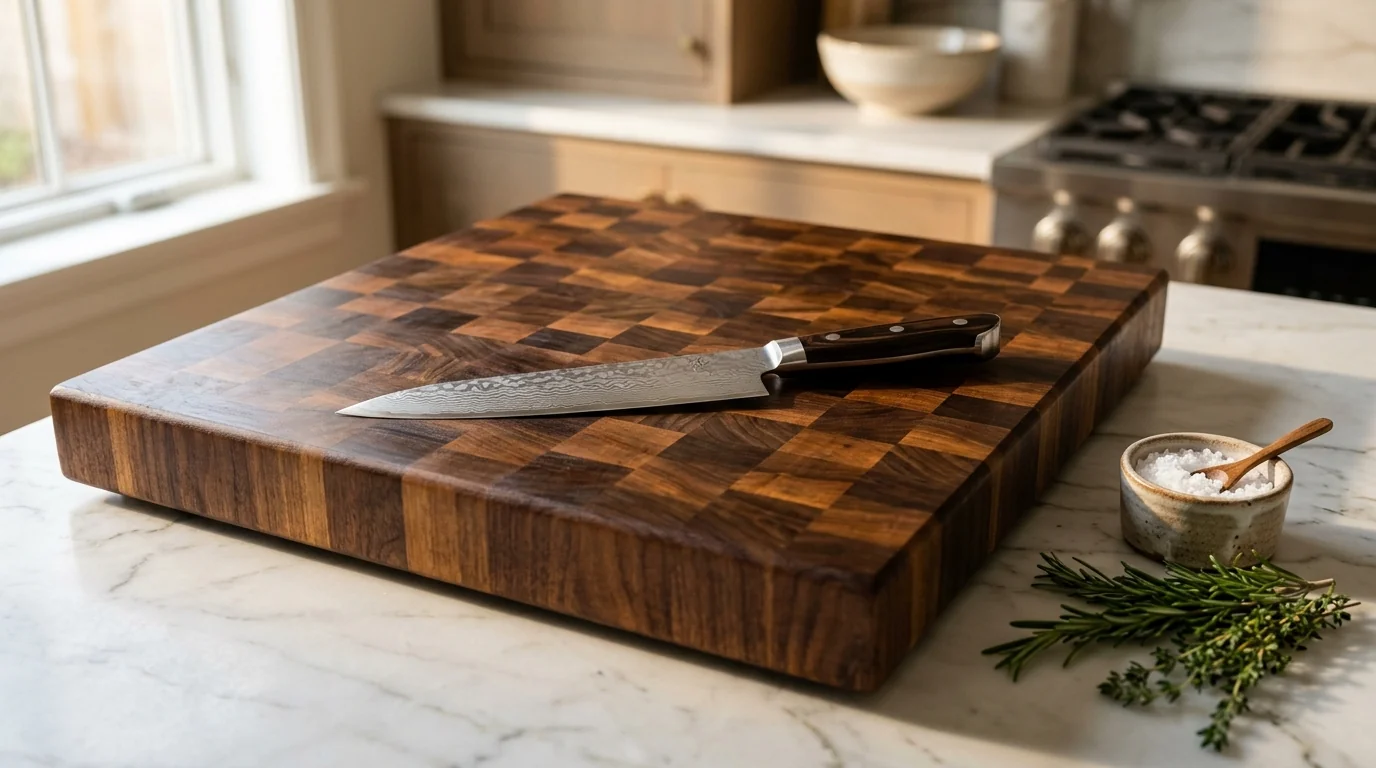
The true champion of food safety and knife longevity is not synthetic plastic, but a marvel of evolutionary botanical architecture: the end-grain hardwood butcher block. Through natural capillary desiccation, antimicrobial wood extractives, and self-healing fiber orientation, end-grain wood does what plastic never could: it actively neutralizes deadly foodborne pathogens while keeping your culinary prep completely free of synthetic polymer contamination.
The Microplastic Shedding Crisis: Eating 50 Grams of Polymer Annually
When a chef’s knife blade—hardened to 58–62 HRC on the Rockwell scale—strikes a relatively soft polyethylene surface, the sharp steel acts as a microscopic chisel. With every slicing and rocking stroke, the blade carves tiny shavings and flakes of plastic from the board.
In a groundbreaking 2023 study conducted at North Dakota State University, researchers measured the exact mass of microplastics generated during typical household food preparation on commercial plastic chopping boards. The findings were staggering:
- A single home cook generates between 1,500 and 7,500 microscopic plastic particles per chopping session.
- Across an average year of daily meal preparation, a single plastic cutting board sheds between 15 and 50 grams of microplastics—the equivalent weight of ten credit cards ground directly into salads, stir-fries, and children’s school lunches.
- These particles range from 1 to 500 micrometers in size, small enough to penetrate the intestinal epithelial barrier, enter systemic blood circulation, and accumulate in liver, kidney, and spleen tissue, where they stimulate chronic inflammatory macrophage cascades.
“When you slice food on a scarred polyethylene board, you are not just preparing dinner; you are micro-planing synthetic petroleum polymers directly into your family’s bloodstream.”
The Deep Fissure Biofilm Trap: Why Dishwashers Cannot Sterilize Plastic
Beyond toxicological ingestion, the foundational argument for plastic—sanitary safety—crumbles under microbiological examination. When plastic boards are brand new, their slick, non-porous surface is indeed easy to rinse clean.
However, after just two weeks of knife contact, the surface becomes etched with hundreds of microscopic grooves and ragged fissures. Under scanning electron microscopy, these knife cuts are revealed to be narrow, V-shaped chasms with jagged plastic flaps hanging over the opening.
When raw poultry juices containing Salmonella enterica or Campylobacter jejuni seep into these microscopic chasms, capillary forces pull the bacteria deep into the bottom of the fissure. Surface tension prevents dishwashing detergents, bleach solutions, and dishwasher water jets from penetrating the narrow slot. The trapped bacteria secrete extracellular polymeric substances (EPS), constructing an impenetrable slimy matrix known as a biofilm.
In landmark food safety trials conducted at the Food Research Institute at the University of Wisconsin-Madison, microbiologists inoculated plastic and wooden boards with millions of E. coli and Salmonella bacteria. While dishwashing sanitized smooth plastic, heavily scarred plastic boards harbored viable, pathogenic bacterial colonies even after rigorous cleaning with bleach and hot machine wash cycles. The moment a wet cucumber or warm chicken breast was sliced on the scarred plastic, the trapped bacteria transferred onto the food instantly.
The End-Grain Wood Defense: Capillary Desiccation and Polyphenolic Warfare
How does organic wood outperform synthetic plastic? The secret lies in the living biological architecture of trees, specifically the orientation of xylem vascular bundles in an end-grain block.
Unlike edge-grain or face-grain boards (where wood fibers run horizontally like pencils laid flat), an end-grain block is constructed by standing wood blocks vertically on end, so the cross-section of the tree rings faces the ceiling. This creates three miraculous biological defense mechanisms:
1. The Self-Healing Capillary Parting
When a sharp knife strikes an end-grain board, the blade does not cut across the wood fibers; it slides gently between the vertical fibers, pushing them aside like parting hair. When the blade lifts, the natural elasticity of the wood and the presence of natural oils allow the fibers to snap back together. The surface literally self-heals, eliminating the deep, permanent jagged caves where bacteria hide in plastic.
2. Osmotic Capillary Desiccation (The Microbial Desert)
Wood is a naturally hygroscopic material composed of cellulose, hemicellulose, and lignin. When bacterial liquids contact the surface of an end-grain board, the vertical xylem tubes draw the moisture downward into the interior of the wood via powerful capillary forces.
Bacteria require surface water to metabolize and multiply. As the water is stripped away into the wood’s porous cellular matrix, the bacteria stranded on the surface suffer rapid osmotic dehydration. Within three to four hours, 99.9% of bacteria on a dry hardwood cutting board die of thirst.
3. Natural Antimicrobial Phytochemicals
Trees did not evolve to be easily digested by microbial rot; they produce complex chemical defense weapons: tannins, flavonoids, terpenoids, and polyphenols. As moisture draws bacteria into the wood pores, these natural antimicrobial compounds disrupt the bacterial cellular membranes and denature their enzymatic proteins, achieving complete biological neutralization without a drop of chemical bleach.
Knife Edge Longevity: Why End-Grain Preserves Razor Sharpness
For cooks who value high-performance Japanese or German cutlery, cutting boards dictate edge retention far more than cutting technique. When a razor-thin blade edge (sharpened to a delicate 15-degree angle) strikes a hard plastic board, the inflexible synthetic polymer acts as an anvil, causing the microscopic apex of the steel to roll over, chip, or dull in just three or four cooking sessions.
On an end-grain block, because the fibers part vertically to receive the blade, the knife experiences virtually zero impact resistance. Professional sushi masters and French butcheries rely exclusively on end-grain blocks because a single sharpening will maintain shaving-sharp performance for months of daily prep.
📥 Free Download: End-Grain Wood Hygiene & Microplastic Prevention Blueprint
Microbiology of cutting surfaces: polyethylene microplastic shedding, bacterial biofilm traps in knife cuts, and end-grain wood conditioning protocols.
The Master End-Grain Maintenance Protocol: Lifelong Heirloom Care
An end-grain hardwood block (crafted from North American Sugar Maple, Siberian Larch, or Black Walnut) is not a disposable consumable; it is a kitchen heirloom that will last fifty years if conditioned with proper lipid chemistry. Follow this clinical care regimen:
1. Initial Mineral Oil Capillary Saturation
When you acquire a new end-grain board, its vertical capillary channels are thirsty. Generously pour USP food-grade mineral oil across the surface. Allow the oil to soak in for four hours; repeat until the wood refuses to absorb more liquid. Mineral oil is an inert, non-drying alkane that will never turn rancid or sticky, creating an internal hydrophobic barrier that prevents raw food juices from soaking deep into the block.
2. The Beeswax Moisture Seal
Once a month, apply a generous layer of cutting board wax (a 4:1 blend of food-grade mineral oil and melted natural beeswax). Buff it into the wood using a clean cotton cloth. The beeswax fills microscopic surface pores and hardens into a silky, water-repellent barrier that causes liquids to bead up like water on a freshly waxed car.
3. Daily Cleansing: The Salt and Hot Water Protocol
After food prep:
- Scrape away organic debris with a flat stainless steel bench scraper.
- Wipe the surface with a damp sponge and a few drops of mild castile soap.
- For deep sanitizing after raw poultry or fish, sprinkle coarse sea salt across the board and scrub vigorously with the cut half of a fresh lemon. The citric acid and abrasive salt lift proteins and neutralize odors naturally.
- Rinse with warm water, wipe completely dry with a clean kitchen towel, and store the board standing on edge in a well-ventilated area so both sides dry uniformly.
4. The Golden Rules of Wood Board Preservation
- Never submerge in a sink of water: Soaking wood forces water into the cellular matrix, causing uneven swelling and catastrophic glue joint cracking.
- Never run in a dishwasher: The 160°F caustic alkaline spray will strip all natural oils, dissolve waterproof wood glues, and warp the block into firewood.
- Never use vegetable oils: Olive oil, canola oil, and vegetable oil contain polyunsaturated fats that oxidize under room air, turning rancid and sticky within weeks.
Elevate Your Culinary Sanctuary
Food preparation is an intimate, grounding ritual that connects us to nutrition, family, and home. Returning to the natural elegance of an end-grain hardwood block is not merely an aesthetic upgrade; it is an act of proactive health preservation.
By banishing scarred plastic micro-planers from your kitchen, you protect your family from synthetic polymers and persistent bacteria—restoring your prep station to a timeless sanctuary of culinary beauty, razor precision, and pure biological safety.