
Walk into almost any newly built or flipped suburban home today, and you will look up to behold a ceiling that resembles a slice of Swiss cheese: twenty, thirty, or forty six-inch recessed can lights arranged in a rigid, airport-runway grid across the drywall. Contractors love them because they are cheap to install and illuminate every square inch of space indiscriminately; homeowners request them believing that more overhead lumens equal a brighter, more luxurious home.
Yet after spending an evening in a room illuminated entirely by ceiling downlights, a peculiar physical sensation sets in. You find yourself squinting. Your eyes feel gritty and dry, a dull tension ache forms behind your brow, and you feel an inexplicable urge to turn off the overhead lights and sit in the dark. If you look at someone sitting across the dining table or kitchen island, their face looks harsh and aged—deep, ghoulish shadows carved under their eye sockets, nose, and chin like characters in a horror film.
The problem is neither your vision nor your mood: it is severe physiological visual stress caused by high-angle disability glare and catastrophic vertical-horizontal luminance imbalance. In the refined world of architectural lighting design and visual ergonomics, ceiling grids of bare recessed downlights are considered an architectural tragedy. Transforming your home into an authentic haven of visual comfort requires abandoning the ceiling grid and mastering the Layered 3-Plane Perimeter Wash.
The Physics of Glare: The Unified Glare Rating (UGR) Crisis
In optical physics and lighting engineering, glare is quantified using the Unified Glare Rating (UGR), codified by the International Commission on Illumination (CIE 117). UGR measures the psychological discomfort caused by high-luminance light sources in the human field of view on a scale from 10 (barely perceptible glare) to 28 (unbearable physiological discomfort):
- UGR < 14: The human visual comfort threshold. Light sources are shielded; ambient illumination feels soft, natural, and calming.
- UGR 19: The strict maximum legal limit for commercial office spaces where humans read screens.
- UGR 24 to 28+: The typical reading of cheap, flush-trimmed residential recessed LED retrofit cans.
When you sit on a sofa in a living room gridded with flush recessed cans, those LED diodes project unshielded light outward at wide angles (often 90 to 120 degrees). Even if you are not looking directly up at the ceiling, those intense points of raw luminance enter your peripheral ocular field at high angles (between 45 and 85 degrees).
Your pupil’s pupillary light reflex is thrown into constant confusion: it attempts to constrict to protect the retina from the blazing ceiling diodes, while simultaneously trying to dilate to see the shadowed furniture below. This constant muscular tug-of-war in the ciliary muscles of the iris induces rapid eye fatigue, tension headaches, and elevated sympathetic nervous system arousal.
“Grid recessed downlights don’t light human living spaces; they light the floorboards. Humans don’t live on their bellies staring at the floor; our eyes gaze horizontally at vertical walls and human faces.”
The Vertical Plane Luminance Law: Why Bare Floors Make Rooms Feel Dim
The great optical delusion of grid downlighting is that blasting 5,000 lumens onto a dark hardwood floor makes a room feel bright. It does not. Human visual perception of spatial brightness is governed by the Vertical Plane Luminance Law.
The human visual field spans approximately 130 degrees vertically and 200 degrees horizontally, with the line of sight resting primarily in a horizontal plane. When light strikes a dark floor, up to 90% of the light is absorbed by the dark rug or wood grain, with minimal diffuse reflection reaching the eye.
When light strikes vertical surfaces—walls, architectural bookshelves, artwork, and tailored drapery—the light bounces directly into the human horizontal field of view. Illuminating 100 square feet of vertical wall space makes a room feel three to four times brighter than directing twice as many lumens onto the floor, all while using a fraction of the electrical energy and producing zero glare.
The Downward Shadow Mask: The “Campfire Horror” Effect
In nature, ambient light is balanced: direct sunlight is diffused by the expansive blue sky dome, and horizontal reflections bounce softly off ground terrain and surrounding trees. Overhead downlights produce an unnatural, brutal unidirectional cone of light straight downward.
When downlight strikes a human face from directly above:
- The forehead casts deep, dark black sockets over the eyes, completely masking eye contact and micro-expressions.
- The nose casts a sharp triangle of shadow across the mouth.
- The chin casts dark shading over the neck and collarbones.
In interpersonal psychology, eye contact is the primary neurobiological conduit for trust and empathy. When family members sit across from each other under harsh downlights, the inability to clearly read softened facial expressions subconscious increases conversational friction, social exhaustion, and relational defensiveness.
The Layered 3-Plane Perimeter Wash Architecture
Master lighting designers create luminous, intimate, and glare-free living sanctuaries by structuring illumination across three distinct horizontal and vertical planes, keeping ceiling light sources virtually invisible:
Plane 1: The Perimeter Vertical Wall Wash (The Ambient Foundation)
Never place downlights in the center of the ceiling. Move your fixtures to the perimeter of the room, positioning them exactly 24 to 30 inches away from the walls, spaced 30 to 36 inches apart.
Use dedicated asymmetric wall-wash fixtures or deep baffled spotlights angled toward the drywall. Instead of spraying light into the center of the room, the fixtures paint the walls with a smooth, continuous vertical sheet of light. The walls become giant, diffuse acoustic reflectors that bathe the entire room in soft, indirect, shadowless illumination.
Plane 2: Concealed Architectural Coves and Pelmets (The Up-Light Layer)
To eliminate dark ceilings without causing glare, integrate concealed indirect up-lighting. Run high-CRI (90+), warm 2700K 24V LED strip lighting inside architectural ceiling coves, behind crown moldings, or behind drapery pelmet boxes.
The light washes upward across the white ceiling plaster, creating a luminous, glowing canopy that lifts the perceived height of the room by two feet, entirely free of visible hotspots or glare.
Plane 3: Low-Level Task Anchors (The Intimate Human Scale)
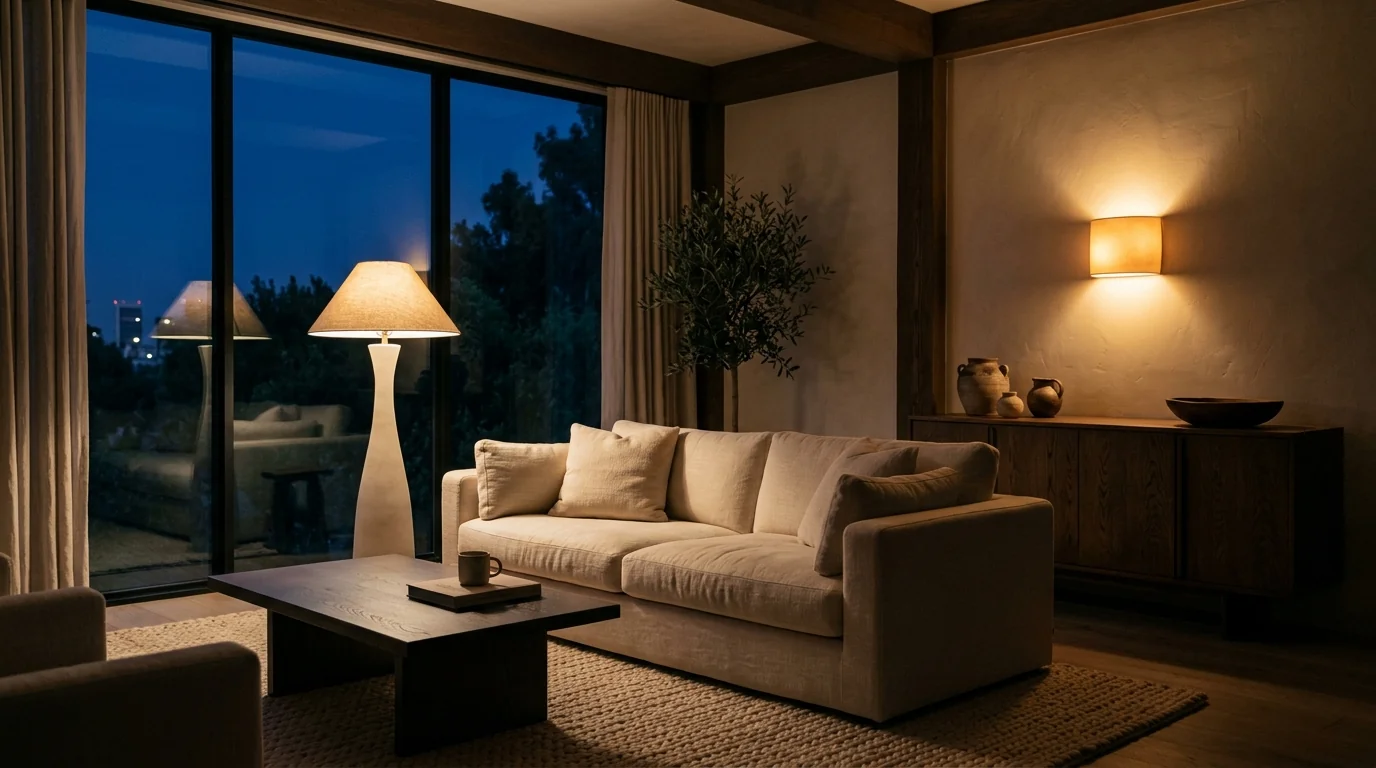
Bring the light down to human eye level (between 36 and 54 inches above the finished floor). Populate the living room with heavy ceramic table lamps, reading sconces, and low floor lamps fitted with natural linen, parchment, or pleated fabric shades.
These fixtures create warm pools of intimate, task-oriented light that invite family members to gather, read, and converse, anchoring spatial zones within the broader architecture.
📥 Free Download: Architectural Perimeter Lighting & UGR Glare Reduction Guide
Photometric engineering: Unified Glare Rating (UGR < 14) thresholds, 3-plane perimeter lighting layouts, deep baffled fixtures, and circadian kelvin curves.
The Hardware Fix: Regressed Deep Baffles and the 45-Degree Cutoff
If your room already has recessed ceiling cans and you cannot rewire the walls, you do not need to tear down the ceiling. You can eliminate 90% of visual glare through a simple mechanical hardware upgrade:
- Replace Flat White Trim Rings: Banish flush, frosted plastic lens retrofits. Their white trim rings catch glare and glow like beacons.
- Specify Deep Regressed Black Baffles: Choose architectural trim inserts where the LED diode is recessed 2 to 3 inches deep inside the ceiling housing, surrounded by stepped black or specular bronze baffles.
- The 45-Degree Visual Cutoff: A quality deep-regressed fixture possesses a 45-degree optical cutoff angle. When you are sitting in the room, the light source is physically invisible—the ceiling looks completely dark. Only the surface being illuminated below receives light. The ceiling becomes quiet, clean, and restful.
Bathe Your Home in Restorative Glow
Light is not merely a utility that allows us to navigate a dark room; it is an active biological regulator of human mood, eye comfort, and relational warmth. A ceiling peppered with glaring spotlights turns a luxury living room into an interrogational sterile clinic.
By shifting your light from harsh ceiling grids to vertical wall washes, concealed indirect coves, and warm human-scale lamps, you restore tranquility to your visual world. Your home feels expansive, peaceful, and deeply nurturing—a true sanctuary where eyes can soften, faces radiate with natural warmth, and the spirit can finally unwind in soothing, shadowless comfort.