

You stop by your neighborhood artisan bakery on a Saturday morning. You carefully select a magnificent, golden-brown boule of naturally leavened sourdough, still radiating warmth from the hearth oven. You take it home, slice through the blistered, crackling crust, and enjoy two thick slices slathered with salted butter. The interior crumb is an airy masterpiece: soft, open, wonderfully chewy, and delicately moist.
Then comes the fateful moment of domestic preservation. Looking at the remaining two-thirds of the loaf, you think about how much you spent on this artisan bread. You worry about mold, and you want to ensure it stays fresh for the coming week. Acting on pure kitchen instinct, you seal the loaf tightly in plastic wrap, open your refrigerator door, and place it safely onto the middle shelf.
The following morning, you pull the loaf out to make breakfast toast. But as your knife cuts into the bread, something catastrophic has occurred. The once-crackling crust has transformed into a tough, leathery rind. Worse, the pillowy, custard-like interior crumb has turned stiff, crumbly, chalky, and dry. You chew a piece and shake your head in dismay, assuming the bread somehow “dried out overnight.”
In reality, the bread did not lose moisture. You did not protect it; you subjected it to the most destructive biochemical environment possible for baked wheat. According to cereal chemists, food physicists, and professional bakers, storing bread in the refrigerator accelerates staling by up to six times faster than leaving it on your kitchen counter. Understanding the macromolecular physics of starch retrogradation reveals why your refrigerator is a bakery graveyard, and how ancient storage wisdom keeps bread fresh for days.
The Great Culinary Myth: Staling Is Not Dehydration
The widespread habit of refrigerating bread stems from a fundamental misunderstanding of what bread staling actually is. Most people assume that staling is simply evaporation—the gradual loss of water to the surrounding air, similar to how an apple slice dries out when left uncovered.
If staling were merely water loss, you could take a completely stale slice of bread, weigh it on a precision laboratory scale, and observe a significant loss of mass compared to when it was fresh. Yet when food scientists conduct this exact experiment, they discover that a rock-hard stale loaf often contains the exact same percentage of water as it did twenty minutes after emerging from the baker’s oven.
Staling is not a drying process; it is a profound structural and chemical phase change known in organic biochemistry as starch retrogradation. To understand retrogradation, you have to look into the molecular life cycle of a wheat grain.
The Baking Miracle: Gelatinization and the Amorphous Crumb
Wheat flour is composed primarily of two things: protein (glutenin and gliadin, which form the gluten matrix) and starch. Starch makes up roughly 70 to 75 percent of the flour and consists of two distinct glucose polymers:
- Amylose: A long, straight, linear chain of glucose molecules linked by alpha-1,4-glycosidic bonds.
- Amylopectin: A massive, highly branched, bushy molecule containing thousands of glucose units with branching points occurring every 24 to 30 glucose units.
In raw flour, these starch molecules are tightly packed together inside semi-crystalline, microscopic granules that are completely insoluble in cold water. But when a baker mixes flour with water, shapes the dough, and slides it into a 450°F (232°C) oven, a miraculous physical transformation occurs: starch gelatinization.
As the internal temperature of the dough passes 140°F (60°C), water molecules penetrate the tightly wound starch granules. The granules swell dramatically like microscopic water balloons. As heat continues to rise past 180°F (82°C), the internal hydrogen bonds maintaining the crystalline structure break apart completely. The linear amylose molecules leach out into the surrounding water, and the branched amylopectin molecules unfold and expand.
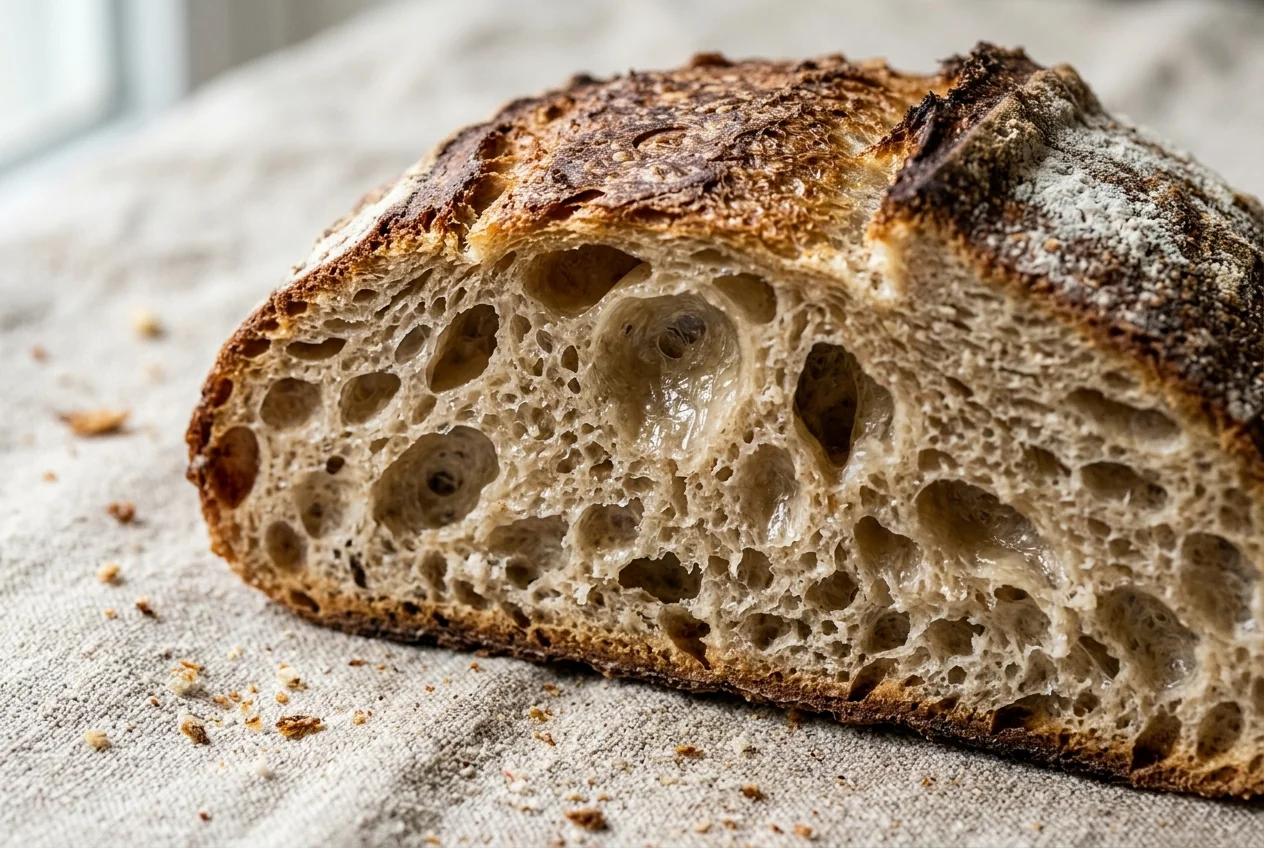
When the bread finishes baking, this unfolded, water-swollen starch network sets into an amorphous, flexible, disordered gel. It is this disorganized, gelatinized starch matrix that traps water and creates the soft, tender, elastic crumb structure that we associate with fresh bread.
The Chilling Trap: Why 38°F Is the Peak Recrystallization Zone
The moment bread is pulled from the oven and begins to cool, entropy reverses. The unfolded starch polymers—particularly the massive branched amylopectin molecules—do not want to remain in an unstable, disorganized gel. They naturally seek to return to their lowest energy state: an ordered, rigid, crystalline lattice.
This process of recrystallization is starch retrogradation:
- As thermal kinetic energy drops, neighboring amylopectin branches begin to align with each other.
- Hydrogen bonds reform between adjacent glucose chains, pulling the polymers back into tight, rigid crystalline clusters.
- As the starch matrix crystallizes and tightens, it physically expels the water molecules that were once trapped inside its gel network (a phenomenon known as syneresis).
- This expelled water does not necessarily evaporate out of the loaf; instead, it migrates outward toward the crust or becomes locked within the rigid crystal boundaries, leaving the surrounding gluten network feeling dry, firm, and crumbly.
Now, consider how temperature affects this chemical reaction. In most chemical reactions, lowering the temperature slows down the reaction rate. But crystallization kinetics follow a unique bell-shaped curve determined by two competing forces: thermodynamic driving force (which increases as temperature drops below the melting point) and molecular diffusion mobility (which slows down as temperature drops).
When food scientists map the velocity of starch retrogradation across a thermal spectrum, they discover a shocking peak: the rate of amylopectin recrystallization reaches its absolute maximum between 32°F and 40°F (0°C to 4.4°C).
And what is the factory-calibrated temperature of a standard home refrigerator? Exactly 35°F to 38°F (1.6°C to 3.3°C). By placing your fresh artisan bread inside the refrigerator, you are not preserving it; you are storing it in the exact, precise thermal sweet spot engineered by nature to turn soft gelatinized starch back into chalky, rigid crystals as rapidly as possible. Bread stored in a 38°F refrigerator stales as much in a single day as bread left at a comfortable 70°F room temperature does in six full days.
The Plastic Bag Paradox: Trapping Moisture vs. Breeding Spores
If the refrigerator is out of the question, what about sealing your bread inside a standard ziplock bag or plastic grocery bag on your kitchen counter?
While plastic wrap prevents moisture from evaporating into the dry air of your kitchen, it creates a secondary culinary disaster. An artisan bread crust is supposed to be dry, blistered, and brittle—a protective shield containing roughly 10 to 12 percent moisture, compared to the 40 to 45 percent moisture of the interior crumb.
When bread sits inside an airtight plastic bag at room temperature, water vapor continuously migrates from the damp crumb outward toward the crust. Because the impermeable plastic barrier prevents this moisture from escaping into the atmosphere, the water vapor becomes trapped against the crust. Within 12 hours, the crisp crust softens into a rubbery, tasteless rind.
Even worse, this warm, humid microclimate trapped inside the plastic bag creates an ideal greenhouse incubator for fungal spores (such as Penicillium and Aspergillus) that naturally float in domestic air. Within three to four days, green fuzzy colonies begin blooming across the surface, forcing you to discard the entire loaf.
The Victorian Solution: The Physics of the Wooden Bread Box
For centuries before the invention of electric refrigeration, households in Europe and North America relied on a simple wooden or ceramic countertop container known as a bread box. Modern minimalist kitchens often discarded bread boxes as bulky, outdated clutter. Yet materials scientists and traditional bakers recognize the wooden bread box as a masterclass in passive environmental engineering.
A properly constructed wooden bread box (made of unfinished oak, maple, cedar, or sustainable bamboo) preserves bread through three distinct physical mechanisms:
- Thermal Stability: Thick wooden walls provide natural insulation, buffering the interior loaf against rapid temperature fluctuations caused by direct sunlight, ovens, or drafty windows, keeping the bread safely at an optimal 68°F to 72°F (20°C to 22°C) ambient baseline.
- Hygroscopic Moisture Buffering: Natural unsealed wood is a porous, hygroscopic material. When internal humidity rises as moisture leaves the loaf, the wood fibers gently absorb the excess water vapor, preventing the crust from becoming soggy and eliminating the humid greenhouse conditions that fuel mold growth.
- Micro-Ventilated Air Circulation: Unlike airtight plastic containers, bread boxes feature subtle ventilation gaps or porous seams. This allows a tiny, controlled exchange of air—just enough to allow moisture to disperse, but shielded from high-velocity air drafts that would dehydrate the interior crumb.
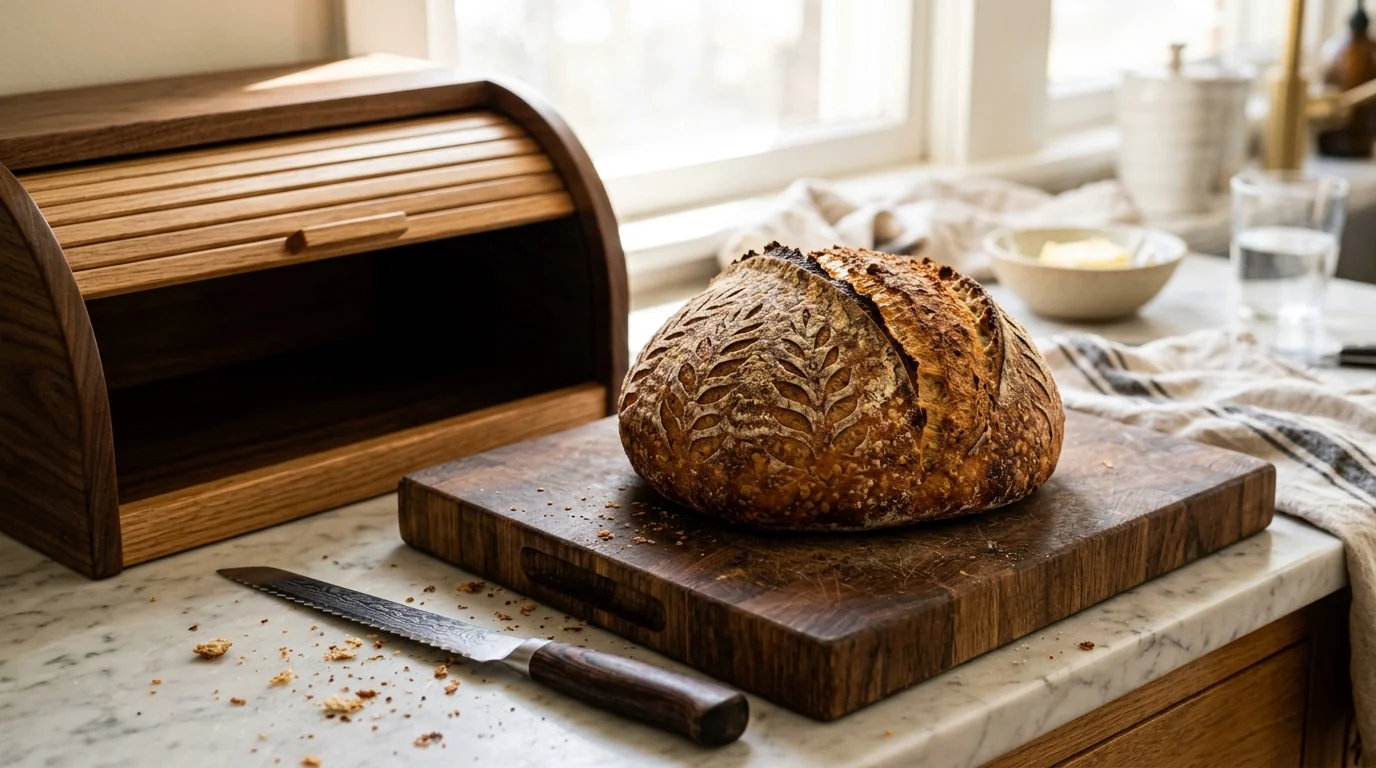
When stored inside a wooden bread box with the cut side placed face-down on a wooden cutting board, a crusty sourdough or rustic loaf retains its crackling crust and tender, elastic crumb for four to six full days with zero refrigeration required.
The Regeneration Protocol: How to Revive Day-Old Bread with Heat
Because starch retrogradation is a physical recrystallization rather than a permanent chemical destruction, it is 100 percent reversible. If your loaf has begun to feel firm and stale after three or four days on the counter, you do not need to throw it in the trash. You can use the thermodynamic properties of amylopectin to melt the crystals back into fresh gelatin:
- Preheat Your Oven to 350°F (175°C): Do not use a microwave. Microwaves heat water molecules unevenly, causing rapid steam bursts that temporarily soften the bread, but leave it rubbery and cause it to turn into a rock-hard brick within three minutes of cooling.
- Apply a Cold Water Mist: Hold your stale, uncut loaf (or a large heel) under a running kitchen tap for one brief second, or spray the exterior crust thoroughly with a water mister bottle. The crust should feel wet, but not waterlogged. This surface moisture creates a protective steam barrier that prevents the crust from burning while heat penetrates the interior.
- Bake on the Open Middle Rack for 8 to 10 Minutes: Place the wet loaf directly onto the center oven wire rack. As the internal temperature of the crumb crosses 140°F (60°C), the thermal energy melts the recrystallized amylopectin lattice back into its amorphous, gelatinous state. Meanwhile, the surface water evaporates, creating a paper-thin, shatteringly crisp, blistered new crust.
- Rest for Five Minutes Before Slicing: Pull the loaf from the oven. Resist the urge to cut it immediately; resting on a wire cooling rack allows the molten starch gel to stabilize, restoring the original soft, custardy chew of day-one bakery perfection.
The Deep Freeze Sanctuary: Storing Bread for the Long Haul
If you purchase multiple artisan loaves, or if you live alone and cannot finish a large sourdough boule within four days, there is one appliance that preserves bread flawlessly: your freezer.
While the refrigerator sits right in the peak retrogradation disaster zone (38°F), a deep freezer operates at 0°F (-18°C) or lower. At zero degrees, the temperature plunges far below the glass transition point of wheat starch. Water molecules freeze instantly into microscopic ice crystals before amylopectin chains have the time to align and recrystallize. Starch retrogradation is placed into complete molecular suspended animation.
To freeze bread properly: slice the fresh loaf completely on day one. Place sheets of parchment paper between the slices (or freeze them flat on a baking sheet for an hour), then transfer the frozen slices into an airtight freezer bag. When you want bread, pull out a single frozen slice and drop it directly into your toaster or onto a hot dry skillet. Within ninety seconds, the frozen starch re-gelatinizes, delivering the exact flavor, texture, and aroma of freshly baked artisan bread whenever you desire.
By banishing bread from your refrigerator and respecting the miraculous biophysics of starch gelatinization, you honor the craftsmanship of the baker, eliminate household food waste, and ensure every meal begins with the sublime comfort of truly fresh bread.
📥 Free Download: Bakery Preservation & Starch Retrogradation Guide
Amylose vs amylopectin crystallization kinetics, wooden bread box buffering physics, and thermal loaf revival protocols.