

It is 7:45 on a Tuesday evening. Dinner is finished, the dinner dishes are loaded into the dishwasher, and your family gathers in the open-concept living room. You expect this hour to signal a gentle, soothing descent into rest and relaxation. You envision peaceful conversations, quiet book reading, and children drifting naturally toward drowsiness.
Yet instead of calm, your home vibrates with a strange, chaotic restlessness. Your young children become unexpectedly hyperactive, running circles around the sofa and bursting into sudden emotional tears over minor frustrations. Your teenager stares into the middle distance, snapping irritably at basic questions. You and your partner sit on the couch feeling a contradictory, frustrating physiological state: physically exhausted to your bones, yet internally wired, alert, and unable to settle.
Most households blame this evening tension on modern digital stress, long workdays, or sugar consumed at dinner. But chronobiologists, neuroscientists, and architectural lighting designers point to a far more immediate physical culprit hovering six feet above your head: the spectral quality, angle, and intensity of your home’s artificial lighting.
Over the past two decades, a quiet revolution in interior remodeling replaced warm, low-level incandescent lamps with grids of high-powered, cool-white overhead recessed LED downlights. While these fixtures make kitchens look magazine-clean at noon, running them after sunset acts as a biological wrecking ball against human circadian neurochemistry. Understanding how light frequency and retinal anatomy control your internal master clock reveals why shifting your lighting at sunset is the single most transformative wellness upgrade you can make to your home.
The Ocular Photobiology: How Your Eyes Read the Sky
To understand why overhead lighting disrupts evening peace, you have to look beyond the rods and cones that allow you to see shapes, text, and colors. In the early 2000s, chronobiologists discovered a third, previously unknown photoreceptor inside the mammalian eye: intrinsically photosensitive retinal ganglion cells (ipRGCs).
These ipRGCs do not participate in conscious visual image formation. They are biological light meters whose sole mandate is measuring ambient environmental irradiance to synchronize your body’s 24-hour circadian clock. These cells contain a unique photopigment called melanopsin, which is exquisitely tuned to detect a very specific wavelength of electromagnetic radiation: blue-cyan light between 460 and 490 nanometers.
In the natural world untouched by electricity, this blue-cyan wavelength is found in abundance in only one place: the bright, open midday sky. When the sun rises to its solar zenith at noon, blue light floods the atmosphere. When melanopsin absorbs this blue light, it fires continuous electrical signals along the retinohypothalamic tract directly into the suprachiasmatic nucleus (SCN)—the master biological pacemaker situated within the hypothalamus of the brain.
The SCN responds by commanding the body’s daytime neurochemical cascade:
- Cortisol Production: Elevates baseline cortisol to promote alertness, focus, and physical energy.
- Core Body Temperature Elevation: Raises core metabolic temperature to support active cellular work.
- Absolute Melatonin Suppression: Sends an inhibitory signal through the sympathetic chain to the pineal gland, completely shutting down the synthesis and secretion of melatonin (the hormone of sleep and cellular repair).
The Angle of Incidence: The Lower Retinal Trap
Here is the critical anatomical secret that most interior designers and lighting manufacturers overlook: where light strikes your eye matters just as much as its color temperature.
Through millions of years of hominid evolution, the human eye adapted to outdoor solar geometry. The sun is only overhead when it is dangerously bright at midday. At dawn and dusk, the sun sits low on the horizon, filtering through thick atmospheric layers that scatter blue light, leaving behind only warm, long-wavelength amber, red, and gold tones.
Consequently, your eyes evolved with an asymmetrical retinal distribution: the vast majority of your melanopsin-containing ipRGC receptors are clustered densely within the inferior (lower) hemisphere of your retina. Because the eye’s crystalline lens inverts incoming light like a camera lens, light striking the lower retina originates exclusively from above your head.
Now consider the architectural layout of the modern suburban home: recessed “can lights” mounted flush in the ceiling, firing bright, un-diffused downward cones of light directly into the lower retinas of everyone standing or sitting below. When you sit beneath a 4000K or 5000K overhead downlight at 8:00 PM, you are exposing your inferior retina to high-intensity, short-wavelength photons arriving from an elevation that, in nature, exists exclusively at 12:00 PM on a clear summer day.
Your conscious mind knows it is nighttime, but your primitive suprachiasmatic nucleus receives an unambiguous, non-negotiable optical command: It is high noon. Stand by for active survival. Do not produce melatonin under any circumstances.
The Melatonin Freeze: The True Cost of Evening Blue Light
The biochemical consequences of this optical deception are profound. In clinical trials conducted by Harvard Medical School and the Brigham and Women’s Hospital, researchers compared the hormonal profiles of individuals exposed to typical domestic room light (roughly 100 to 200 lux) versus dim light (under 10 lux) in the hours prior to bedtime.
The findings were striking:
- Suppression Velocity: Exposure to standard indoor room light delayed the onset of melatonin secretion by an average of 90 minutes compared to dim light.
- Magnitude of Suppression: Standard domestic lighting suppressed total circulating nighttime melatonin levels by more than 85 percent, cutting the biological amplitude of the sleep signal to a mere fraction of its healthy baseline.
- Phase Delay: The master clock inside the SCN was physically phase-shifted backward, making it almost impossible to fall asleep naturally until midnight or 1:00 AM.
- Emotional Dysregulation: Because the brain remained in a high-cortisol state without the calming, GABA-enhancing effects of melatonin, subjects exhibited significantly higher irritability, emotional reactivity, and executive fatigue.
When young children are exposed to overhead cool-white lighting while brushing their teeth or getting ready for bed, their brains experience an acute circadian mismatch. Deprived of melatonin and flooded with confusing midday signals, their nervous systems respond with paradoxical hyperactivity—the classic “wired and tired” bedtime battle that exhausts modern parents every evening.
Circadian Layering: The 3-Tier Interior Lighting Architecture
Curing evening circadian insomnia does not require living in total darkness or reading by candlelight like an 18th-century villager. It requires replacing flat, single-tier overhead grids with a sophisticated design discipline known as Circadian Layering:
Tier 1: High-Elevation Daytime Lighting (7:00 AM – 4:00 PM)
- Color Temperature: 3500K to 5000K (Neutral to Cool Daylight White).
- Physical Placement: Ceiling recessed downlights, high track heads, and open skylights.
- Biological Function: Deliberately stimulates lower retinal ipRGCs to promote alertness, metabolic activation, and daytime productivity.
Tier 2: Transitional Twilight Lighting (4:00 PM – 7:00 PM)
- Color Temperature: 2700K to 3000K (Soft Warm White).
- Physical Placement: Dimmable pendant fixtures over dining tables and under-cabinet LED strips.
- Biological Function: Begins the downward slope of melanopic lux, signaling to the hypothalamus that solar elevation is declining.
Tier 3: The Low-Horizon Sanctuary (7:00 PM – Bedtime)
- Color Temperature: 2200K to 2700K (Ultra-Warm Amber / Candlelight Tone).
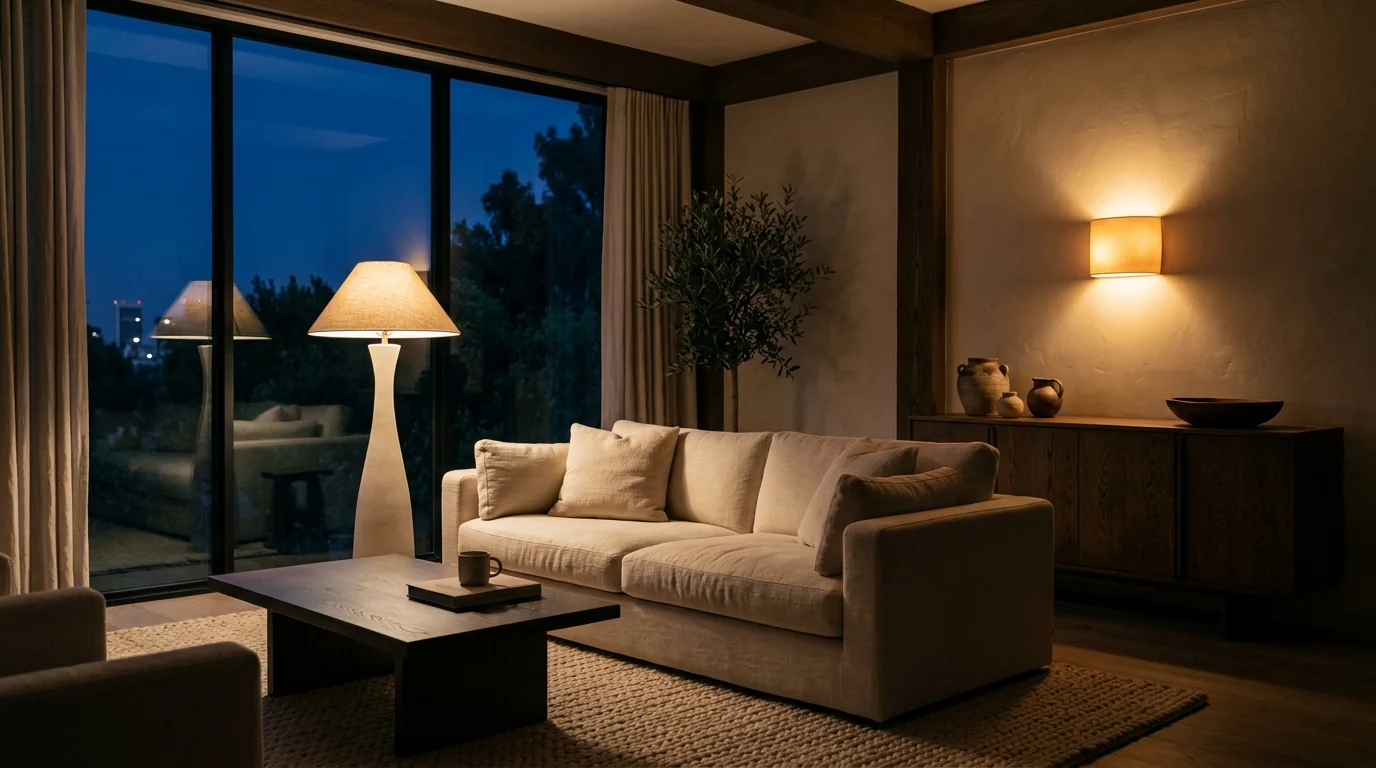
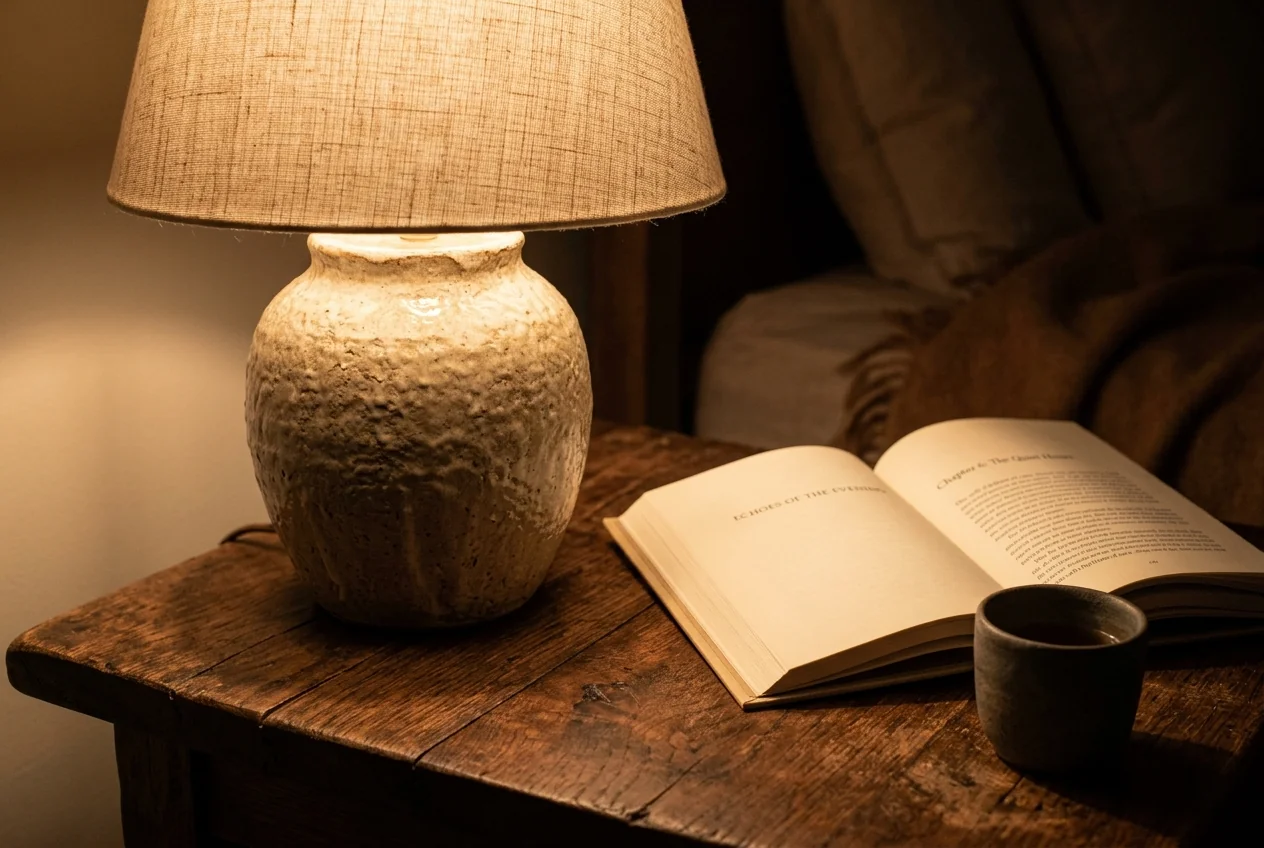
- Physical Placement: Strictly below eye level—ceramic table lamps on side consoles, low floor lamps with opaque fabric shades, and floor-level baseboard wash lights.
- Biological Function: Eliminates light arriving at the lower retina from above, drops melanopic lux below the suppression threshold, and allows the pineal gland to initiate its natural melatonin surge.
The 7:00 PM Shift: A Practical Room-by-Room Protocol
Transforming your home’s evening lighting environment requires zero electrical rewiring. You can execute the entire protocol using simple bulb swaps and a consistent daily behavioral routine:
1. The Living Room: Kill the Ceiling Grids
At 7:00 PM every evening, declare a total ban on overhead recessed downlights in your primary living space. Turn them off completely. Instead, illuminate the room using two or three strategically placed table lamps fitted with 2700K or 2400K warm LED bulbs. Ensure the lampshades are made of dense linen, ceramic, or parchment that diffuses light downward toward the floor rather than beaming raw light upward toward the ceiling.
2. The Kitchen: Under-Cabinet Horizon
Modern kitchens are the worst offenders in domestic light pollution, often illuminated like commercial operating suites. After dinner cleanup is complete, shut off all central island downlights. Leave on only a single strip of warm 2700K under-cabinet tape lighting, or place a small cordless decorative table lamp on the countertop. This provides safe passage for getting a glass of water without blinding your retinas with blue spikes.
3. The Bathroom: The Bedtime Trap
The most common moment adults and children sabotage their sleep is 20 minutes before bed during the toothbrushing routine. You spend two hours in a softly lit living room, your melatonin begins to rise, and then you walk into a tiny white-tiled bathroom and flip on a multi-bulb vanity fixture blasting 5000K daylight into a giant mirror. In less than 60 seconds, that intense reflection resets your SCN and shuts down melatonin secretion.
The fix is simple: install a warm 2200K amber nightlight plugged into an outlet near the floor, or place a rechargeable warm-toned cordless light on the vanity counter. Do your evening hygiene by this gentle, low-level glow.
4. Children’s Bedrooms: Floor-Level Story Time
When reading bedtime stories to children, never use the central ceiling fixture. Place a small reading lamp on a low bedside table or floor mat. Use warm 2200K amber bulbs that emit zero blue wavelengths. Within fifteen minutes of lying beneath low-angle amber light, their eyes will begin to droop, their heart rate will slow, and bedtime will transform from an exhausting power struggle into a peaceful, natural surrender to sleep.
Light is not merely a design accessory; it is the most potent environmental drug that enters your body every single day. By aligning your home’s artificial lighting with the ancient rhythms of human ocular biology, you restore true evening tranquility to your family and gift yourself the deep, restorative sleep your mind and body crave.
📥 Free Download: Circadian Lighting Layering & Kelvin Audit Guide
Melanopic lux thresholds, retinal ipRGC receptor mechanics, and room-by-room 3-tier evening lighting plans.