On a hot, humid summer afternoon, you walk into your living room, reach for the wall switch, and turn your ceiling fan to its maximum speed setting. The blades blur into a rapid whirring circle, the motor hums with deep mechanical effort, and the pull-chain clatters rhythmically against the glass globe.
You stand directly underneath the fixture, expecting a refreshing, wind-tunnel breeze to cool your overheated skin. Instead, you feel almost nothing: a faint, feeble whisper of air that barely ruffles a loose sheet of paper on the coffee table. You wonder: “How can a fan spinning at 200 RPM move so little air? Is the motor failing, or are ceiling fans just useless decorative relics?”
Your motor is not broken. In the fluid dynamics of residential HVAC, you have fallen victim to the most pervasive cost-cutting engineering shortcut in the modern ceiling fan industry: sub-optimal aerodynamic blade pitch. Millions of mass-market ceiling fans are intentionally manufactured with shallow 10-to-12-degree blade angles that chop through air like dull knives, drawing full electrical wattage without generating convective velocity. By understanding the physics of angle of attack, cubic feet per minute (CFM) volumetric displacement, and convective wind-chill evaporation, you can properly calibrate your fans and slash your home cooling costs by 30%.
The Fluid Dynamics of Blade Pitch: Angle of Attack
A ceiling fan blade is not a decorative paddle; it is an aerodynamic rotary wing governed by the exact same physical principles that lift a Boeing 787 or propeller-driven aircraft: Bernoulli’s principle and Newton’s third law of motion.
The single most critical geometric variable dictating fan performance is the blade pitch, also known in aeronautics as the angle of attack. This is the angle of tilt between the flat chord line of the fan blade and the horizontal ceiling plane:
1. The 10-to-12-Degree Mass Market Trap
Walk into any big-box home improvement retailer and inspect the budget ceiling fans priced between $60 and $120. Over 85% of these units feature a blade pitch between 10 and 12 degrees.
Why do manufacturers choose this shallow angle? Because of manufacturing cost and motor quality. Inexpensive fans are equipped with small, low-torque AC shaded-pole motors. If a manufacturer paired a weak motor with a steep blade angle, the heavy aerodynamic drag of moving air would cause the motor to overheat, hum loudly, and burn out its windings within two years. To protect their cheap motors from burning up, manufacturers flatten the blades. At 11 degrees, the blades slice through the air with almost zero mechanical resistance. The fan spins fast, but it displaces virtually zero air column volume.
2. The 14-to-15-Degree Aerodynamic Sweet Spot
High-performance architectural ceiling fans, by contrast, are engineered with blade angles between 14 and 15 degrees. At a 14-degree pitch, each blade scoops a massive volumetric bite of air on every revolution, forcing a coherent, high-velocity downward air column directly into the living space. When paired with a modern high-torque, brushless DC motor, a 14-degree fan displaces between 6,000 and 8,000 CFM of air, compared to an anemic 3,000 CFM produced by an 11-degree budget model—a 100% to 150% increase in actual airflow on identical or lower electrical wattage.
3. The 18-Degree Aerodynamic Stall Trap
If 14 degrees is superior to 11 degrees, why not tilt the blades to 20 or 25 degrees? Because fluid dynamics imposes an immutable boundary condition: aerodynamic flow separation and stall. Beyond 16 degrees, the air flowing across the upper surface of the blade can no longer maintain laminar attachment. It breaks away into violent, swirling turbulent eddies. Instead of projecting a smooth column of air downward, the fan creates massive aerodynamic drag, generating loud wind buffeting noise and motor strain without increasing floor-level air velocity.
“A ceiling fan spinning with an 11-degree blade pitch is an expensive ceiling blender that chops air without moving it. At 14 degrees, it becomes an aerodynamic turbine that transforms room air currents into an evaporative cooling engine.”
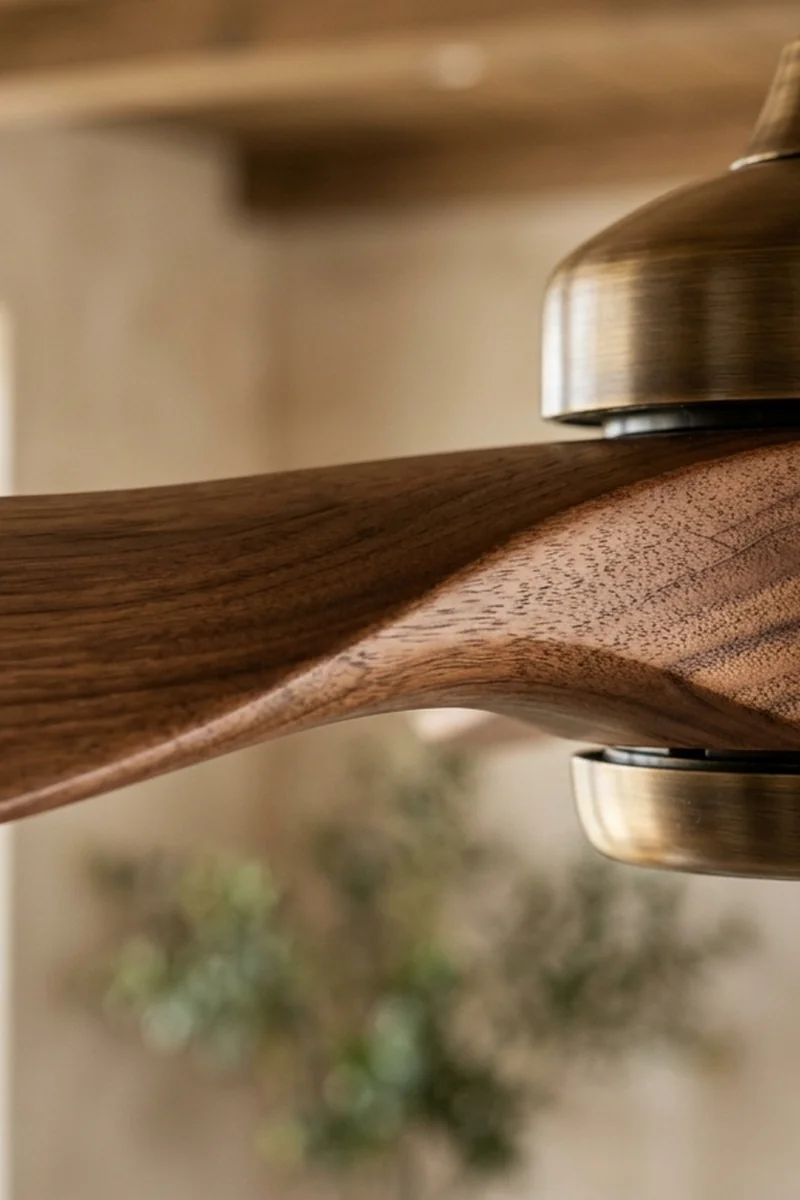
Engineered with aerodynamically contoured composite blades set at a 14-degree angle of attack, driven by an ultra-quiet 6-speed DC motor delivering over 6,500 CFM of high-velocity airflow.
Wind Chill Physics: Fans Cool People, Not Rooms
One of the most widespread energy-wasting misconceptions in home management is the belief that leaving ceiling fans running cools down an empty room. Ceiling fans do not lower room temperature by a single fraction of a degree (much like the thermal insulation dynamics explored in our thermal curtain convective loop window study). In fact, because electric motors generate radiant heat, running a fan in an empty room actually makes the room slightly warmer.
Ceiling fans cool human bodies through one specific thermodynamic mechanism: forced convective and evaporative heat transfer.
Under normal conditions, your skin is surrounded by a microscopic, stagnant insulating envelope of warm, humid air called the boundary layer. Your body radiates heat into this boundary layer until temperature and humidity equilibrium is reached, slowing further heat loss. When a ceiling fan projects an air column with a velocity of 200 to 300 Feet Per Minute (FPM) across your skin, it violently sweeps away that stagnant boundary layer. Unsensible perspiration on your dermal surface evaporates rapidly, absorbing its latent heat of vaporization (approximately 540 calories per gram of water) directly from your skin capillaries.
This evaporative acceleration creates a physical wind-chill effect that lowers perceived skin temperature by 4.0 to 5.5 degrees Fahrenheit (2.2 to 3.0 degrees Celsius). If your room is 78°F, a 14-degree fan running at 250 FPM makes your body feel as though you are standing in a crisp 73°F room.
The 4-Degree Thermostat Offset: Slashing Energy Bills
Understanding this wind-chill metric unlocks substantial financial savings on your summer electricity utility bills. For every 1.0 degree Fahrenheit you raise your central air conditioning thermostat, your HVAC compressor runs less often, reducing your home’s total cooling energy consumption by 3% to 4%.
By operating a properly pitched 14-degree ceiling fan while you occupy the room, you can comfortably raise your central A/C thermostat from 72°F to 76°F without sacrificing a single ounce of physiological comfort. In a typical 2,500-square-foot home, that 4-degree thermostat offset slashes summer cooling electricity bills by 12% to 16% every single month. Because a brushless DC fan consumes only 20 to 35 watts of electricity (the equivalent of a nightlight), the energy cost of running the fan is negligible compared to the massive power savings of idling a 3,500-watt central A/C compressor.
Precision digital level with strong magnetic base, providing 0.1-degree accuracy to measure and calibrate exact ceiling fan blade pitch angles and downrod alignment.
Free Download: Ceiling Fan Aerodynamics & Blade Pitch Guide
Blade pitch angle comparison matrices, CFM airflow calculation formulas, seasonal rotation direction protocols, and room sizing clearance blueprints.
The 4-Step Protocol for Ceiling Fan Calibration
To maximize aerodynamic airflow and eliminate motor humming in your living spaces, follow this four-step calibration protocol:
1. Measure Your Actual Blade Pitch Angle
Turn off the fan and allow it to come to a complete stop. Take a digital magnetic angle gauge (inclinometer), zero it against your ceiling or wall, and place it directly across the top surface of the blade chord perpendicular to the blade bracket. If the angle reads below 13 degrees, you are dealing with a low-efficiency blade design. On many metal-bracket fans, the blade irons can be gently and uniformly recalibrated using an adjustable wrench to achieve the optimal 14-degree angle.
2. Verify the 8-to-9-Foot Floor Clearance Window
For optimal convective circulation, the bottom edge of fan blades should hang exactly 8 to 9 feet above the finished floor. If your ceiling is 10 or 12 feet high and you mounted the fan flush to the ceiling with a hugger bracket, the air column dissipates into the ceiling void before it ever reaches human seating level. Install an extended downrod (12, 18, or 24 inches) to position the fan blades in the active convective air zone.
3. Maintain Seasonal Directional Discipline
As thoroughly demonstrated in our thermodynamic guide to seasonal ceiling fan direction, fans feature a small directional toggle switch on the motor housing:
- Summer (Counterclockwise Rotation): When standing beneath the fan looking up, the blades must rotate counterclockwise. This forces the blade pitch to push air down, creating the high-velocity convective cooling breeze.
- Winter (Clockwise Rotation at Low Speed): When heating your home, hot air rises naturally and pools against the ceiling (thermal stratification). Reverse the fan to rotate clockwise at its lowest speed setting. This pulls cool floor air gently upward, displacing the trapped ceiling heat and forcing it down along the outer walls without creating a chilling draft.
4. Remove the Boundary-Layer Dust Ridge
Inspect the leading edge of your fan blades every month. Over time, static electricity attracts a thick, crusty ridge of household dust and pet dander along the front leading edge. A 2-millimeter ridge of dust disrupts the boundary-layer laminar airflow over the blade (mirroring the convective choke analyzed in our condenser coil dust blanket cleaning guide), increasing motor drag by 15% and diminishing floor-level air velocity by up to 20%. Wipe the blades with a microfiber cloth dampened in warm soapy water to preserve pristine aerodynamic efficiency.
As an Amazon Associate, azuloz.com earns from qualifying purchases.