
Every morning, millions of dedicated indoor plant enthusiasts perform a cherished ritual: they fill an aesthetic glass or brass spray mister with water, wander through their living rooms, and lovingly pump fine clouds of water droplets across the broad green leaves of their Monstera deliciosa, Ficus lyrata, and delicate Calathea foliage.
The reasoning feels intuitive and deeply caring: tropical plants originate in humid rainforests where relative humidity hovers between 75% and 90%. Modern climate-controlled homes—especially during winter heating months—are as arid as deserts, often dropping to a bone-dry 15% to 25% relative humidity. Misting feels like providing your beloved green companions with a refreshing morning jungle rain.
Yet professional botanists, greenhouse horticulturists, and plant physiologists reveal a sobering truth: spraying your houseplants with a misting bottle does virtually nothing to increase ambient humidity, and in many cases, actively harms your plants by inviting devastating fungal and bacterial infections.
The failure of foliar misting is rooted in atmospheric thermodynamics, boundary layer physics, and Vapor Pressure Deficit (VPD). When you understand the biophysics of plant transpiration and master the microclimate grouping and active cool-mist humidification strategy, you can banish crispy brown leaf edges and create a thriving indoor jungle that flourishes year-round.
The Thermodynamic Evaporative Flash: Why Misting Fails
To understand why foliar spray bottles fail to help houseplants, you must examine the physical volume of water involved and the laws of evaporative diffusion.
A typical hand-pump mister atomizes tiny water droplets ranging from 50 to 150 microns in diameter. While this fine mist creates an impressive visual cloud, the actual volumetric quantity of water dispersed in three or four pumps is minuscule—barely a single milliliter (0.03 fluid ounces).
When this tiny amount of water lands on warm, dry foliage in a typical 200-square-foot living room, physics takes over:
- Instantaneous Evaporative Dissipation: Within 5 to 10 minutes, ambient dry air currents evaporate the water droplets completely into the vast surrounding room air.
- Negligible Ambient Humidity Shift: Precision digital hygrometers placed adjacent to the plant reveal that relative humidity spikes by 5% to 8% for roughly four minutes, then collapses completely back to baseline.
- The 23-Hour Drought: Plants require continuous, stable humidity 24 hours a day to prevent cellular stress. A five-minute humidity spike followed by 23 hours and 55 minutes of bone-dry air provides zero biological benefit. You would need to stand beside your plants and spray them every six minutes, 24 hours a day, to make a measurable difference in their transpiration rate.
“Misting a houseplant to raise humidity is like throwing a single cup of water onto a bonfire and expecting to cool down the room. The moisture evaporates into thin air in minutes, leaving the plant as thirsty as before.”
The Fungal Pathogen Trap: Why Wet Leaves Breed Rot
While misting provides zero meaningful humidity benefit, it introduces a severe biological hazard: prolonged foliar wetness.
In a wild tropical rainforest, daily downpours are accompanied by vigorous, continuous outdoor breezes that dry leaf surfaces within minutes, and sunlight is packed with natural ultraviolet (UV) radiation that sterilizes fungal spores. Inside a modern residential home, air circulation is low and indoor lighting lacks germicidal UV rays.
When standing water droplets sit trapped in the velvety crevices of Calathea leaves, the crowns of African Violets, or the unfurling sheaths of Philodendrons for hours, they create the ultimate biological agar for opportunistic pathogens:
- Bacterial Leaf Spot (Pseudomonas & Xanthomonas): Flagellated bacterial cells swim through standing surface water, entering through open stomata and hydathodes, causing greasy, water-soaked brown lesions with bright yellow halos.
- Anthracnose and Fungal Blight (Colletotrichum): Fungal spores require four to six hours of continuous surface liquid water to germinate and send down invasive hyphae into leaf tissue. Misting provides the exact water window these deadly fungi need to destroy mature leaves.
- Mineral Limescale Deposits: If you mist with standard municipal tap water, dissolved calcium carbonate dries into unsightly, chalky white mineral spots across the foliage. These alkaline deposits clog microscopic stomatal pores and block photosynthetically active radiation (PAR) from reaching chloroplasts.
Amazon US Verified
Top-Fill Ultrasonic Cool Mist Plant Humidifier
Large 4.5L capacity room humidifier with digital humidistat, 360-degree dual mist nozzles, and whisper-quiet operation that maintains steady 55%–65% RH without wetting foliage surfaces.
The Science of Vapor Pressure Deficit (VPD)
To care for tropical houseplants properly, you must understand Vapor Pressure Deficit (VPD)—the primary atmospheric metric governing all plant life.
VPD is the difference between the pressure exerted by the water vapor inside the saturated leaf interior (which is always 100% relative humidity) and the water vapor pressure of the surrounding room air. When room humidity is very low (high VPD), dry air exerts an aggressive, vacuum-like pull on the leaf stomata. Water is sucked out of the foliage faster than the root system can drink it up from the potting mix.
To protect itself from fatal dehydration, the plant forcefully slams its microscopic stomatal pores shut. But when stomata close, the plant cannot absorb carbon dioxide (CO2). Photosynthesis halts, cellular growth stalls, and the delicate edges of mature leaves desiccate and die, resulting in those ugly, crispy brown leaf margins.
Real Solutions: How to Build Genuine Tropical Microclimates
Instead of futilely spraying leaves with water, implement these three scientifically validated horticultural protocols:
1. The Canopy Clustering Strategy (Boundary Layer Physics)
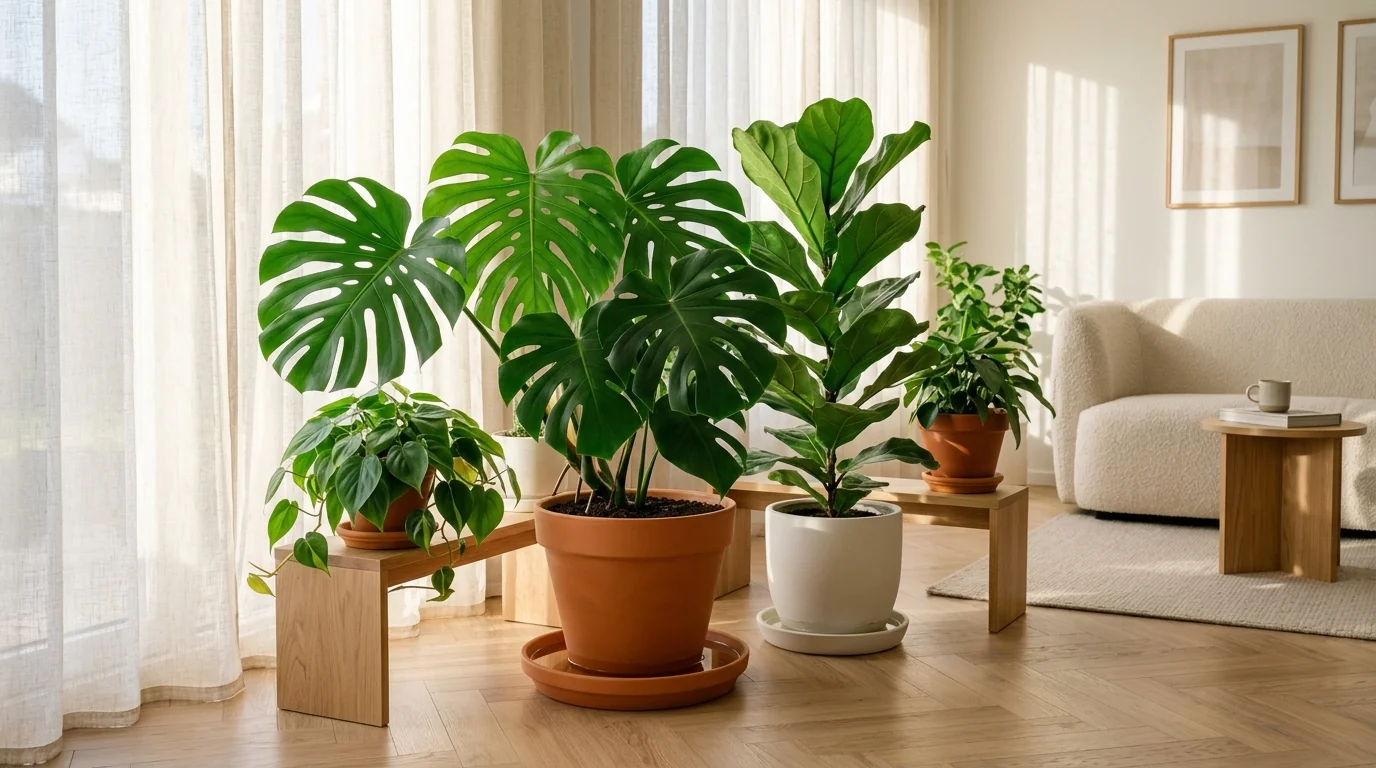
Every living plant naturally transpires water vapor through its leaves 24 hours a day. When an isolated plant sits alone in the corner of a room, that transpired moisture is swept away by room air currents. However, when you cluster five to eight houseplants closely together on a console table or tiered plant stand, their combined transpiration creates a shared, thick boundary layer of humid air. Relative humidity within the interior canopy cluster remains 12% to 18% higher than the rest of the room continuously.
2. The Pebble Tray Sub-Irrigation Pad
Place wide, shallow plastic or metal trays beneath your plant cluster. Fill the trays with 1 inch of smooth decorative river pebbles and pour in water until the water level sits roughly 1/4 inch below the top of the stones. Set your potted plants directly atop the dry surface of the pebbles. As the water evaporates naturally from the tray below, it rises continuously through the foliage above, creating a steady upward convective stream of pure water vapor without submerging the root ball.
3. Dedicated Regulated Humidifiers
For high-value collections containing delicate Alocasia, Calathea, or Anthurium species, invest in a dedicated ultrasonic or evaporative cool-mist humidifier placed 3 to 4 feet away from the plants. Set the humidistat between 55% and 65% relative humidity. This stabilizes atmospheric VPD, keeps stomata open for robust photosynthesis, and eliminates brown leaf tips permanently.
📥 Free Download: Houseplant Humidity & Boundary Layer Physics Field Guide
Vapor Pressure Deficit (VPD) charts, foliar disease prevention guides, pebble tray schematics, and winter indoor jungle survival protocols.
As an Amazon Associate, azuloz.com earns from qualifying purchases.