

You arrive home after a grueling, nine-hour workday staring at computer monitors, fluorescent office troffers, and backlit smartphones. Your eyes feel gritty and tired, your temples throb with low-grade tension, and your autonomic nervous system is yearning for rest. You walk into your living room and, out of pure domestic habit, flip the wall switch by the entryway door.
Instantly, a blistering, 5,000-lumen flush of cool-white illumination floods down from the dead center of the ceiling. The single, central overhead fixture—affectionately and derisively known across modern culture as “The Big Light”—blinds your vision, casts harsh, unflattering vertical shadows under your eyes and furniture, and drains all cozy warmth from the room. Within five minutes of sitting on your sofa under that central glare, you feel irritable, wired, and unable to settle into evening relaxation.
Across social media and architectural circles, a widespread grassroots rebellion has emerged against “The Big Light.” Millions of people instinctively despise turning on their ceiling fixtures, yet few understand the exact biological, ophthalmological, and architectural mechanisms that make overhead ceiling lighting so uniquely hostile to human wellbeing.
The problem is not your imagination; it is rooted in circadian photoreceptor biology, ocular zenith glare, and luminance contrast ratios. When you understand why center ceiling fixtures induce acute mental fatigue and master the 3-tier low-Kelvin perimeter lamp layering blueprint, you transform your home into an architecturally sculpted sanctuary of restorative evening calm.
The Circadian Biology of the ‘Big Light’: The Zenith Glare Trap
To understand why center overhead lighting induces physical stress, you must examine the evolutionary history of the human ocular system.
For hundreds of thousands of years, our hominid ancestors’ neurological states were calibrated entirely by the natural trajectory of the sun across the sky:
- Midday Equatorial Sun (Alertness & Stress): At solar noon, intense, full-spectrum daylight (5,500K to 6,500K) descends directly from zenith (90 degrees overhead). In nature, this zenith lighting signaled high metabolic exertion, hunting, vigilance, and acute predator awareness.
- Dusk and Firelight (Safety & Sleep): As the sun descends toward the horizon, light shifts from overhead zenith to a low, horizontal plane. Atmospheric Rayleigh scattering filters out short blue wavelengths, leaving only warm, golden-amber rays (1,800K to 2,400K). At night, light came exclusively from horizontal campfires and hearths set at eye level or floor level, signaling safety, communal storytelling, and physiological rest.
When you illuminate a residential living room or bedroom with a bright, cool-white fixture mounted in the center of the ceiling, your brain experiences profound evolutionary confusion. You are artificially simulating solar noon at 8:00 PM inside a domestic space.
“Turning on ‘The Big Light’ at night is the biological equivalent of sounding a silent, invisible fire alarm inside your brain, commanding your pineal gland to abort melatonin synthesis.”
The Retinal Mechanism: ipRGCs and Melatonin Suppression
In 2002, neuroscientists discovered a specialized class of light-sensing cells in the human eye that operate independently of traditional vision: intrinsically photosensitive retinal ganglion cells (ipRGCs).
These cells contain a unique photopigment called melanopsin, which is acutely sensitive to short-wavelength blue light (460nm to 490nm). Crucially, ipRGCs are concentrated predominantly in the inferior (lower) half of the human retina—the exact anatomical region wired to monitor light descending from overhead ceiling angles.
When a central overhead ceiling light activates these inferior retinal ganglion cells, they send immediate, high-velocity electrical impulses along the retinohypothalamic tract directly to the suprachiasmatic nucleus (SCN)—the master circadian pacemaker in the brain. The SCN issues an emergency neurochemical directive:
- Melatonin Shutoff: The pineal gland is immediately commanded to halt production of melatonin, the hormone responsible for lowering core body temperature and inducing restorative delta deep sleep. Studies reveal that exposure to typical cool-white residential overhead lighting suppresses melatonin by up to 85% and delays sleep onset by over 90 minutes.
- Cortisol Elevation: Adrenal signaling keeps cortisol elevated, prolonging sympathetic nervous system fight-or-flight arousal long after dinner.
- Pupillary Asthenopia (Eye Strain): Because the solitary ceiling fixture is dramatically brighter than the dim, shadowed corners of the room, your pupils are subjected to extreme luminance contrast ratios (often exceeding 50:1). As your gaze darts between your phone, your coffee table, and the room periphery, the tiny ciliary muscles and pupillary sphincters must constantly contract and dilate, inducing acute muscular eye fatigue, tension headaches, and dry eyes.

The Architectural Flatness: Why Overhead Bulbs Kill Aesthetic Depth
Beyond neurological exhaustion, center ceiling fixtures commit the ultimate architectural crime: they obliterate spatial depth and make high-end interiors look cheap and institutional.
A single point-source light mounted on the ceiling casts harsh, unnatural downward shadows. It creates dark shadows under your eyes (giving guests a tired, sunken appearance), accentuates every minor imperfection or drywall seam, and leaves vertical wall surfaces completely unilluminated.
In classical architectural theory, rooms feel welcoming and luxurious when illumination creates pools of graduated light and soft shadow. A solitary overhead bulb flattens 3D architectural planes into a sterile, featureless box reminiscent of an interrogation room or a hospital examination clinic.
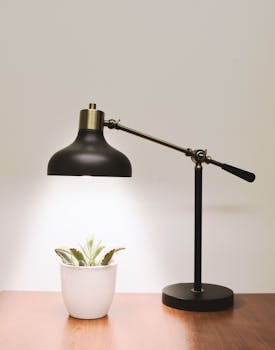
Amazon US Verified
Dimmable Warm Amber Table Lamp with Textured Linen Shade
Eye-level horizontal diffuser featuring stepless rotary dimming and flicker-free 2200K–2700K warm LED illumination that protects melatonin synthesis while sculpting cozy ambient vignettes.
The 3-Tier Low-Kelvin Lamp Layering Blueprint
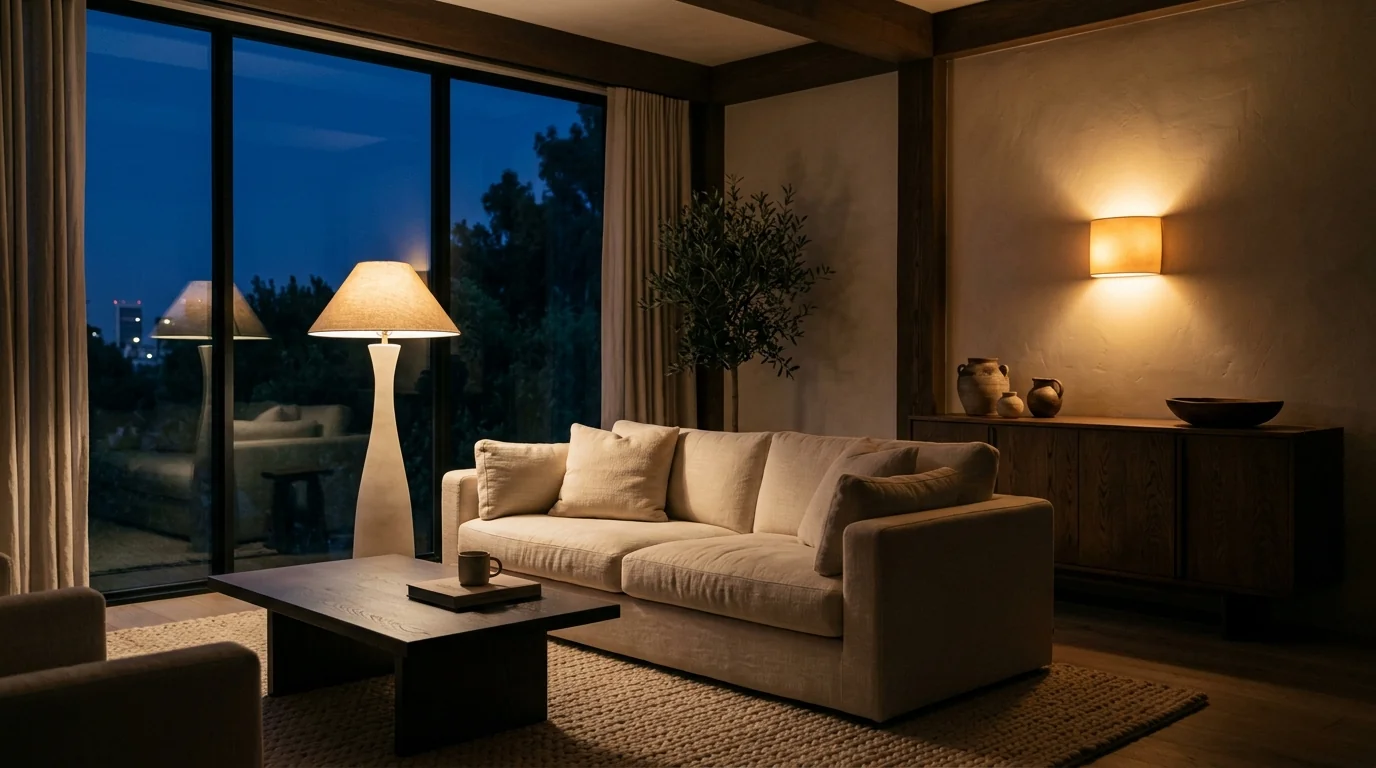
How do you illuminate a home beautifully without ever touching “The Big Light”? Architectural lighting designers replace the single central source with a distributed 3-tier perimeter lighting system calibrated to the evening circadian spectrum (2,200K to 2,700K):
Tier 1: Eye-Level Horizontal Table Lamps (The Intimacy Layer)
Place table lamps on end tables, credenzas, bookshelves, and nightstands at a height of 36 to 48 inches above the floor. Ensure the lamp shades are opaque or made of heavy, textured linen, bouclé, or frosted milk glass. This diffuses the light horizontally into seated eye levels, completely shielding pupils from harsh direct filament glare and mimicking ancient hearth fires.
Tier 2: Upward Floor Bounces (The Ambient Envelope)
Position tall floor lamps—such as torchiere lamps or arched floor lamps with opaque shades—in dark, neglected corners of the room. By projecting light upward against the ceiling, the light reflects back down into the room as an extraordinarily soft, shadow-free, low-glare luminous cloud. This elevates vertical surfaces and widens the perceived visual width of the room.
Tier 3: Low-Level Grounding Accents (The Hearth Layer)
Install warm 2,200K to 2,400K LED accent strips concealed beneath kitchen base cabinets, under floating credenzas, or behind headboards. Lighting the bottom twelve inches of a room grounds the spatial floor plane, allows effortless navigation without turning on switches, and signals deep nocturnal safety to the primitive brain.
📥 Free Download: Low-Kelvin Ambient Lighting & Lamp Layering Blueprint
Circadian lux calculations, lamp placement floor plans, dim-to-warm bulb recommendations, and glare-free living room schematics.
The Golden Evening Rule: The 7:00 PM Light Switch Protocol
Make a conscious, permanent agreement in your household: at 7:00 PM (or sunset), all center ceiling fixtures are permanently switched off for the night.
Turn on three or four low-wattage, warm amber perimeter lamps. The transformation is immediate and visceral. The atmosphere softens; visual noise drops; heart rates settle; conversation becomes quieter, more intimate, and grounded. You reclaim your home from clinical sterility and give your nervous system the evolutionary sanctuary it deserves.
As an Amazon Associate, azuloz.com earns from qualifying purchases.