

You return from a massive weekend trip to the grocery store with six canvas bags overflowing with fresh produce, dairy, deli meats, and pre-packaged meal essentials. Armed with determination, you open your refrigerator doors and begin a meticulous game of domestic Tetris. You slide cartons of milk behind tall pitchers of iced tea, stack glass casserole dishes three layers high on the middle shelf, wedge bags of crisp apples between condiment jars, and press plastic containers of leftovers flat against the plastic back wall.
When you step back, the sight is deeply satisfying: every square inch of shelf space is utilized, not a single cubic centimeter of air is wasted, and your family appears fortified for the coming two weeks. You close the heavy magnetic door with a triumphant snap, convinced that you have achieved the pinnacle of domestic organization and food preparedness.
Yet if an appliance engineer, thermodynamicist, or commercial food safety inspector peeked inside your packed refrigerator, they would see an unfolding domestic disaster. By packing your shelves to the brim, you have not secured your food supply; you have triggered an invisible mechanical choke point. Understanding the fluid convection physics behind residential refrigeration reveals why an overpacked fridge ruins your compressor, triples your electricity consumption, and creates lethal bacterial microclimates that silently spoil your food.
The Thermodynamic Fallacy: Your Refrigerator Does Not Create “Cold”
To understand why an overstuffed refrigerator fails, you must first dismantle a fundamental misconception about atmospheric physics: there is no such physical entity as “cold.” Cold is simply the perceptual absence of thermal energy (heat). Your refrigerator does not pump “coldness” into a sealed box; it is a thermal extraction engine engineered to pump heat energy out of your food and dump it into your kitchen.
This heat removal process is powered by a closed-loop vapor-compression cycle:
- A motorized pump—the compressor—compresses chemical refrigerant vapor, raising its temperature and pressure.
- The superheated refrigerant travels through exterior condenser coils (located beneath or behind the appliance), shedding its heat into your kitchen air and condensing into a high-pressure liquid.
- The liquid passes through an expansion capillary valve, where pressure drops abruptly, causing the refrigerant to flash-boil and plunge to sub-zero temperatures inside the internal evaporator coils.
- A motorized evaporator fan forces ambient air from the refrigerator cabinet across these freezing evaporator coils. Heat from the air transfers into the cold refrigerant, which vaporizes and travels back to the compressor to repeat the cycle.
Here is the critical physical reality that governs the entire machine: refrigeration relies entirely on air as a working fluid. If air cannot physically circulate across every food container, heat energy cannot leave the food. Static, trapped air is an exceptional thermal insulator. When you pack shelves edge-to-edge, you effectively wrap your food in an invisible insulating blanket, trapping warmth inside your containers and preventing the evaporator coils from doing their job.
The Convective Choke Point: Creating the Bacterial “Danger Zone”
Inside a healthy, properly loaded refrigerator, air circulation operates through a combination of forced mechanical convection (the evaporator fan) and natural buoyant convection (cool air sinks because it is denser, while warm air rises). This creates continuous, smooth toroidal currents that sweep across shelves, equalizing temperatures throughout the cabinet.
When you pack shelves full, you introduce severe aerodynamic resistance:
- Vent Occlusion: Cold air typically enters the main refrigerator compartment through discharge vents located on the upper back wall. When you push a large family-sized pack of chicken breasts or a flat casserole dish directly against these vents, you physically block the air discharge jet.
- Thermal Dead Zones: Deprived of convective air currents, the interior breaks apart into extreme temperature microclimates. Right around the blocked vent, freezing air backs up, dropping temperatures to 28°F (-2°C) and turning delicate spinach, lettuce, and milk into frozen, cell-ruptured slush.
- The Door Pocket Trap: Meanwhile, at the front of the shelves and inside the plastic door bins, the lack of air turnover allows heat radiating through the door seals to pool uninhibited. Temperatures in the door compartments easily climb to 43°F to 48°F (6°C to 9°C).
In food microbiology, temperatures between 40°F and 140°F (4.4°C to 60°C) are classified as the Bacterial Danger Zone. Pathogenic foodborne bacteria—including Listeria monocytogenes, Salmonella enterica, and Escherichia coli—do not need to be at room temperature to multiply; in stagnant 45°F door pockets, their doubling time accelerates dramatically. Homeowners frequently open a carton of milk stored in the door and wonder why it smells sour four days before its expiration date, completely unaware that their overpacked shelves created an incubator inside their appliance.
The Mechanical Toll: Why Overpacking Destroys the Compressor
The consequences of choked airflow extend far beyond spoiled yogurt and frozen cucumbers; it strikes at the mechanical heart of the appliance: the compressor.
A residential refrigerator compressor is an electric motor operating under strict thermodynamic design parameters. In a balanced system, the compressor runs in measured duty cycles—typically engaging for 20 to 30 minutes to pull the cabinet down to its target temperature, then shutting off for 20 to 30 minutes to rest and cool down its internal copper windings.
When airflow is choked by wall-to-wall containers, the refrigerator’s internal thermistor (temperature sensor) continuously registers that the cabinet air is too warm. The sensor sends an unrelenting demand to the main electronic control board: Keep running.
Instead of a healthy 50 percent duty cycle, the compressor is forced into continuous, non-stop operation, running 90 to 100 percent of the time. This produces three catastrophic engineering failures:
- Thermal Overheating of Motor Windings: Without adequate rest intervals, the compressor’s hermetically sealed motor cannot dissipate internal winding heat. The protective lubricating oil breaks down chemically, leading to metal-on-metal friction and mechanical seizure.
- Start Relay and Capacitor Burnout: The continuous electrical draw overheats the positive temperature coefficient (PTC) start relay and capacitor, leading to sudden electrical failure that leaves your entire fridge warm overnight.
- Spiking Utility Bills: A refrigerator forced to run continuously due to choked convection draws between 200 and 400 percent more kilowatt-hours of electricity per month, quietly adding dozens of dollars to your monthly utility bills.
The 70-Percent Rule: The Golden Ratio of Domestic Cold Storage
To eliminate thermal microclimates, protect your compressor, and maximize food preservation, commercial refrigeration engineers adhere to a golden operational standard: The 70-Percent Rule.
At no point should your refrigerator cabinet exceed 70 percent volumetric capacity. The remaining 30 percent of the interior volume must remain open, unobstructed air channels. Air requires continuous physical pathways to flow from the top discharge vents, tumble down through the middle tiers, sweep across the front of the shelves, and return to the lower intake grilles.
Maintaining the 70-percent rule requires adhering to three simple spacing disciplines:
- The Perimeter Moat: Maintain a strict 2-inch to 3-inch gap between any food container and the back and side walls of the refrigerator. Never push items flush against the plastic liner.
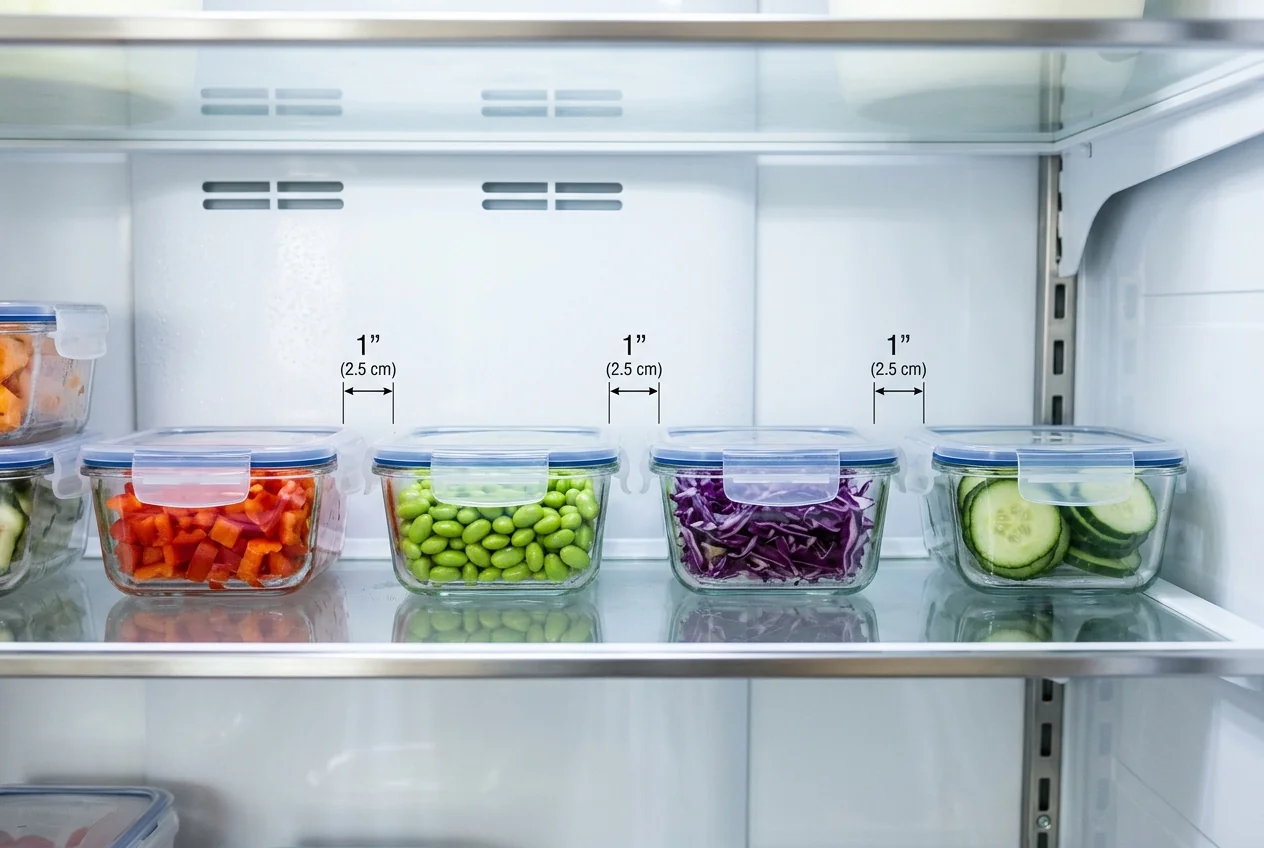
- The Inter-Container Gap: Leave at least one finger’s width (roughly 1 inch) of open space between adjacent food containers on every shelf. Air must be able to circulate 360 degrees around each vessel to extract heat through its sidewalls.
- The Vent Exclusion Zone: Locate the cold air discharge grilles (typically marked by slotted plastic louvers at the top or center of the rear panel). Maintain an absolute 4-inch radius of completely open space in front of these vents.
The 4-Tier Storage Architecture: Harmonizing Physics and Food Safety
Because temperatures within a refrigerator naturally vary based on proximity to the evaporator coils and door openings, storing food correctly requires aligning your groceries with the thermodynamic realities of each zone:
Tier 1: The Upper Shelves (36°F to 38°F / 2.2°C to 3.3°C)
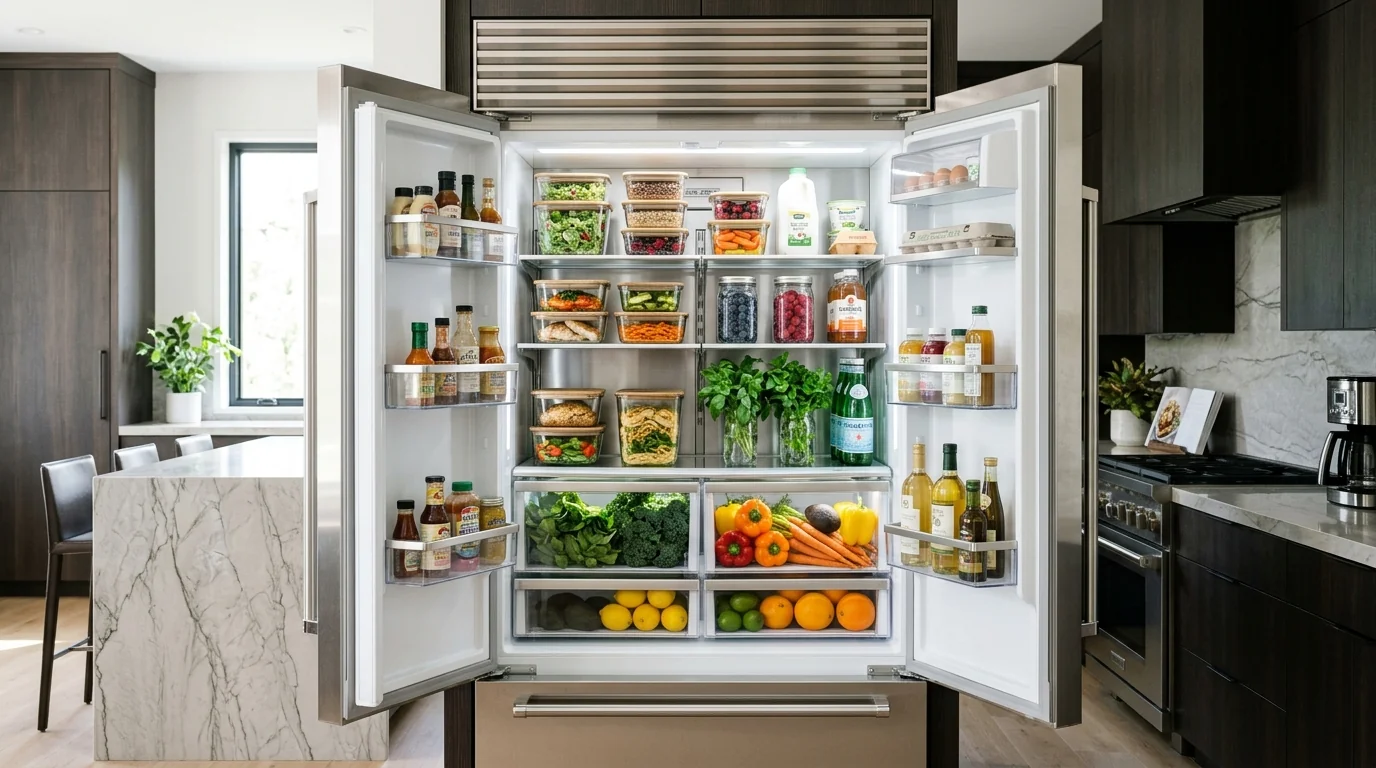
The top tier boasts the most stable, consistent temperatures because it is buffered from the immediate floor drafts when the door opens. Reserve this zone for foods that require zero further cooking: leftovers, prepped salad bowls, cooked deli meats, hummus, yogurts, and delicate fresh berries. Storing pre-cooked foods on high shelves also eliminates the physical risk of raw food liquids dripping down from above.
Tier 2: The Middle Shelves (35°F to 37°F / 1.6°C to 2.7°C)
The middle shelf experiences steady, rapid convective airflow. This is the optimal home for dairy products—whole milk, heavy cream, cheeses, and sour cream. Keep milk cartons toward the back of the middle shelf where temperatures remain cold and uniform.
Tier 3: The Bottom Shelf (33°F to 35°F / 0.5°C to 1.6°C)
Cold air sinks to the lowest point of the cabinet, making the bottom glass shelf the absolute coldest zone in the entire refrigerator. This zone should be dedicated exclusively to raw animal proteins: poultry, beef, pork, and seafood. Storing raw meats at 34°F halts bacterial reproduction in its tracks. Always place raw meats inside a rimmed stainless steel or glass baking dish to catch any accidental juice leaks and prevent cross-contamination.
Tier 4: The Crisper Drawers (37°F to 40°F / 2.7°C to 4.4°C)
Crisper drawers are enclosed microclimates designed to control vapor transpiration. Calibrate your dual drawers with purpose:
- High Humidity (Vent Closed): For leafy greens, herbs, broccoli, and carrots. Closing the vent traps moisture vapor, preventing thin leaves from dehydrating and withering.
- Low Humidity (Vent Open): For ethylene-producing fruits like apples, pears, and stone fruits. Opening the sliding vent allows ethylene gas to escape into the main cabinet, preventing premature rotting.
Tier 5: The Door Bins (40°F to 43°F / 4.4°C to 6.1°C)
Every time you open the refrigerator door, the door bins are completely bathed in room-temperature kitchen air. The door is the warmest, most thermally volatile real estate in the entire appliance. Only store items that are heavily preserved with salt, acid, or sugar: mustard, ketchup, soy sauce, hot sauces, pickles, olives, salad dressings, and pasteurized juices. Never store fresh milk or whole raw eggs in the door bins, despite the molded egg trays provided by appliance manufacturers.
The 10-Minute Monthly Appliance Reset
To ensure your refrigerator operates at peak thermodynamic efficiency and delivers decades of trouble-free cooling, execute this quick monthly maintenance audit:
- Conduct the Paper Squeeze Test on Door Gaskets: Close your refrigerator door on a standard one-dollar bill or strip of paper. Pull the paper gently. If it slides out with zero resistance, your magnetic vinyl door gasket is worn, cracked, or dirty, allowing hot, humid room air to continuously leak into the cabinet. Clean the gasket with warm water and baking soda, or replace it.
- Purge the “Ghost” Jars: Once a month, pull out half-empty jars of marinades and specialty sauces that have sat untouched for four months. Discard them to free up vital cubic inches of convective airflow.
- Vacuum the Exterior Condenser Coils: Pull your refrigerator out once every six months and vacuum the metal coils located behind or underneath the unit. A 1/8-inch blanket of pet hair and dust on condenser coils cuts heat dissipation efficiency by 30 percent, forcing the compressor to run hotter and louder.
Your refrigerator is not a static storage locker; it is a dynamic, living wind tunnel of thermal preservation. By giving your shelves room to breathe, respecting the 70-percent rule, and aligning your groceries with internal microclimates, you protect your family’s health, slash your energy footprint, and keep your kitchen running with effortless thermodynamic precision.
📥 Free Download: Refrigerator Airflow & Thermodynamic Blueprint
Convective fluid channels, the 70% capacity rule, and temperature microclimate zoning guidelines.