

You stand in the fitting room of a clothing boutique, running your hands across the sleeve of a beautifully draped camel wool blazer, an ivory silk blouse, or a cloud-soft cashmere cardigan. The garment fits impeccably. But as you prepare to walk toward the cash register, you flip open the interior side seam to inspect the white fabric care tag. There, printed in stark black letters, sit three words designed to strike dread into any budget-conscious shopper: DRY CLEAN ONLY.
Your mind immediately tallies the hidden lifetime cost of ownership: the weekly errands to the strip-mall dry cleaner, the twenty-dollar cleaning bill per piece, the wire hangers cluttering your closet, the strange chemical odor clinging to the fabric, and the eventual stiffening of fibers after half a dozen commercial cycles. For many, that tiny tag is enough to put the garment back on the rack.
Yet if you speak to textile conservators, museum curators, and bespoke tailors, they will let you in on one of the fashion industry’s best-kept secrets: over 90 percent of garments labeled “Dry Clean Only” do not need to go anywhere near a commercial dry cleaner. In fact, routine commercial dry cleaning often accelerates the degradation of fine natural fibers. Understanding the legal origins of care tags and the physics of thermal steaming reveals how you can maintain luxury garments at home with greater safety, zero toxic solvents, and practically zero cost.

The FTC Loophole: Why Care Labels Are Legal Shields, Not Science
To understand why clothing tags are so misleading, you have to examine the legal landscape governing textile manufacturing. In the United States, garment care instructions are regulated by the Federal Trade Commission (FTC) under the Care Labeling Rule (16 CFR Part 423).
Under federal law, apparel manufacturers are legally mandated to provide at least one reliable method for cleaning the garment. Crucially, the law does not require the brand to list the best method, the most environmentally sustainable method, or the method that will preserve the fabric the longest. They are only required to list a method that will not destroy the garment.
Furthermore, testing multiple cleaning methods—such as conducting standardized laboratory trials for gentle hand-washing, low-temperature drying, and vertical steaming—costs clothing brands thousands of dollars per fabric run. If a manufacturer labels a wool sweater “Hand Wash Cool” and an inattentive consumer tosses it into a 1200 RPM hot wash cycle with heavy laundry detergent, the sweater shrinks and the consumer demands a refund.
To insulate themselves against customer complaints, warranty claims, and liability lawsuits, fashion brands take the path of least resistance: they slap “Dry Clean Only” on virtually every garment containing natural fibers. The label is an aggressive corporate liability disclaimer designed to transfer 100 percent of the risk from the manufacturer to the dry cleaner.
The Chemistry of Dry Cleaning: The Hidden Perils of “Perc”
The term “dry cleaning” is one of the most misleading marketing phrases in modern commerce. Dry cleaning is not dry; your clothes are completely submerged in liquid and tumbled inside a massive, motorized industrial washing drum.
The difference is that the liquid is not water. For more than seven decades, the overwhelming solvent of choice in commercial dry cleaning has been perchloroethylene (commonly known in the industry as “perc”). Perc is a synthetic chlorinated hydrocarbon solvent prized by commercial operators because it dissolves non-polar compounds (such as body oils, grease, and fats) without swelling water-soluble fibers like wool or rayon.
However, perc introduces serious physical and biological hazards:
- Toxicological Profile: Perchloroethylene is classified by the U.S. Environmental Protection Agency (EPA) and the International Agency for Research on Cancer (IARC) as a likely human carcinogen and a potent neurotoxin. Chronic exposure is linked to liver damage, kidney dysfunction, and cognitive impairment. Many states and European nations are actively phasing it out or banning it entirely.
- Stripping of Natural Lipids: Animal protein fibers (such as sheep wool, cashmere, and alpaca) depend on an ultra-thin natural lipid coating known as 18-methyleicosanoic acid (18-MEA) and residual lanolin. These natural waxes give wool its water resistance, suppleness, and elasticity. Perc is an aggressive non-polar solvent that completely strips these protective waxes away. Over multiple cycles, the fiber cortex becomes brittle, dry, and prone to microscopic fracturing.
- Residue and Odor: The distinct “dry cleaner smell” that greets you when you unzip a plastic garment bag is not cleanliness; it is volatile organic perc vapor trapped in the fabric weave. Off-gassing these fumes in a closed bedroom closet exposes your family to continuous low-level chemical inhalation.
The Physics of Pure Thermal Steam: Molecular Hydrogen Reset
If toxic chemical solvents are harsh and washing machines cause felting, what is the professional conservator’s secret for maintaining fine natural textiles? The answer is pure, high-velocity gaseous water vapor: thermal steam.
To understand why steaming is so miraculous for natural fibers, you have to look at the physics of wrinkles. At a molecular level, natural fibers like wool, silk, and cotton are composed of long polymer chains held in alignment by cross-linking hydrogen bonds. When you wear a garment, body heat, mechanical pressure, and sweat cause these weak hydrogen bonds to break and reform in bent, compressed configurations—creating visible wrinkles and creases.
When you direct a vertical plume of 212°F (100°C) steam onto hanging fabric, three distinct physical phenomena occur simultaneously:
- Instantaneous Bond Relaxation: Unlike liquid water (which floods the fiber and causes swelling), steam delivers micro-particulate vapor paired with intense thermal kinetic energy. The heat and humidity instantly break the misplaced hydrogen bonds holding the wrinkle in place. Under the natural gravitational weight of the hanging garment, the fibers relax and drop back into their straight, parallel resting state.
- Thermal Deodorization and Sanitization: The unpleasant smell in worn clothing is rarely the fabric itself; it is volatile fatty acids produced by bacteria (specifically Staphylococcus and Corynebacterium) feeding on skin sweat in high-friction areas like the underarms. At 212°F, thermal steam instantly denatures bacterial proteins, killing 99.9 percent of odor-causing microbes on contact without a single drop of chemical detergent.
- Pile Re-Lofting: In wool and cashmere, steam penetrates the cortex and reactivates the natural helical crimp of the keratin proteins. Flattened, compressed fibers spring back to life, restoring the plush, airy loft and tactile softness of the original knitwear.
The Critical Triage: What Can Be Steamed vs. What Truly Needs Dry Cleaning
While 90 percent of garments can be cared for at home, there are specific, legitimate architectural reasons certain garments genuinely require professional dry cleaning. Performing a quick structural triage prevents costly home mistakes:
Safe for Home Steaming & Spot Care (90% of Your Wardrobe):
- Unstructured Wool & Cashmere: Sweaters, cardigans, scarves, knit dresses, and unlined wool coats.
- Pure Silk: Blouses, scarves, and unlined silk dresses (steam from the inside out to avoid water droplets).
- Fine Cotton & Linen: Tailored shirts, trousers, and summer dresses.
- Synthetics & Blends: Polyester, nylon, and acrylic knitwear.
Must Go to a Professional (The 10% Exception):
- Structured Tailoring with Interfacing: High-end men’s suit jackets and tailored blazers contain hidden interior layers—horsehair canvas, chest felts, and fused adhesive interfacing—sandwiched between the wool shell and the lining. If saturated with moisture, water-soluble canvas glues can dissolve or shrink at different rates than the wool, causing permanent puckering (“bubbling”) along the lapel.
- Viscose and Rayon: Rayon is a regenerated cellulose fiber with extraordinarily weak wet tensile strength. When exposed to steam or water, rayon fibers lose up to 50 percent of their structural integrity and can stretch or shrink unpredictably.
- Mixed Media & Ornate Trim: Garments with genuine leather collars, suede patches, delicate feathers, hand-sewn sequins, or antique metal beading.
- Heavy Oil & Paint Stains: Ground-in motor oil, industrial grease, or salad dressing saturated into fine silk that cannot be lifted with mild surfactants.
The 4-Step At-Home Garment Preservation Masterclass
To reduce your dry cleaning bills by 90 percent while extending the lifespan of your wardrobe by years, execute this simple professional routine:
1. Invest in a Wild Boar Bristle Clothes Brush
The most overlooked garment care tool in the modern home is a classic clothes brush. After wearing a wool coat, blazer, or trousers, hang the garment and brush downward with firm, sweeping strokes. Natural boar bristles reach between the woven yarns, physically dislodging road dust, microscopic grit, food crumbs, and dried soil before they can work their way into the fiber core and act like microscopic sandpaper.
2. The Vertical Steaming Routine
Hang your garment on a sturdy, contoured wooden hanger. Fill a handheld or standing garment steamer with distilled water (distilled water prevents calcium mineral scale from clogging the nozzle or spitting onto fabric).
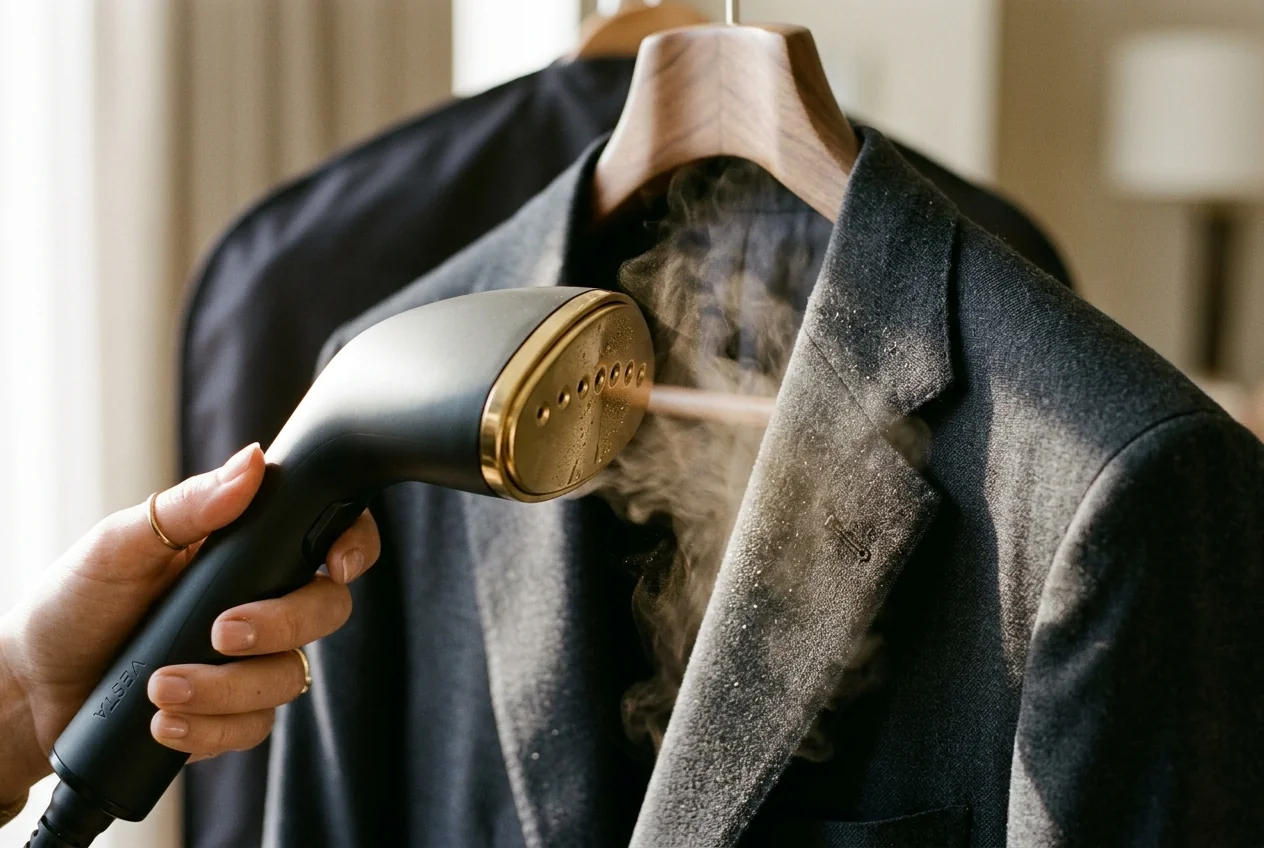
Hold the fabric taut with one hand and sweep the steam nozzle smoothly down the garment, holding the brass head approximately half an inch from the surface. For delicate silks, steam from the inside of the garment outward. Allow the garment to hang undisturbed for ten minutes after steaming so residual vapor evaporates, setting the smooth fibers in place.
3. Spot-Treat Lipids with Mild Enzymatic Chemistry
If you drop food on a wool or silk garment, never rub the spot aggressively with a wet napkin, which drives the stain deeper into the weave.
Instead, mix a drop of gentle pH-neutral liquid wool wash or delicate baby shampoo with cold water. Dip a clean white cotton washcloth into the solution and gently dab (blot) the stain from the outside edge toward the center. Blot with a second dry cloth to lift the emulsified oil, then steam the area to blend the fibers.
4. The Seasonal Storage Protocol
Clothes moths are not attracted to wool fibers; they are attracted to the microscopic traces of human sweat, skin flakes, and body oils left behind on worn wool.
Before packing winter coats and cashmere sweaters away for the summer, steam every square inch thoroughly and brush them. Store them in breathable 100 percent natural cotton canvas garment bags (never sealed in plastic dry cleaner bags, which trap humidity and off-gassed chemicals). Add natural cedar blocks or dried lavender sachets to the closet. The natural aromatic thujone in cedar acts as an organic deterrent, ensuring your fine knitwear emerges in the autumn as fresh, pristine, and luxurious as the day you brought it home.
By demystifying the care label and embracing the gentle power of thermal steam, you break free from the expensive, chemical-heavy dry cleaning cycle—protecting your wardrobe, your health, and your family’s budget for a lifetime.
📥 Free Download: Garment Care Label Decoder & Steaming Guide
FTC liability label loopholes, perchloroethylene solvent risks, and the 4-step home steaming and boar bristle preservation routine.