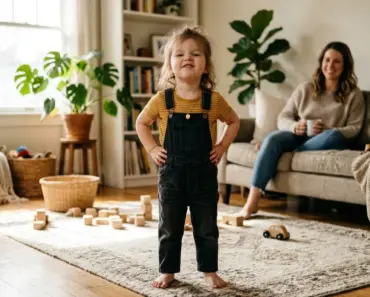

Step across the threshold of a typical modern family playroom, and you are immediately greeted by an overwhelming, multi-colored sensory spectacle. Plastic storage totes brim with tangled plastic figurines, battery-operated electronic gadgets blink and chirp from forgotten corners, plush animals pile ceiling-high in woven hampers, and hundreds of interlocking plastic bricks carpet the floor like miniature landmines.
Every single one of these objects was acquired out of profound parental love and generosity. We buy our children toys to celebrate birthdays, reward milestones, spark holiday wonder, and provide enriching sensory experiences. Consciously or subconsciously, modern parents operate on an intuitive cultural equation: More toys equal more creative possibilities, greater intellectual stimulation, and happier, more independently engaged children.
Yet if you observe what actually happens inside an overstuffed playroom, reality delivers a baffling and frustrating paradox. Despite owning enough playthings to stock a small retail boutique, children in toy-dense environments rarely engage in peaceful, deep, focused play. Instead, they wander restlessly from bin to bin, dump entire baskets of blocks onto the carpet, fiddle with a gadget for forty seconds, abandon it, and inevitably utter the four words that drive parents to the brink of despair: “I’m bored! There’s nothing to do.”
This restlessness is not a sign of ungratefulness, nor does it indicate an attention deficit. It is a direct neurobiological reaction to environmental sensory overload. Landmark developmental psychology research reveals that having fewer toys does not restrict a child’s imagination; it dramatically expands their sustained attention, sparks sophisticated divergent problem-solving, and restores emotional tranquility to the home.
The Toledo Experiment: The Science of Fewer Toys
The scientific dismantling of the “more is better” toy paradigm arrived in a groundbreaking study conducted by Dr. Carly Dauch and a team of developmental researchers at the University of Toledo, published in the peer-reviewed journal Infant Behavior and Development.
The researchers set out to measure how the quantity of toys in a child’s immediate environment alters the duration, depth, and quality of their independent play. They recruited toddlers between 18 and 30 months of age and observed them playing individually in a controlled playroom under two distinct environmental conditions:
- Condition A (High Density): The playroom was furnished with 16 different age-appropriate toys scattered invitingly across the floor.
- Condition B (Low Density): The exact same playroom was furnished with only 4 carefully curated toys.
The researchers recorded every interaction using high-resolution video telemetry, tracking metrics including the number of toys touched, the length of time spent with each object, and the complexity of the child’s play manipulations.
The results shocked educators and parents alike:
- Engagement Duration Tripled: In the 4-toy environment, toddlers played with individual toys for significantly longer, sustained durations—often spending three to four times more continuous minutes exploring a single object compared to when 16 toys were present.
- Play Depth and Creativity Quadrupled: When surrounded by 16 toys, children engaged in superficial, repetitive actions: picking an item up, pressing a single button, tossing it aside, and reaching for the next shiny plastic object. In the 4-toy environment, children exhibited profound divergent thinking: they used a single wooden block as a telephone, a sandwich, a bridge for a toy cow, and a hammer, inventing intricate multi-step narrative scenarios.
- Sensory Agitation Vanished: In the 16-toy condition, toddlers exhibited high frequencies of abrupt posture shifts, scanning gazes, and whining. In the 4-toy condition, their physical bodies relaxed into calm, grounded, seated concentration—a state known in psychology as “flow.”
The Immature Prefrontal Cortex: The Cost of Selective Attention
Why does an abundance of toys cause children to lose the ability to play? The answer lies in the developmental architecture of the human brain’s executive control center: the prefrontal cortex (PFC).
In adults, the prefrontal cortex possesses mature, well-myelinated neural circuits responsible for top-down selective attention. If an adult sits at a desk to read a book in a coffee shop, their brain actively filters out background conversations, street traffic, and the hum of the espresso machine. The brain expends effort to ignore non-essential sensory inputs, keeping focus anchored to the printed page.
In a toddler or young school-age child, however, top-down inhibitory filtering is virtually non-existent. A child’s brain is biologically wired for bottom-up attentional capture. Their survival mechanism is designed to scan the entire horizon and attend to whatever sensory stimulus is loudest, brightest, or moving fastest.
When a child sits on the floor of a playroom containing 25 visible toys, their visual cortex is bombarded with competing electromagnetic wavelengths, contrasting shapes, and commercial logos. For the child to focus on building a tower with six wooden blocks, their fragile, developing prefrontal cortex must exert immense, exhausting metabolic energy to actively suppress the visual pull of the 24 other toys sitting within their peripheral gaze.
Within fifteen minutes, the child’s finite reservoir of prefrontal glucose is completely depleted. The brain experiences acute cognitive fatigue. Unable to filter the visual noise any longer, the child’s nervous system enters a state of sensory dysregulation. They dump toy baskets, throw objects across the room, and break into emotional tears over minor frustrations—not because they are misbehaving, but because their environment has overwhelmed their cognitive processing capacity.
Active Toys vs. Passive Toys: The Entertainment Trap
Compounding the problem of toy volume is the technological nature of modern playthings. Over the past three decades, traditional play materials have been largely replaced by electronic, battery-operated “interactive” toys that sing, flash LED lights, talk, and dance at the push of a plastic button.
Infant educator Magda Gerber, founder of Resources for Infant Educarers (RIE), coined a profound pedagogical maxim that remains the gold standard in early childhood development:
“Passive toys make active babies; active toys make passive babies.”
When a toy is “active”—when it flashes lights, sings the alphabet, and provides pre-programmed digital entertainment—the toy is doing 90 percent of the cognitive work. The child is reduced to a passive button-pusher, awaiting the next predetermined dopamine burst. Once the child has pushed the button three times and memorized the song, the toy has exhausted its novelty. It has no open-ended utility. The child discards it, craving another new gadget.
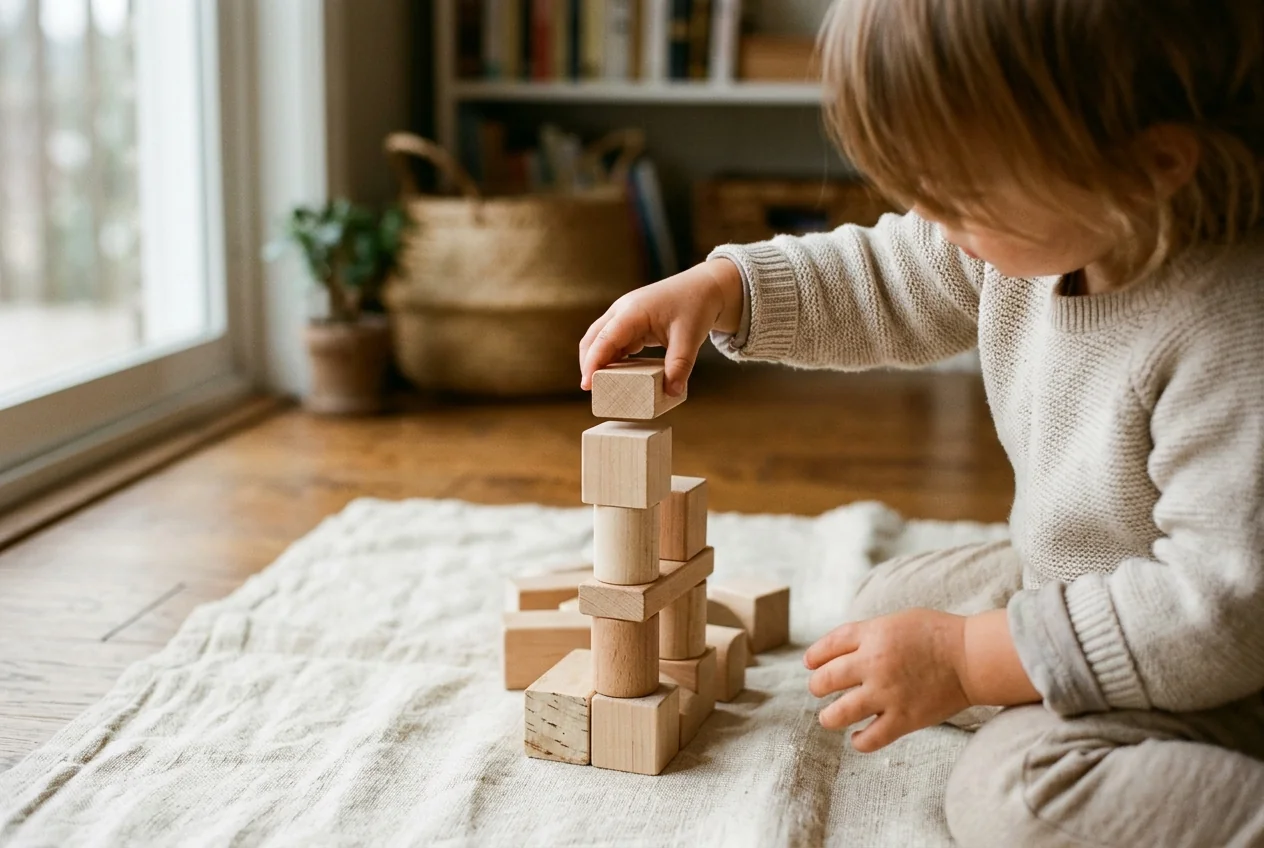
By contrast, when a toy is “passive”—such as a set of unpainted solid maple building blocks, a square of natural silk fabric, a stack of nesting bowls, or a collection of smooth river stones—the object does nothing on its own. It is completely inert. For the toy to come alive, the child must supply 100 percent of the intelligence, narrative, physics, and emotional energy. A wooden block can become an airplane, a hospital, a birthday cake, or an animal stall. Passive, open-ended materials invite lifelong mastery, encourage spatial-visual reasoning, and never lose their developmental relevance.
The 4-Bin Rotation Architecture: The High-Yield Play System
Eliminating playroom chaos does not mean throwing your child’s cherished possessions into the garbage. It requires implementing a simple, highly effective behavioral strategy known as Toy Rotation.
The goal of toy rotation is to keep 80 percent of your child’s toys stored completely out of sight in closets, while displaying only 4 to 6 high-yield, open-ended play materials in their everyday living space.
To execute a flawless rotation, divide your play materials into four core developmental categories across four sealed, opaque storage bins:
Bin Category 1: Construction & Spatial Engineering
- Materials: Solid wood building blocks, magnetic building tiles, architectural planks (such as Kapla or CitiBlocs), or simple interlocking wooden gears.
- Neurological Benefit: Fosters three-dimensional spatial reasoning, fine motor grip pressure, structural balance intuition, and hand-eye coordination.
Bin Category 2: Symbolic & Narrative Play
- Materials: A set of realistic wooden or felt animal figures, simple unpainted peg dolls, a small basket of wooden play vegetables, or colorful natural playsilks.
- Neurological Benefit: Drives language acquisition, emotional projection, Theory of Mind, and social-emotional storytelling.
Bin Category 3: Fine Motor Mastery & Problem Solving
- Materials: A high-quality wooden jigsaw puzzle, wooden bead-stringing rods, geometric shape sorters, or a set of nesting wooden cups.
- Neurological Benefit: Trains task perseverance, bilateral hand coordination, and logical deductive reasoning.
Bin Category 4: Gross Motor & Proprioceptive Regulation
- Materials: Wooden balance stepping stones, a curved wooden balance board (wobble board), or a heavy canvas beanbag toss.
- Neurological Benefit: Provides heavy work for the vestibular and proprioceptive systems, releasing physical tension and improving postural core strength.
The Sunday Evening Swap: Restoring Novelty Without Spending a Dime
The logistical beauty of a 4-bin rotation system is its ability to manufacture fresh, thrilling novelty without spending a single dollar on new purchases. In neurobiology, the brain’s dopamine reward pathways are wired to respond to perceptual novelty.
When a toy sits on a shelf in plain view for six consecutive months, the child’s brain habituates to it. The object becomes invisible background clutter. But when that exact same wooden train set or block bin is packed into an opaque container in a hall closet and hidden for three weeks, something miraculous happens: the child’s visual memory decays.
On Sunday evening, while your children are asleep, spend ten minutes resetting the playroom:
- Pack up the current toys and return them to their respective storage bins in the closet.
- Pull out just one item from each of the four categories (for example: one box of blocks, one set of farm animals, one puzzle, and a balance board).
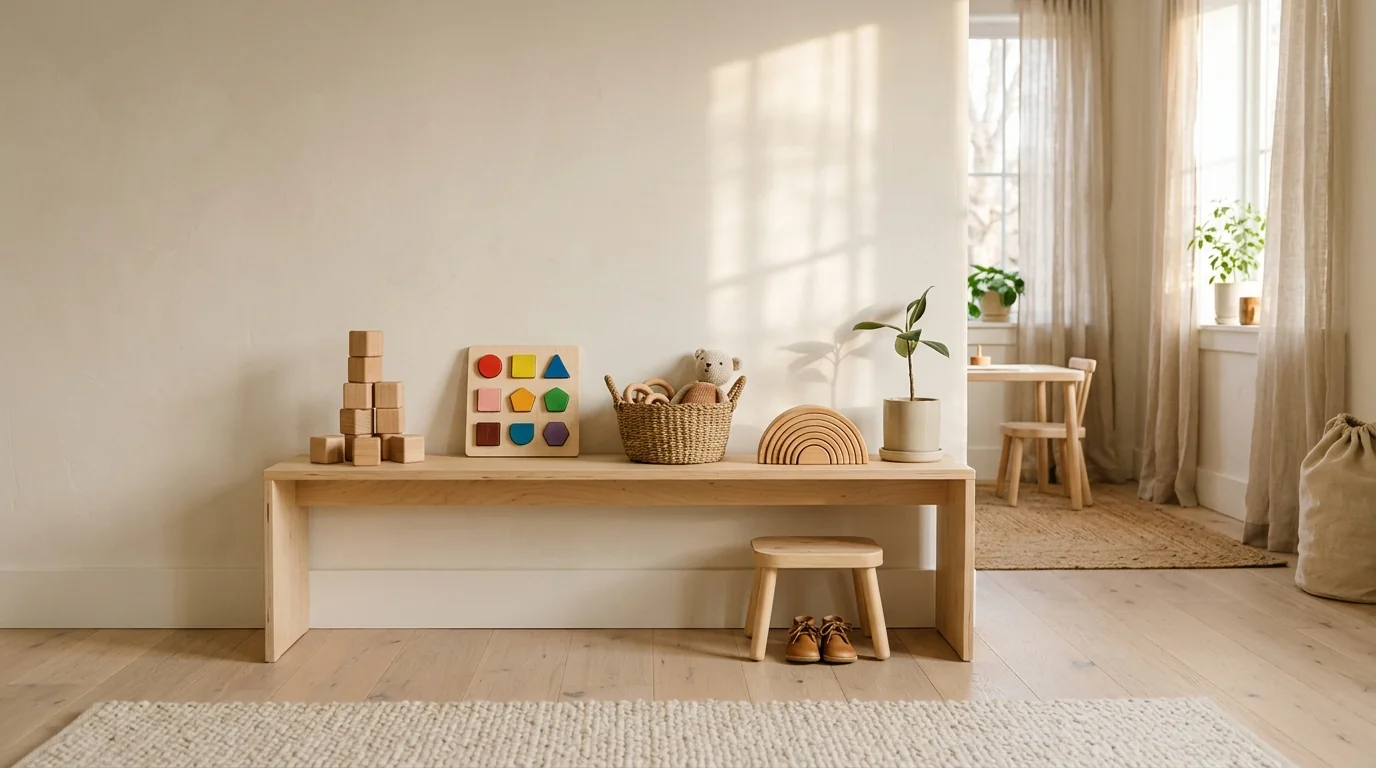
- Display these four items thoughtfully on low, open wooden shelves. Ensure each toy has breathing room around it, displayed like a beautiful object in an art gallery rather than crammed into a plastic tub.
When your child walks into the playroom on Monday morning, their eyes will widen with delight. Seeing a toy they haven’t laid eyes on in a month triggers an immediate, joyful spike in dopamine. They will drop to the floor, approach the blocks with fresh creative energy, and spend forty uninterrupted minutes constructing an imaginary world.
By pruning the sensory excess from your child’s physical space, you give them the greatest developmental gift of modern life: the mental calm to focus, the space to imagine, and the profound, unhurried joy of true childhood play.
📥 Free Download: Toy Rotation & High-Yield Play Architecture
Overcoming choice fatigue: sensory pruning, sustained attention metrics, and the 4-bin rotation matrix.