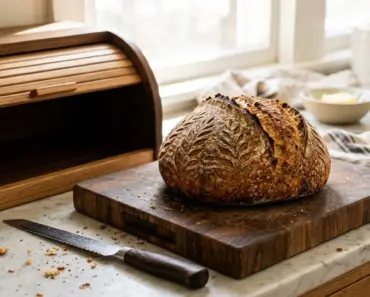

In the late 1980s and early 1990s, a sudden wave of panic swept through restaurant kitchens, culinary academies, and domestic households across the Western world. Government health agencies, food safety regulators, and consumer watchdog groups issued an urgent decree: throw away your traditional wooden cutting boards immediately. Wood, the public was warned, is an organic, porous, absorbent sponge that traps dangerous raw meat juices, harbors deadly pathogens, and contaminates your family’s dinner.
In their place, the modern plastics industry offered a seemingly flawless technological savior: the polypropylene plastic cutting board. Smooth, non-porous, inexpensive, and capable of being sterilized in a 140-degree dishwasher cycle, plastic was heralded as the undisputed champion of modern kitchen hygiene. Millions of beautiful maple and walnut heirloom butcher blocks were unceremoniously hauled to curbside trash cans.
Yet if you step into the test kitchen of a modern microbiologist or consult with professional food safety scientists today, you will encounter a startling truth that turns thirty years of consumer conventional wisdom on its head: wooden cutting boards are vastly more antimicrobial and sanitary than plastic boards. Understanding the micro-vascular capillary physics and natural bio-compounds of hardwood reveals why nature’s design outperforms synthetic polymers, and how plastic boards pose a far more sinister threat to human health.
The Wisconsin Experiment: The Discovery That Stunned Food Science
The scientific unraveling of the plastic cutting board myth began in the laboratories of the Food Research Institute at the University of Wisconsin-Madison, led by microbiologists Dr. Dean O. Cliver and Nese Ak. The researchers did not set out to prove wood was superior; in fact, their initial hypothesis was the exact opposite. Commissioned to evaluate methods for sterilizing contaminated wood, they fully expected to confirm that wooden boards were bacterial hazards.
The researchers inoculated several types of wooden boards (including maple, birch, oak, and cherry) and various commercially available plastic cutting boards with lethal, high-density broths of common foodborne bacterial pathogens:
- Escherichia coli (E. coli)
- Salmonella enterica
- Listeria monocytogenes
- Staphylococcus aureus
The boards were then held at room temperature, and the researchers tested the surfaces at regular time intervals to measure bacterial survival and recovery rates.
What they observed completely baffled the scientific community:
- The Wooden Vanishing Act: Within three minutes of applying millions of live bacterial cells to the surface of the unsealed wooden boards, over 99.9 percent of the bacteria completely disappeared. When the wood was tested again two hours later, the researchers could not recover a single living bacterial pathogen from the surface. Even when left unwashed overnight at room temperature, the bacteria remained dead.
- The Plastic Proliferation: On the plastic cutting boards, by contrast, zero bacterial die-off occurred. The pathogens remained alive, active, and fully viable on the surface. When left overnight at room temperature, the bacterial colonies fed on microscopic moisture droplets and multiplied exponentially.
- Cross-Contamination Reality: When researchers swiped a clean knife across the inoculated wooden board and chopped fresh vegetables, zero bacteria transferred to the food. When they repeated the action on the plastic board, massive bacterial colonies instantly colonized the vegetables.
Skeptical scientific peers demanded replications across multiple universities and research centers. Again and again, the findings held firm: under realistic domestic kitchen conditions, wooden cutting boards consistently killed pathogenic bacteria without chemical disinfectants, while plastic boards preserved them.
The Capillary Dehydration Mechanism: How Wood Kills Bacteria
How does an inert block of tree wood possess the miraculous ability to eradicate lethal bacteria within minutes? The answer is rooted in the micro-vascular fluid dynamics of botanical anatomy.
Wood is not a solid, uniform mass like a sheet of extruded polymer. A living tree is an intricate hydraulic pump composed of millions of vertical, microscopic straw-like tubes known as xylem vessels and tracheids, designed by nature to transport water and dissolved minerals from the root system up to the canopy leaves.
When a tree is felled, milled, kiln-dried, and crafted into a butcher block, those hollow xylem vessels remain intact, creating an immense internal porous surface area. When you slice raw chicken breast or beef on a wooden board and meat juices pool on the surface, a fundamental physical force engages: capillary action.
Capillary action—driven by surface tension and adhesive intermolecular forces—pulls liquid rapidly inward away from the surface into the dry interior core of the wood fibers:
- Surface Desiccation: The bacteria sitting in the meat juices are sucked down into the microscopic pores along with the fluid. The surface of the cutting board dries out rapidly. Because bacteria require free surface water to sustain metabolic cellular respiration and replicate, the bacteria on the surface are immediately starved of moisture.
- Internal Tannin Attacks: Trapped deep inside the wood matrix, the bacteria encounter nature’s chemical defense armory. Hardwoods like oak, walnut, and maple contain high concentrations of natural polyphenols, astringent tannins, and organic terpenoids. These bio-compounds evolved over millions of years to protect living trees against fungal and bacterial invasion. The tannins bind to the outer bacterial membrane proteins, puncturing their cell walls.
- Physical Entrapment & Desiccation: Unable to return to the surface, the trapped microbes are sealed within the drying wood fibers, desiccating completely into harmless, dead organic matter within hours.
The Plastic Trap: Knife Scarring and Microplastic Shedding
If wood uses capillary dehydration to neutralize bacteria, why did the myth of plastic superiority persist for so long? Because laboratory tests demonstrating plastic’s clean profile were conducted exclusively on brand-new, un-scratched plastic sheets.
In a real-world kitchen, a brand-new plastic cutting board remains smooth for perhaps two weeks. Every time your high-carbon steel chef’s knife strikes the board with chopping pressure, the hard steel blade slices into the softer polypropylene, polyethylene, or nylon polymer. Unlike wood, which is fibrous and elastic, plastic is rigid. The knife blade creates thousands of microscopic, jagged, canyon-like micro-grooves and jagged plastic burrs.
These knife scars become a microbial fortress:
- Microscopic meat proteins, starch pastes, and animal fats get packed into the deep, narrow crevices of the plastic scars during meal prep.
- When you wash the plastic board in a sink with a sponge, the soft sponge bristles are physically too thick to reach the bottom of the knife canyons.
- Even inside a high-temperature dishwasher, surface tension prevents soapy water from penetrating into the depths of deep knife gouges. Furthermore, the intense heat of the drying cycle warps the plastic board, preventing it from sitting flat on your countertops.
- The warm, moist crevices of scarred plastic boards become permanent incubators where bacteria flourish undisturbed between meals.
The Hidden Ingestion: The Microplastic Crisis
Beyond bacterial contamination, modern material science has uncovered a far more insidious hazard associated with plastic cutting boards: microplastic shedding. In a landmark 2023 study published in Environmental Science & Technology by researchers at North Dakota State University, scientists quantified the exact volume of microplastic particles generated during routine food preparation on commercial plastic boards.
The findings were alarming: a typical home cook chopping meat and vegetables on a polypropylene or polyethylene cutting board sheds between 1,500 and 7,500 microscopic plastic particles into their food every single year—equivalent to consuming dozens of credit cards’ worth of petroleum polymers over a lifetime. These microplastic shards penetrate the human intestinal barrier, circulate in the bloodstream, and trigger chronic inflammatory immune responses.
End-Grain vs. Edge-Grain: The Self-Healing Architecture
When selecting a wooden cutting board, you will encounter two primary styles of construction: edge-grain and end-grain. Understanding the structural orientation of wood fibers determines both the longevity of your knives and the hygiene of your board:
Edge-Grain Boards
Edge-grain boards are constructed by gluing long strips of wood side-by-side, so the horizontal length of the tree rings faces upward. While edge-grain boards are durable and affordable, a chef’s knife cuts horizontally across the wood fibers, severing them over time and creating small surface scars that eventually require light sanding.
End-Grain Butcher Blocks (The Supreme Masterpiece)
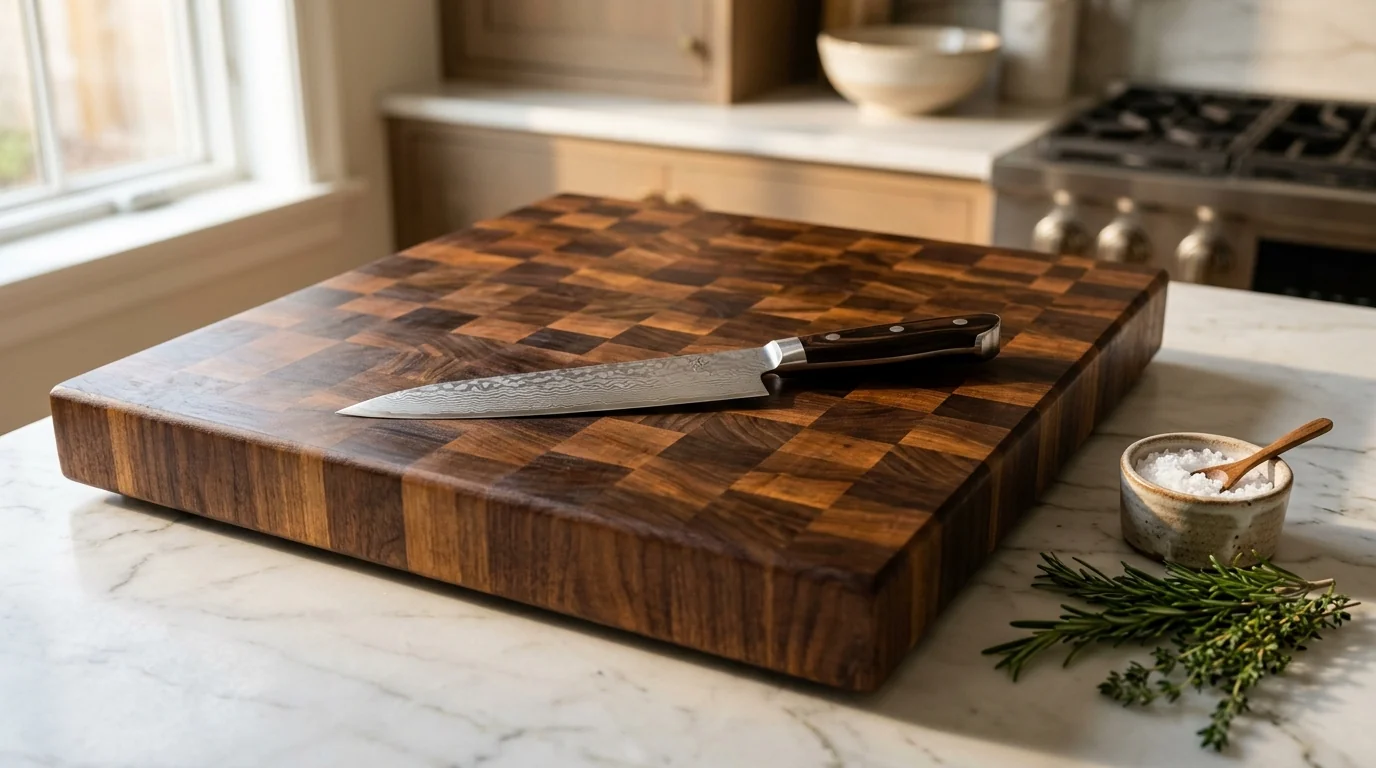
An end-grain board is constructed by arranging short vertical blocks of wood in a checkerboard pattern, so the cut cross-sections of the tree rings—the open capillary ends—face directly upward toward the ceiling. Think of an end-grain board like a dense paintbrush standing on its bristles:
- The “Self-Healing” Action: When your razor-sharp chef’s knife strikes an end-grain board, the blade does not sever the wood fibers; it slides smoothly between the vertical fibers like parting hair. When you lift the knife, the natural elasticity of the wood fibers causes them to spring back together. The board literally heals itself, leaving zero deep knife scars.
- Edge Preservation: Because your knife blade does not collide with severed horizontal fibers, your expensive Japanese and German kitchen knives retain their razor-sharp edges four to five times longer without needing re-sharpening.
The Board Preservation Masterclass: Monthly Care and Hygiene
To ensure your end-grain or edge-grain wooden cutting board provides a lifetime of hygienic service and becomes a gorgeous culinary heirloom, adhere to four foundational care rules:
- Never Soak, Never Dishwash: A wooden board should never, under any circumstances, be submerged in a sink full of water or placed inside an electric dishwasher. The extreme heat, harsh alkaline detergent builders, and prolonged water saturation dissolve the food-safe PVA glue joints and cause the wood fibers to expand unevenly, resulting in catastrophic warping and cracking.
- The 60-Second Hand Wash: Immediately after prepping food, wash the board with warm running water, a mild grease-cutting dish soap, and a non-abrasive sponge. Rinse thoroughly, wipe both sides completely dry with a clean cotton towel, and stand the board on its edge to air dry. Standing it on its edge ensures equal airflow across both sides, preventing uneven moisture loss that causes cupping.
- The Mineral Oil Saturation: Once a month (or whenever the wood appears dry and pale), saturate the board with 100 percent pure, food-grade USP mineral oil. Mineral oil is an inorganic, non-drying oil that will never turn rancid or sticky (never use vegetable, olive, or canola oil, which oxidize and spoil). Pour the oil generously across the wood and allow the dry xylem capillaries to drink for six hours. The oil displaces water inside the pores, creating an impenetrable interior moisture buffer.
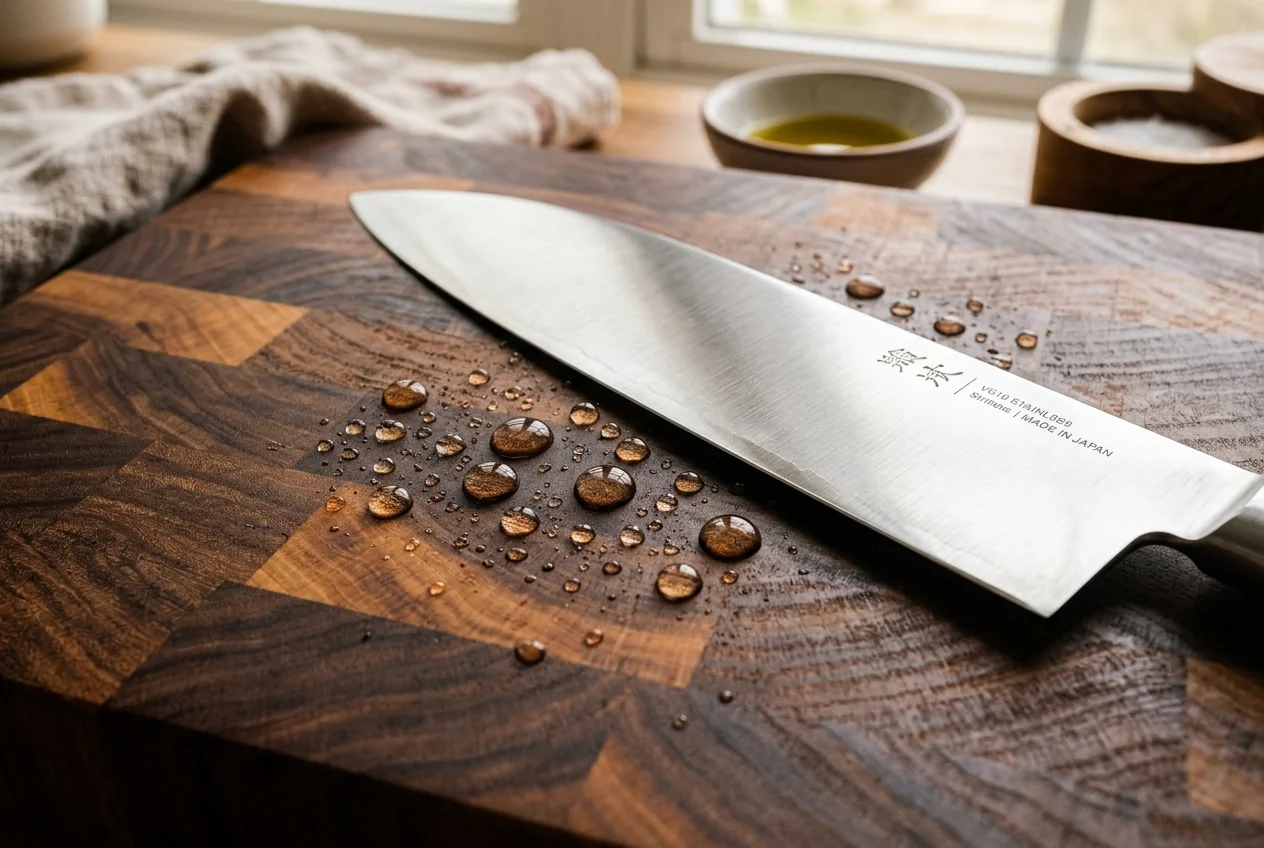
- The Beeswax Hydrophobic Shield: After oiling, buff a warm paste of four parts mineral oil to one part melted organic beeswax across every surface of the board. The beeswax sets into a silky, water-repellent barrier that causes meat juices, beet juice, and water to bead on the surface like water on a freshly waxed car, preventing deep stains and keeping your board pristine for generations.
By returning to the timeless biological wisdom of the end-grain butcher block, you banish toxic microplastics from your family’s dinner plates, protect your fine knives, and enlist nature’s own capillary chemistry to maintain the purest, safest prep station in your entire home.
📥 Free Download: Wood Cutting Board Preservation & Hygiene Guide
Capillary dehydration physics, antibacterial tannins, and end-grain beeswax conditioning protocols.