

You step across the threshold into an ultra-modern, newly renovated apartment. The floors are poured grey epoxy, the kitchen cabinets are finished in high-gloss acrylic lacquer, the countertops are flawless engineered quartz, and the walls are painted in flat, crisp builder’s white. The space is impeccably clean, sterile, and minimalist. Yet five minutes after sitting down on the synthetic sofa, you notice a subtle, persistent restlessness: your shoulders remain elevated, your breathing stays shallow, and your eyes dart continually around the room, unable to find a comfortable resting place.
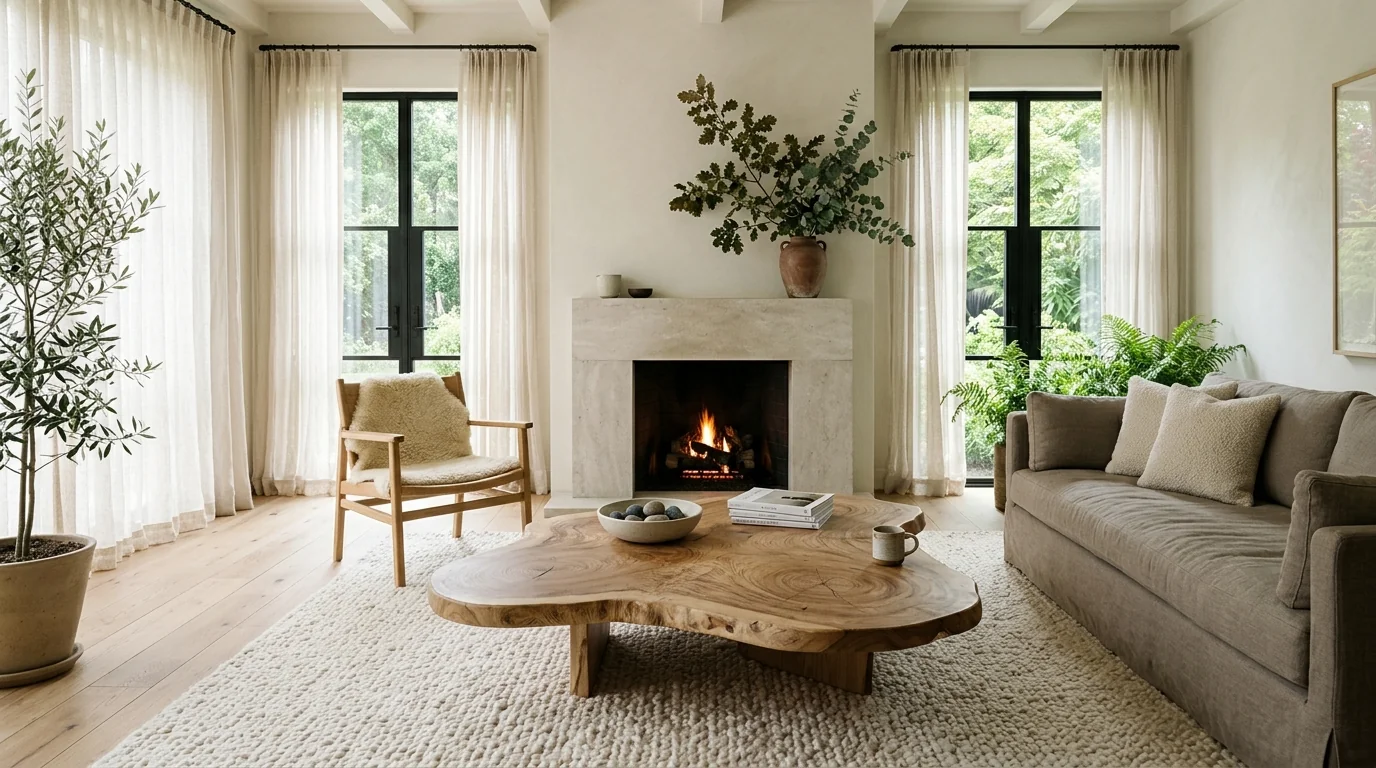
Now, contrast that with a completely different architectural experience. You walk into a living room anchored by a solid, unlacquered live-edge white oak coffee table where the natural tree rings and radial checks are proudly displayed. Beneath your feet lies an undyed, handwoven chunky wool rug. The windows are draped in heavy, slubbed Belgian linen that diffuses afternoon sunlight into soft, dappled shadows across a raw limestone fireplace.
Within thirty seconds of entering this second room, an involuntary biological shift occurs: your chest expands with a deep exhalation, your resting heart rate drops by several beats per minute, and an overwhelming wave of somatic groundedness washes over your nervous system. Most people describe this sensation with vague interior design adjectives: “It feels cozy,” “It feels warm,” or “It has great energy.”
Yet cognitive neuroscientists, biophysicists, and ocular researchers now know that this profound physical calming is not an emotional illusion; it is an exact mathematical response. Deep within the visual cortex of your brain lies an evolutionary recognition program tuned to a specific geometric signature known as the Fractal Dimension (D-Value). Understanding the biophysics of natural textures reveals how curating statistical fractals within your home acts as a biological reset button for chronic stress.
The Geometry of Nature: What Is a Fractal Dimension?
To understand why natural textures alter human neurochemistry, you must first leave behind the rigid, sterile rules of classical Euclidean geometry. Euclidean geometry—the geometry of squares, triangles, straight lines, and perfect circles—is an artificial human invention. It is the language of rulers, steel beams, and mass-produced assembly lines.
In the natural world, however, you will never find a perfectly straight line or a sterile, mirror-flat plane. As the legendary mathematician Benoît Mandelbrot famously observed: “Clouds are not spheres, mountains are not cones, coastlines are not circles, and bark is not smooth, nor does lightning travel in a straight line.”
Nature speaks in the language of fractals—geometric patterns that exhibit self-similarity across multiple spatial scales. A large oak tree branches into smaller limbs, which branch into smaller twigs, which branch into leaf veins. If you zoom in on a coastline from a satellite, a helicopter, or down on your hands and knees among the tidepools, the jagged statistical irregularity remains remarkably consistent.
In mathematics, the complexity and spatial density of a fractal pattern is quantified by its Fractal Dimension, or D-value:
- A smooth one-dimensional line has a D-value of 1.0.
- A completely flat, solid two-dimensional plane has a D-value of 2.0.
- Fractal patterns occupy the fractional mathematical space between dimensions. A simple, sparse branching pattern might have a D-value of 1.1, while an intensely dense, crowded pattern resembles a D-value of 1.9.
The Taylor Discovery: The 1.3 to 1.5 Neurological Sweet Spot
The bridge between fractal mathematics and human stress reduction was forged by Dr. Richard Taylor, a physicist and director of the Materials Science Institute at the University of Oregon. Partnering with NASA, the visual science department, and neuroscientists, Taylor investigated how the human visual system processes different environmental geometries.
Taylor’s team analyzed hundreds of natural scenes—ocean waves, cloud formations, mountain horizons, forest canopies, and cross-sections of natural wood grain. Across millions of data points, they made a stunning discovery: the natural world overwhelmingly clusters within a statistical fractal dimension between 1.3 and 1.5.
Next, Taylor placed human participants into electroencephalogram (EEG) scanners and functional magnetic resonance imaging (fMRI) machines while exposing them to geometric patterns across the entire fractal spectrum:
- Low Complexity (D = 1.1 to 1.2): Produced minimal neurological engagement; participants reported boredom.
- High Complexity (D = 1.7 to 1.9): Triggered visual fatigue, rapid eye strain, and heightened cognitive friction.
- The Mid-Range Sweet Spot (D = 1.3 to 1.5): The moment participants viewed patterns within the 1.3 to 1.5 window, their brains underwent an instantaneous neurochemical shift. EEG sensors recorded a massive 60 percent surge in frontal alpha wave power (8 to 12 Hz)—the exact brainwave frequency associated with effortless meditative flow, relaxed alertness, and emotional calm.
Simultaneously, sensors measuring skin conductance (galvanic skin response) recorded an immediate drop in sympathetic nervous system arousal. Viewing 1.3 to 1.5 fractals physically downregulates your body’s autonomic fight-or-flight circuits, allowing the parasympathetic vagal brake to engage and restore biological balance.

The Evolutionary Wire: Why Saccades Love Wood and Stone
Why should a particular mathematical ratio found in tree bark or river stones cause human blood pressure to drop and brainwaves to synchronize into alpha states? The answer is embedded in the evolutionary history of the human visual system.
For more than two million years, human hominids evolved in open savannas, dense forests, and coastal estuaries. Our survival depended entirely on the visual ability to detect camouflage predators, identify edible berries, and navigate complex terrain. To do this, the human eye developed a unique search behavior known as a fractal saccadic scanpath.
When you look across a landscape, your eyes perform rapid ballistic jumps (saccades) followed by brief pauses (fixations). When mathematicians analyzed the trajectories of human eye saccades, they discovered that our gaze jumps across physical space in a fractal distribution that precisely matches a D-value of 1.4. In essence, the human eye was biologically engineered to search for its own reflection in the geometry of nature.
When you enter a room furnished with natural materials—solid cathedral-grain walnut, honed unfilled travertine stone, slubbed linen, and woven wool—your visual system enters a state of effortless resonance. Because the physical objects possess the exact 1.3 to 1.5 D-value your eye is pre-programmed to scan, your visual cortex processes the scene with virtually zero metabolic friction. This effortless processing is known in cognitive psychology as perceptual fluency.
Conversely, when you spend eight hours inside a room built of synthetic laminates, flat painted drywall, and smooth plastic, your eye encounters a sensory vacuum. The visual cortex frantically searches for fractal self-similarity, finds only Euclidean straight lines or dead pixels, and experiences continuous cognitive strain. We experience this subconscious strain as ambient domestic fatigue, irritability, and restlessness.
The 4 Tactile Pillars: Integrating 1.3–1.5 Fractals into Your Home
Transforming your home into a neurobiological sanctuary does not require living in a rustic log cabin. You can seamlessly integrate the 1.3 to 1.5 fractal dimension into sophisticated, modern interiors through four foundational material choices:
1. Solid Cathedral-Grain and End-Grain Wood
Ditch plastic laminates, vinyl faux-wood veneers, and high-gloss painted furniture. When selecting dining tables, coffee tables, cutting boards, or shelving, choose solid natural hardwoods (such as white oak, walnut, ash, or maple) finished with matte, clear natural oils rather than thick polyurethane plastic coatings. The sweeping parabolas of cathedral grain and the tight concentric rings of end-grain wood possess a verified natural fractal dimension of 1.38 to 1.44, providing an immediate focal anchor that soothes resting gaze.
2. Undyed Woven Animal & Plant Fibers
Replace synthetic polyester rugs and polypropylene textiles with 100 percent natural wool, raw jute, sisal, or abaca. A hand-knotted or chunky-loop undyed wool rug contains microscopic, multi-scale crimp variations that scatter light in organic fractal clusters. Walking barefoot across a textured wool rug delivers both tactile proprioceptive stimulation and visual alpha-wave activation.
3. Slubbed Linen and Dappled Light Diffusion
Standard synthetic roller shades or vinyl mini-blinds slice incoming daylight into harsh, Euclidean horizontal bars that create jarring luminance contrast. Replace them with un-ironed, heavy Belgian linen drapery. Natural flax fibers contain irregular, organic thicknesses known as “slubs.” When afternoon sunlight filters through linen weave, it creates a shifting, dappled shadow pattern on your floorboards that perfectly mimics the fractal light filtering through a forest tree canopy.
4. Honed Sedimentary Stone and Limewash Plaster
Avoid high-gloss polished synthetic quartz that reflects glare like a mirror. Instead, incorporate honed, unfilled natural stones—such as porous travertine, textured limestone, or soapstone. On wall surfaces, replace flat latex paint with breathable mineral limewash or Roman clay plaster. As limewash dries, natural micro-crystalline mineral deposits bloom across the wall in subtle, cloud-like fractal gradients that soften hard room boundaries and invite calm visual contemplation.
The Whole-Home Sensory Audit
To evaluate the biophilic health of your current living environment, take this quick visual audit across your primary living space:
- The 60-Second Scan: Sit in your favorite living room chair. Look slowly around the room. How many surfaces within your primary field of view feature genuine, unsealed natural grain, weave, or mineral texture? If more than 70 percent of what you see is smooth painted drywall, flat glass screens, and synthetic plastic, your nervous system is operating in a fractal deficit.
- The Tactile Horizon: Touch the surface where your hands rest most frequently (your dining table, desk, or coffee table). If your fingers touch cold, inert plastic laminate, consider introducing a solid wood desktop or a natural leather blotter to introduce tactile organic variance.
- Living Greenery Layers: Introduce plants with complex multi-scale branching structures—such as a fiddle-leaf fig, an olive tree, or a delicate maidenhair fern. The natural fractal foliage breaks up the sharp 90-degree corners of rectangular rooms, creating natural micro-sanctuaries of calm.
Your home is not merely a container for your possessions; it is an external nervous system that continuously shapes your mental state. By harmonizing your domestic surfaces with the ancient, sacred fractal geometry of the natural world, you give your eyes a reason to rest, your mind permission to unwind, and your soul a true place of peace.
📥 Free Download: Biophilic Fractal Design & Sensory Audit Worksheet
Harnessing the 1.3-1.5 D-Value rule to downregulate autonomic stress in domestic interior spaces.