
Step inside a modern corporate office, an airport terminal, or a speculative newly renovated suburban home. Look closely at the surfaces surrounding you: perfectly flat, unbroken drywall painted in sterile gray; precision-machined synthetic laminate cabinets without a single grain flaw; seamless extruded vinyl flooring; and uniform recessed LED pot lights casting flat, shadows-less illumination across the room.
To the modern minimalist designer, this represents the height of sleek, orderly aesthetic perfection. But to your evolutionary neurobiology, this synthetic landscape is an alien, sensory-deprived wasteland. Within minutes of occupying spaces dominated by flat, non-fractal surfaces, your nervous system exhibits subtle signs of chronic autonomic distress: muscle tension increases, eye blink rates drop, and brainwave monitoring reveals a sharp decline in restorative alpha activity.
For more than 99% of human evolutionary history, our visual cortex developed and calibrated in natural environments dominated by one specific mathematical geometry: statistical fractals. From the branching limbs of ancient white oaks and the dendritic veining of marble to the jagged silhouettes of mountain ranges and the delicate ripples of ocean water, nature is universally fractal. When interior architecture strips fractals away, it triggers an innate neuro-physiological condition known as sensory monotony fatigue. By understanding the science of fractal dimension (D-value), the human eye’s fractal fluency, and biophilic architectural integration, you can transform sterile living spaces into restorative sensory sanctuaries that calm the human nervous system by design.
The Geometry of Nature: Understanding the Fractal Dimension (D-Value)
In classical Euclidean geometry—the mathematics of man-made structures—shapes are clean, integer dimensions: a flat wall is a two-dimensional plane (D = 2.0), while a solid column is a three-dimensional cylinder (D = 3.0). But nature rarely works in straight lines or smooth spheres. As the mathematician Benoit Mandelbrot famously observed: “Clouds are not spheres, mountains are not cones, coastlines are not circles, and bark is not smooth, nor does lightning travel in a straight line.”
Natural forms are governed by fractal geometry—repeating, self-similar patterns where the structural characteristics of the whole are mirrored in its smaller constituent parts across multiple spatial scales. A large tree branch divides into smaller boughs, which divide into twigs, which in turn display leaves whose veins mirror that exact same branching architecture.
Mathematicians quantify the density and complexity of a fractal using the fractal dimension, denoted as D. The D-value exists on a fractional spectrum between 1.0 and 2.0:
- Low D-Values (D = 1.1 to 1.2): Sparse, simple fractals, such as a solitary winding river viewed from high altitude or sparse wisps of cirrus clouds.
- Mid-Range D-Values (D = 1.3 to 1.5): Balanced statistical complexity, such as natural wood growth rings, coastal shorelines, weathered sandstone stratification, and the drip paintings of Jackson Pollock.
- High D-Values (D = 1.6 to 1.9): Extremely dense, intricate, and chaotic fractals, such as dense tangled briar patches, microscopic moss colonies, or turbulent river rapids.
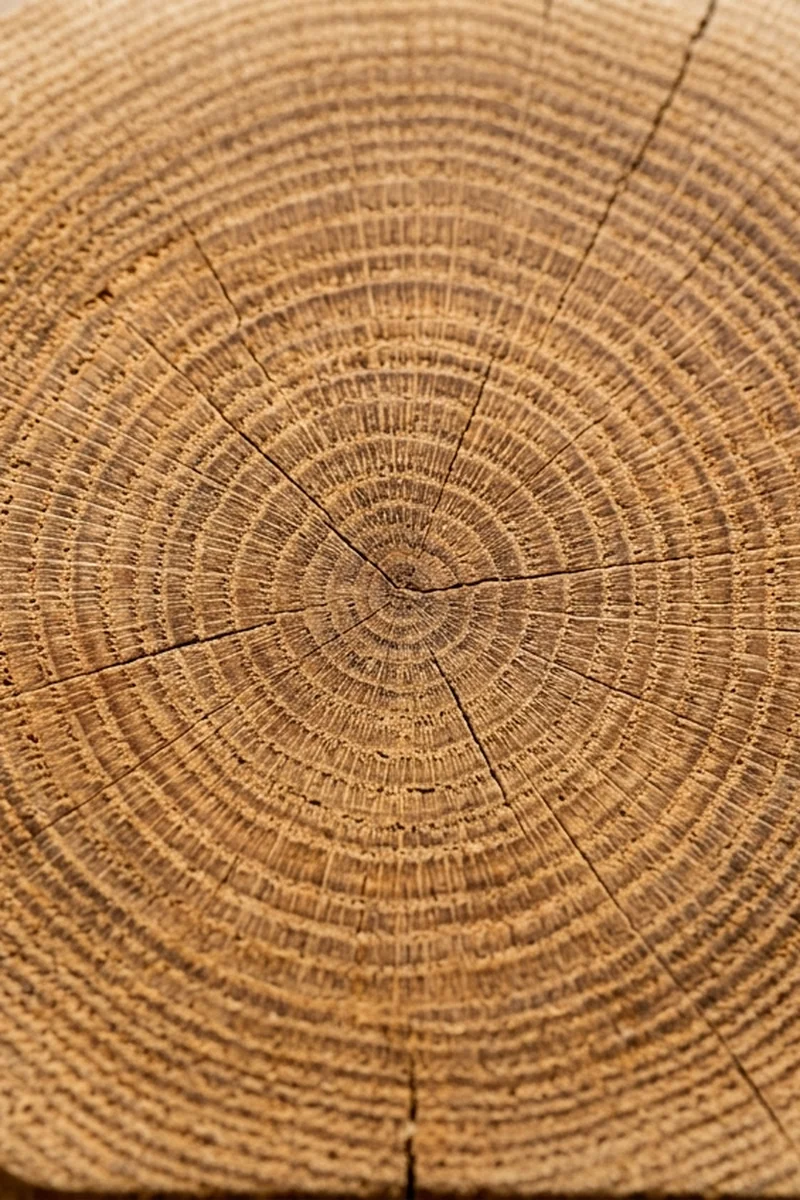
Handcrafted from sustainably sourced solid oak preserving continuous annular growth rings, natural medullary rays, and authentic D=1.35 biophilic fractal surfaces.
The Fractal Fluency Effect: How the Eye Resonates with Mid-D Patterns
Pioneering neuro-architectural research led by physicist Dr. Richard Taylor at the University of Oregon discovered a stunning biological phenomenon known as fractal fluency.
When the human eye scans an environment, it does not move in smooth, continuous sweeps. Instead, the oculomotor muscles execute rapid, jerky ballistic jumps called saccades, interspersed with brief resting fixations. When researchers mapped the spatial trajectories of human eye saccades using high-speed optical tracking, they made an extraordinary discovery: the human visual search pattern is itself an exact statistical fractal with a dimension of D = 1.35.
Because our visual search apparatus operates at D = 1.35, the visual cortex processes natural patterns with matching mid-range fractal dimensions (D = 1.3 to 1.5) with virtually zero computational effort. In optical cognitive science, this is called visual resonance.
When subjects are exposed to mid-range fractal patterns in laboratory settings while connected to electroencephalograms (EEG) and autonomic telemetry:
- Immediate 60% Surge in Alpha Waves: Brainwave activity shifts instantly from high-alert beta rhythms into relaxed, wakeful alpha waves (8 to 12 Hz) in the frontal and parietal lobes. Alpha waves indicate a state of calm, tranquil focus—the neurological state achieved during deep mindfulness meditation.
- Autonomic Parasympathetic Activation: Galvanic skin conductance drops rapidly, heart rate variability (HRV) increases, and salivary cortisol levels plummet by up to 60%. The sympathetic “fight-or-flight” nervous system stands down, allowing restorative cellular repair.
“When you look at natural wood grain or veined travertine, your visual cortex is not working to decipher the shape. It recognizes its own fractal search architecture, instantly discharging cognitive tension.”
The Sterile Wall Trap: Why Synthetic Uniformity Exhausts the Brain
Contrast this effortless fractal resonance with what occurs when you sit in a room enveloped in smooth, synthetic surfaces: painted drywall, flat gray melamine kitchen cabinets, and uniform quartz countertops.
A flat, painted drywall surface possesses a fractal dimension of D = 1.00—it has zero structural variation across spatial scales. When your gaze falls on a flat wall, your visual system encounters a sensory vacuum. Expecting the organic complexity it evolved with over two million years, the visual cortex must constantly search for edges and micro-textures that do not exist.
This perceptual frustration leads to sensory under-stimulation—a physiological stressor compounded when rooms suffer from acoustic issues, as explored in our research on living room acoustic reverberation and stress—triggering ocular dry-eye from suppressed blink rates and subconscious mental restlessness. In architectural psychology, spending prolonged hours in rooms devoid of natural fractals has been directly linked to increased irritability, lower problem-solving stamina, and diminished creative cognition.
Features unpolished natural sediment banding and porous cavity textures, introducing authentic geological fractal geometries (D=1.4) into contemporary living and workspace environments.
Free Download: Biophilic Fractal Design & Stress Reduction Blueprint
Fractal dimension calculation tables, architectural material selection guides, wood grain orientation blueprints, and visual sensory audit worksheets.
The 4-Step Blueprint for Integrating Interior Fractals
You do not need to live inside a forested cabin to experience the restorative neurological benefits of fractal fluency. You can systematically layer mid-range fractals into any modern apartment or home:
1. Feature Solid, Quarter-Sawn or Live-Edge Timber
Replace flat synthetic laminate or painted wood furniture with solid natural hardwoods—specifically species like white oak, walnut, or ash. Quarter-sawn cuts expose the wood’s medullary rays and annular growth rings, which naturally exhibit D-values between 1.34 and 1.42. Ensure the wood is finished with a low-sheen penetrating hard-wax oil rather than a thick, plasticky polyurethane film that glazes over the microscopic surface texture.
2. Introduce Unpolished Sedimentary Stone
Incorporate architectural accents made from authentic geological stones: Roman travertine, honed slate, or veined marble. The sedimentary layering in travertine and the crystalline fissures in marble are literal physical records of millions of years of fluid dynamics, which can be reflected elegantly across living spaces without clutter by applying proper interior mirror placement and specular sightline geometry, providing permanent mid-D fractal fluency for kitchen backsplashes, coffee tables, or bathroom vanity surfaces.
3. Layer Woven Natural-Fiber Textiles
Avoid synthetic polyester, nylon, and flat microfiber upholstery fabrics. Select rugs, throws, and drapery woven from uncombed wool, Belgian linen, raw silk, or jute. Natural spinning processes leave subtle, stochastic irregularities in the yarn thickness, creating a multi-scale tactile and visual fractal that flat synthetic weaving can never replicate.
4. Position Botanical Branching Cannons
Living plants are dynamic, three-dimensional fractals. Group houseplants with distinctive self-similar branching structures (cared for using proper soil aeration as outlined in our root hypoxia prevention guide) in high-visibility sightlines: Boston ferns (whose fronds repeat their pinnate leaf geometry at three distinct scales), Fiddle Leaf Figs, or Scheffleras. Research confirms that glancing at a living fractal plant for just 40 seconds restores depleted executive attention in knowledge workers.
As an Amazon Associate, azuloz.com earns from qualifying purchases.