

You decide to refresh your home decor. You browse interior design blogs, social media channels, and shelter magazines, and you encounter the single most universally repeated piece of decorating advice in residential design:
“When in doubt, hang a large mirror! Mirrors expand small rooms, double natural light, and make every space feel twice as big!”
Convinced, you purchase a substantial, high-end arch-top mirror with a brushed brass or matte black iron frame. You find an empty stretch of drywall in your dining room or entryway, drill heavy anchors into the studs, and hang the gleaming glass with pride. You step back to admire your handiwork.
Yet over the following weeks, an uncomfortable, subconscious reality sets in. The room does not feel more expansive; it feels restless, distracting, and strangely chaotic. Every time you sit at the dining table, your gaze is pulled toward the mirror. Reflected in the crystal-clear glass is the messy kitchen island sink piled with dirty pots, the chaotic tangled cords trailing behind the media console, and the heap of sneakers and backpacks overflowing the entryway drop tray.
You have fallen victim to the Mirror Reflection Fallacy. In architectural psychology, a mirror is not a passive window into an imaginary parallel dimension; it is a specular duplicate of your real-world environment. When hung without precise sightline geometry, an oversized mirror does not expand space—it doubles visual clutter, introduces severe specular luminance noise, and dramatically accelerates mental fatigue.
By understanding the optical physics of specular ray tracing, cognitive visual load, and the 45-degree architectural bounce rule, you can harness mirrors to channel pure natural daylight, frame breathtaking architectural vignettes, and create genuine spatial serenity.
The Physics of Specular Reflection: Law of Incidence and Optical Duplication
To understand why careless mirror placement ruins a room, you must revisit the fundamental optical law governing all reflective surfaces: the Law of Reflection.
When light rays strike a mirror, they do not scatter randomly as they do on matte drywall or textured plaster (diffuse reflection). Instead, light undergoes specular reflection: the angle of incidence precisely equals the angle of reflection (θi = θr):
Angle of Incidence (θi) = Angle of Reflection (θr)
This mathematical rule means that a mirror does not show what is directly in front of it to a person standing elsewhere in the room. A mirror shows whatever lies along the reflected specular ray path relative to the viewer’s specific seated or standing vantage point.
When homeowners hang a mirror, they almost always do so while standing directly in front of the wall, looking straight into the glass: “Looks great, I see myself centered!” But you do not live your life standing stiffly against an empty wall. You live your life seated on the sofa, relaxing in an armchair, or eating at the dining table. From those primary living angles, the mirror’s reflected cone of vision captures completely different—and often disastrous—vistas.
“A mirror never shows an empty room; it shows what you aim it at. If you aim an expansive mirror at a pile of unfiled mail, dirty dishes, or power strips, you have simply paid money to install a second pile of clutter in your home.”
The Cognitive Load of Visual Clutter: Why Reflections Induce Stress
In environmental neuroscience, human working memory is constantly processing and filtering sensory data from your field of vision. This is known as Visual Processing Load.
When you sit in a room, your peripheral vision monitors your surroundings to ensure physical and psychological safety. When a large mirror reflects chaotic domestic clutter, your brain is subjected to an artificial sensory overload:
- Cognitive Duplication: A kitchen counter holding three appliances, a dish rack, and a knife block already requires significant mental filtering. When mirrored across the room, your visual cortex must process six appliances and two dish racks. Neuroimaging studies demonstrate that high levels of visual clutter elevate salivary cortisol levels and trigger sustained sympathetic nervous system tension.
- Movement Phantom Glare: The human visual system is evolutionarily wired to detect sudden motion in the periphery (a primitive survival mechanism to spot predators). When a mirror is positioned near a hallway or exterior door, every time a family member or pet walks past, the mirror generates a sharp, high-contrast flash of movement in your peripheral vision. Your brain reflexively twitches toward the glass, breaking your concentration and inducing subtle micro-startle fatigue.
- Specular Glare Hotspots: If a mirror reflects a bare light bulb, a low-hanging chandelier, or direct afternoon sunlight, it transforms into an intense optical beacon. Direct specular glare forces the pupils into continuous contraction, causing ciliary muscle tension headaches, ocular dryness, and irritability.

Amazon US Verified
Architectural Arched Solid Metal Decorative Wall Mirror
Heavy-gauge seamless aluminum-alloy framed arched mirror with premium 4mm HD shatterproof glass. Engineered for precise sightline light bouncing, distortion-free reflection, and timeless spatial elegance.
The Golden Rules of Architectural Mirror Placement
To ensure mirrors expand spatial serenity rather than chaotic clutter, architectural interior designers follow four non-negotiable optical placement protocols:
1. The 45-Degree Natural Light Bounce (Perpendicular Placement)
Never hang a large mirror directly opposite a window facing harsh, direct south-facing sunlight. Doing so creates an intolerable blinding glare zone during midday. Instead, hang the mirror perpendicular (at a 90-degree wall angle) to the primary window.
This allows diffuse, natural daylight to strike the glass at a 45-degree angle, bouncing gentle, ambient illumination deep into the shadowed rear corners of the room without casting specular glare into your eyes.
2. The Biophilic Capture Rule
The single most powerful, restorative use of an interior mirror is capturing living nature. Angle your mirror so its reflected sightline captures outdoor garden greenery, swaying tree canopies, or a stunning cluster of indoor tropical houseplants. Reflected biophilic imagery reduces autonomic nervous system stress, lowers blood pressure, and visually dissolves solid drywall into an organic vista.
3. The 57-Inch Museum Eye-Level Anchor
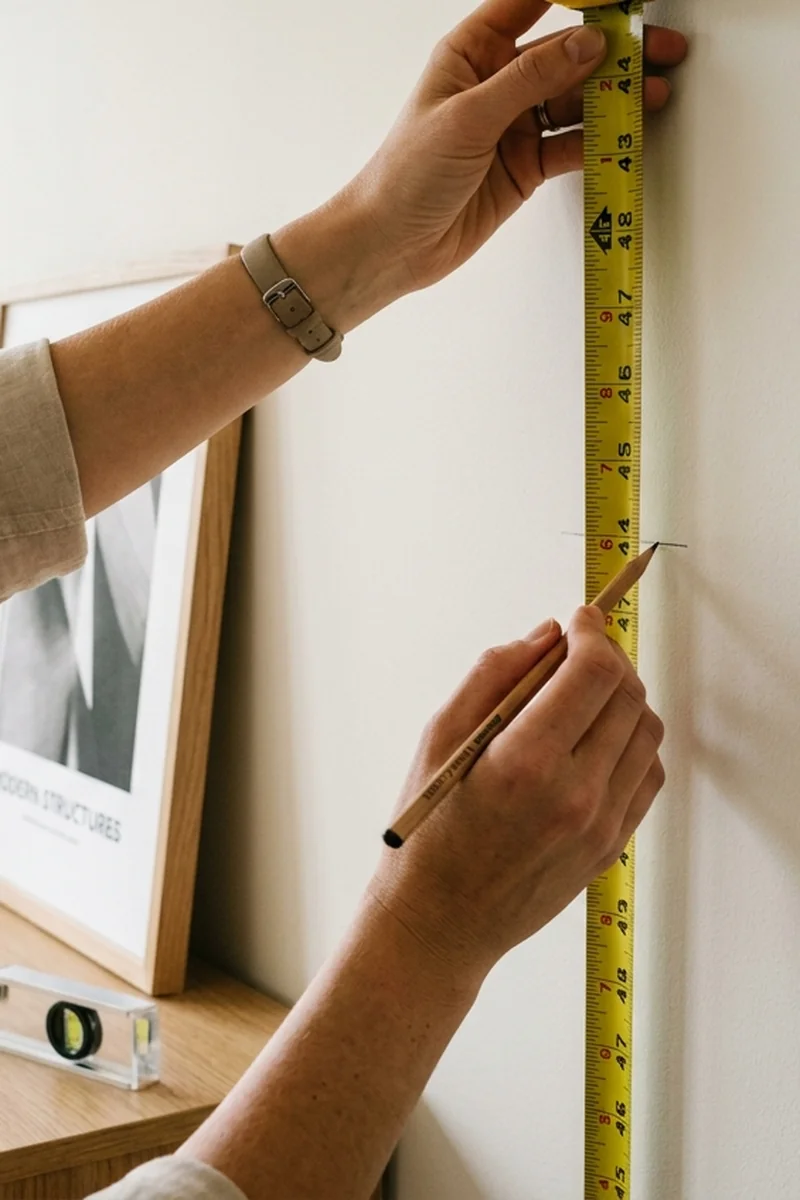
Homeowners chronically hang mirrors too high, turning them into floating surveillance devices that reflect only white ceilings and recessed downlight glare. The center of your mirror slab should sit at 57 to 60 inches above the finished floor (the international museum eye-level standard). If hung above a console table or fireplace mantel, the bottom frame edge should sit 4 to 8 inches above the surface to visually anchor the furniture.
4. The 70% Furniture Proportion Scale
Never hang an undersized mirror that floats like a tiny postage stamp over a wide sofa or credenza. A mirror should span approximately 65% to 75% of the total width of the furniture piece anchored beneath it. This golden ratio provides structural grounding, ensuring the mirror feels like an integrated architectural component rather than an afterthought.
📥 Free Download: Interior Mirror Placement & Sightline Geometry Blueprint
Specular ray-tracing diagrams, sightline audit checklists, 57-inch museum height matrices, and anti-glare dining room layouts.
The Two-Person Sightline Audit: The Pre-Hanging Test
Before driving a single heavy anchor into your drywall, execute this definitive 5-minute pre-hanging audit:
- Have a partner hold the mirror against the candidate wall at the proposed height.
- Walk across the room and sit down in your primary living position: your favorite sofa cushion or dining chair.
- Look directly into the glass. Ask yourself three critical questions:
- Do I see outdoor greenery, architectural artwork, or clean negative space? (YES = Proceed)
- Do I see kitchen sink dirty dishes, television cords, or shoes? (NO = Re-angle immediately)
- Does any overhead light fixture create a direct, piercing starburst in my eyes? (NO = Proceed)
- Shift the mirror 12 inches to the left or right until the reflection captures only beauty, light, and architectural order.
When hung with geometric precision, a mirror ceases to be a chaotic clutter amplifier and becomes an architectural portal—illuminating your home with tranquil natural daylight and timeless visual harmony.
As an Amazon Associate, azuloz.com earns from qualifying purchases.