You crawl beneath your high-end bed sheets after an exhausting day, expecting the refreshing, cool embrace of luxury bedding. Instead, thirty minutes later, you find yourself tossing and turning in an uncomfortable microclimate of trapped radiant heat and clammy moisture. You kick one leg out from under the duvet to find cool air, yet the fabric clinging to your skin feels dense, warm, and stifling.
You inspect the product label: “100% Egyptian Cotton, 600 Thread Count Sateen Weave.” You paid a premium price, trusting that higher thread counts and smooth silkiness naturally guaranteed superior sleep comfort. Yet in the biophysics of nocturnal thermoregulation, you have fallen into the most pervasive bedding trap in the luxury home goods industry: the sateen thermal insulation paradox.
The human brain requires a drop in core body temperature of 1.0 to 1.5 degrees Celsius (approximately 2 to 3 degrees Fahrenheit) to initiate and sustain deep NREM Stage 3 slow-wave sleep. When your sheets fail to conduct heat away from your skin, your core temperature stays elevated, triggering nocturnal cortisol pulses, micro-arousals, and restless REM sleep fragmentation. By understanding the mechanical physics of plain percale weaves versus float-dominated sateen structures, air permeability ratings, and single-ply yarn geometry, you can permanently solve nocturnal overheating and engineer the ultimate restorative sleep sanctuary.
The Textile Architecture: Plain Weave vs. Floating Threads
To understand why two sets of bed sheets made from identical raw Egyptian cotton fibers perform so differently on your mattress, you must look beyond the marketing jargon and examine their microscopic weave mechanics.
1. The Percale Plain Weave (1-Over-1-Under)
Cotton percale is manufactured using a classic plain weave structure. In this mechanical grid, a single warp thread passes over a single weft thread, and then immediately ducks under the next, repeating in an unwavering 1-over-1-under chessboard pattern across every square inch of the fabric.
This perpendicular intersection produces tens of thousands of microscopic, structural interstitial pores between the yarns. These tiny openings act as natural convective chimneys. As your body radiates thermal energy and transpires insensible water vapor (approximately 0.5 to 1.0 liters of moisture per night), warm air rises naturally through the porous percale grid and dissipates into the bedroom environment. The result is the signature crisp, matte, cool-to-the-touch hand feel associated with world-class heritage hotels.
2. The Sateen Float Weave (4-Over-1-Under)
Cotton sateen, by contrast, is woven using an entirely different geometry known as a satin weave variation. Instead of alternating over and under every single thread, the warp yarn “floats” over four (or sometimes five) consecutive weft threads before tucking under one.
By keeping the vast majority of yarn fibers floating exposed on the surface of the textile, sateen creates an extraordinarily smooth, lustrous, light-reflective sheen that mimics silk. However, this aesthetic brilliance comes at a devastating thermodynamic cost. Those floating surface yarns lie flat and compressed against one another, effectively sealing off the interstitial pores. Sateen creates a continuous, dense fibrous barrier that acts like a microscopic thermal blanket, trapping body heat in the pocket between your mattress and your duvet.
“Percale is a porous convective screen that invites airflow; sateen is a laminated thermal barrier that holds radiant heat against the dermal boundary layer. If you sleep warm, sleeping on sateen is the thermodynamic equivalent of sleeping inside a greenhouse.”
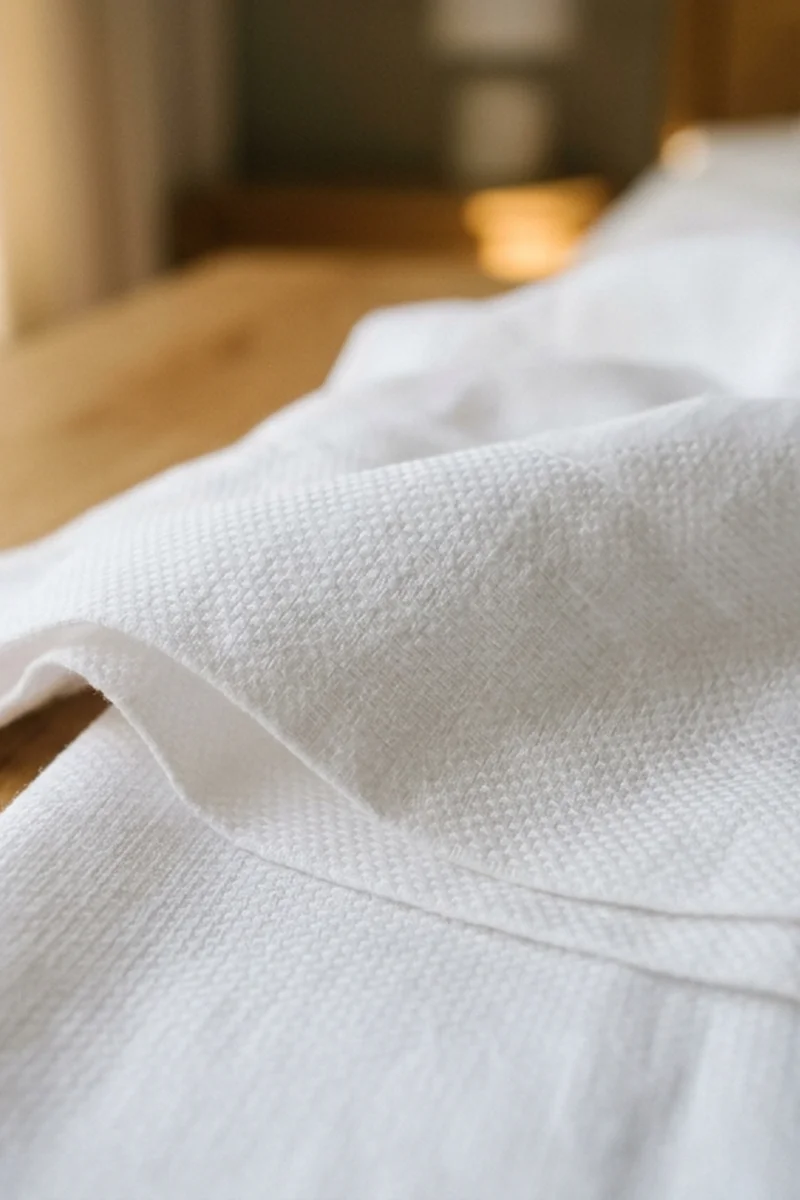
Engineered with a breathable 1-over-1-under plain weave using long-staple cotton fibers, providing exceptional convective airflow, crisp hotel hand-feel, and verified nocturnal cooling performance.
The Thread Count Scam: Why 800-Thread Sheets Sleep Hotter
For over three decades, consumer retail marketing has conditioned buyers to believe that thread count is the primary metric of luxury bedding quality: 300 is decent, 600 is luxurious, and 1,000 must be divine. In textile physics, this assumption is an outright deception.
A standard square inch of cotton fabric can physically accommodate only about 300 to 400 single-ply cotton threads woven side-by-side without overlapping. To market a sheet with an “800 or 1,000 thread count,” manufacturers must take thinner, weaker, lower-grade short-staple cotton fibers and twist two, three, or four of them together into a single multi-ply yarn. They then multiply the thread count by the number of twisted strands: four low-grade fibers twisted together and woven into 250 grid passes are cynically labeled as a “1,000 Thread Count” sheet.
These twisted multi-ply yarns create two major physiological sleep disasters:
- Air Permeability Collapse: As we uncovered in our investigation into the 1,000-thread-count marketing myth, in Frazier air permeability testing, a genuine 280-thread-count single-ply percale sheet demonstrates an air flow rating of 75 to 85 L/m²/s. A multi-ply 800-thread-count sateen sheet drops to a suffocating 10 to 14 L/m²/s—an 80% reduction in breathable convective heat exchange.
- Fiber Pilling and Roughness: Short-staple fibers have thousands of exposed ends that break loose during laundry friction, forming coarse, scratchy pills that irritate sensitive skin and ruin the initial silky hand of the sheet within six months.
Nocturnal Thermoregulation & The Glymphatic Wash
The consequences of trapped bed heat extend far beyond simple comfort; they directly dictate the restorative quality of your neurology.
During the first third of the night, as melatonin rises and core temperature drops, the brain transitions from light sleep into Stage 3 slow-wave deep sleep. During this critical stage, the brain’s glymphatic system activates (a biological process detailed in our guide on how darkness activates brain glymphatic filtration): glial cells shrink by up to 60%, allowing cerebrospinal fluid to surge through brain tissue and flush out neurotoxic metabolic waste products, including amyloid-beta and tau proteins associated with cognitive decline.
However, if ambient bedding temperature remains above 74°F (23°C) around your skin, autonomic thermoregulatory centers in your hypothalamus trigger peripheral vasodilation and sweating. If the sweat cannot evaporate through porous sheets, relative humidity beneath the blanket reaches 90%. This thermal distress triggers sudden micro-arousals—brief 5-to-15-second awakenings that wrench your brain out of slow-wave sleep without you ever consciously remembering them. You wake up feeling exhausted, groggy, and cognitively depleted despite spending eight full hours in bed.
Natural untreated wool fibers provide unmatched vapor absorption and thermodynamic regulation, preventing heat pooling beneath cotton sheets and maintaining ideal skin microclimates.
Free Download: Percale vs. Sateen Bedding & Thermal Sleep Guide
Weave structure comparisons, air permeability metrics, single-ply cotton buying checklists, and temperature-regulating bedding protocols.
The 4-Step Bedding Architecture for Hot Sleepers
If you want to transform your bed into a clinical-grade thermoregulating recovery station, implement this proven four-step textile architecture:
1. Standardize on 270–320 TC Single-Ply Percale
Look specifically for sheets labeled 100% Long-Staple Cotton (such as American Supima or certified Egyptian Giza cotton) woven in a percale plain weave with a thread count between 270 and 320. This is the exact sweet spot where structural durability meets maximum Frazier air permeability.
2. Replace Synthetic Mattress Encasements with Natural Wool or Cotton
Even the crispest percale sheets cannot cool you if they are laid over a memory foam mattress covered in a waterproof polyurethane mattress protector. Polyurethane creates an impermeable plastic vapor barrier. Place an all-natural wool or organic cotton quilted pad between your mattress and your fitted sheet to absorb perspiration vapor and prevent heat reflection.
3. Ban Silicone-Based Fabric Softeners
Never wash high-quality percale sheets with liquid commercial fabric softeners or dryer sheets. These products deposit a waxy layer of silicone polymers over the cotton yarns (much like the soap scum trap examined in our laundry detergent dosage and surfactant buildup guide), sealing their natural capillary channels and destroying their ability to absorb moisture. Use 0.5 cup of distilled white vinegar in the rinse cycle to dissolve mineral salts and keep cotton naturally supple.
4. Adopt the European Dual-Duvet Method
If you share a bed with a partner who runs cold while you run hot, stop fighting over a single massive comforter. Adopt the Scandinavian practice of using two separate twin-sized duvets: a lightweight, breathable linen or low-fill down duvet for the hot sleeper, and a medium-weight duvet for the cold sleeper. This eliminates cross-body heat transfer and nocturnal sheet wrestling.
As an Amazon Associate, azuloz.com earns from qualifying purchases.